















Best magnets for production lines
In production, a mistake in magnet selection usually does not become apparent immediately when ordering, but only on the line. The material is not captured consistently, separation is incomplete, the cycle slows down or maintenance has to deal with excessive build-up. That is why the question of what the best magnets for production lines are does not have one universal answer. The right solution always depends on the type of material, working environment, process speed and required reliability.
Industrial practice shows that a magnet is not just a component. On a production line, it is a functional element that affects production continuity, output quality and operator safety. The difference between a suitably and unsuitable selected solution is often significant, especially in automation, handling of metal parts, material sorting and protection of technology against metal impurities.

How to choose the best magnets for production lines
If a magnet on a line is to work long term and without failures, it is necessary to look beyond the holding force itself. What matters is what needs to be captured or separated, in what layer of material the metal is located, what the distance is between the magnet and the product, and whether the work takes place in a dry, dusty, humid or thermally demanding environment.
A conveyor line in the food industry has different requirements, a press shop has different ones, a recycling operation has different ones, and an assembly workplace with precise positioning of components has different ones again. In some cases, maximum magnetic induction is decisive; elsewhere, simple cleaning, corrosion resistance or the possibility of quick integration into existing technology is more important.
When selecting, it is therefore necessary to assess mainly four areas. The first is the material and shape of the separated or handled object. The second is the operating mode - continuous or intermittent. The third is the surrounding conditions, including temperature and contamination. The fourth is serviceability, meaning how easily the equipment can be cleaned, adjusted and maintained.
Which types of magnets are most often used on production lines
The term magnet for a production line often covers several technically different solutions. This is why products that perform a completely different function in practice are sometimes compared.
Permanent separation magnets
For stable and energy-efficient operations, permanent magnetic separators are a very frequent choice. This includes magnetic bars, plates, grids, rollers or drums. Their advantage is continuous function without the need for power supply and usually also lower operating demands.
They are suitable where ferromagnetic impurities need to be captured from freely flowing bulk material, from conveyors or from technological flows. They work well for protecting crushers, mills, injection moulding machines and other equipment sensitive to metal particles. Their limit may be a fixed magnetic characteristic - if the process requires switching or precise timing of part release, a permanent magnet may not be ideal.
Electromagnets
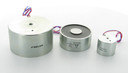
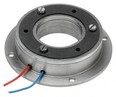
Electromagnets are suitable wherever the magnetic field needs to be switched on and off according to the technology cycle. On production lines, they are used when handling parts, in automated workplaces, when feeding sheets or in applications where gripping and release need to be precisely controlled.
Their strong point is flexibility. On the other hand, power supply, control and thermal regime must be taken into account. In intensive operation, correct dimensioning is important to prevent overheating of the coil or a drop in performance. An electromagnet is not automatically better than a permanent solution - it is better only where the process truly requires a controllable magnetic function.
Magnetic clamps and clamping systems
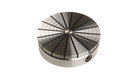
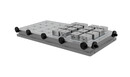
In production lines, especially in machining, assembly and fixtures, magnetic clamps are also important. They enable fast and repeatable fixing of ferromagnetic parts without classic mechanical clamping. This shortens changeover times and, in many cases, improves access to the workpiece.
However, it is necessary to distinguish between applications with flat, sufficiently thick parts and thin-walled or geometrically complex pieces. Material thickness, the quality of the seating surface and the contact area significantly affect the real holding force. Catalogue data should therefore never be read without the context of the specific part.
Magnetic rollers, drums and over-belt separators
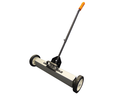
Where a line processes larger volumes of material, more powerful separation assemblies come into consideration. Magnetic rollers are often used on conveyors for continuous separation of metal particles from granulates, crushed material or bulk mixtures. Magnetic drums are suitable for a continuous material flow, and over-belt separators for removing ferromagnetic impurities directly from belt conveying.
Such solutions are selected not only according to the type of metal, but also according to the height of the material layer, belt speed and required output purity. If the material layer is too high or the magnet is positioned outside the effective distance, even a strong system will not work optimally.
The best magnets for production lines according to application
If the selection is to make practical sense, it must be tied to the specific use. When protecting technology against metal impurities, magnetic plates, grids or pipeline separators are usually the best choice. Their task is not to handle a part, but to capture unwanted metal before it damages equipment or degrades the product.
For automated feeding of sheet-metal stampings or steel semi-finished products, electromagnets or specialized magnetic grippers are often more suitable. Here, dosing accuracy, cycle speed and the ability to reliably release the part without jamming are decisive.
In machining and assembly, magnetic clamping systems prove effective when fast part changeover and repeatable positioning are the priority. In recycling and sorting operations, over-belt separators, drums and rollers dominate, as they can handle continuous operation and higher material volumes.
In simplified terms, the best magnet is not the strongest one, but the one that matches the actual working mode. An oversized solution can unnecessarily increase costs and complicate cleaning. An undersized solution, on the other hand, creates losses that become evident very quickly in operation.
Magnet material and its limits
In industrial applications, the choice is often between neodymium and ferrite magnets, or between other specialized materials. Neodymium magnets offer high force in compact dimensions, so they are suitable where there is little space or where high performance needs to be achieved on a small surface.
Their weaker point may be sensitivity to higher temperatures and, with unsuitable surface protection, also to corrosive environments. Ferrite magnets have lower magnetic performance, but in many separation applications they are fully sufficient and at the same time stable in a wider range of operating use. SmCo magnets are used where higher temperatures and more demanding conditions are present, but their use is usually specific both economically and in terms of application.
For a designer or buyer, it is essential not to rely only on the magnet material as the main criterion. The result is determined by the entire magnetic circuit, enclosure, geometry, distance from the part and the method of integration into the line.
Common mistakes when designing a magnetic solution
Several typical mistakes repeat in practice. The first is focusing only on declared holding force without verifying real conditions. Catalogue data is usually measured in ideal contact with a flat steel surface, which is often far from the real part on the line.
The second mistake is underestimating the working distance. The magnetic field weakens quickly with distance, so even a small gap caused by dirt, coating, packaging or a structural cover significantly changes the result. The third mistake is neglecting maintenance. If a separator is difficult to clean or is cleaned irregularly, its efficiency decreases regardless of the original parameters.
The fourth problem is unsuitable integration into the line. A magnet may be high quality, but if it is installed in the wrong place in relation to the material flow, its efficiency will be low. In more complex operations, it therefore makes sense to consult the design with a technical partner who understands not only the product, but also the application.
When catalogue selection is not enough
For simple applications, a correctly selected standard component is sufficient. However, if the line operates at a high cadence, in a dusty environment, with an atypical part or with demanding output cleanliness, selection moves from the product level to the level of a technical solution.
Here, details are decisive - the type of magnetic core, enclosure, cleaning method, field orientation, demagnetization, safety elements and service availability. This is exactly where it makes sense to work with a supplier who can design a solution according to operating conditions, not just ship a catalogue item. In this respect, the technical background and long-standing application practice represented on the market by SELOS Magnety are also an advantage.
If you are currently deciding which magnets are truly the best for your production line, do not start with the question of what is the strongest. Start with the question of what the magnet is supposed to do reliably on the line after thousands of cycles, in a specific environment and without unnecessary downtime.