












Best magnets for sensors in practice
When a sensor in an application switches inaccurately, the problem is often not in the electronics, but in the magnet. That is why the question of what the best magnets for sensors are cannot be answered by a single material or a single size. The type of sensor, distance, operating temperature, surrounding metal, and whether you need only simple position indication or a stable signal in a repeated industrial cycle all play a role.

What Determines Which Magnets for Sensors Are Truly the Best
When selecting a magnet for a sensor, four basic parameters are monitored in practice. The first is magnetic induction at the sensing point — in other words, how strong the magnetic field reaching the active part of the sensor is. The second is material stability over time and temperature. The third is the geometry of the magnet, because the same material behaves differently in different shapes. The fourth is the installation environment, which can significantly affect the result.
This is why the strongest magnets cannot automatically be considered the best magnets for sensors. A magnet that is too strong may saturate the sensor, shift the switching distance beyond expectations, or create an excessively wide active field. In precise position sensing, a properly selected smaller magnet is often more effective than a large neodymium magnet without field control.
The Sensor Type Defines the Basis of Selection
Reed Sensors and Reed Switches
With reed sensors, it is important that the magnet creates a sufficient magnetic field in the correct orientation. These sensors are commonly used in door contacts, cylinders, simple end positions, or basic automation. In many cases, they work reliably with both ferrite and neodymium magnets, but the result depends on the distance and direction of approach.
If the installation distance is larger or space is limited, neodymium is usually the more practical choice. However, in less demanding applications with lower temperatures and sufficient space, ferrite may be completely adequate both economically and functionally.
Hall Sensors
Hall sensors are more sensitive to the precise distribution of the magnetic field. Here, it is no longer enough for the magnet to “switch somehow.” Stable output, repeatable switching points, and predictable behavior when the gap changes are essential. In such applications, neodymium magnets are frequently used because they provide high magnetic field intensity even in a small volume.
In linear Hall sensors or angle and position measurement applications, field homogeneity is also critical. In these cases, the shape of the magnet plays just as important a role as the material itself. A cylindrical magnet, ring magnet, or segment can produce significantly different results even with the same magnetic grade.
Magnetoresistive and Precision Position Sensors
In more precise sensing applications, magnet selection shifts from the category of “strong or weak” to “properly designed.” Factors such as placement, pole orientation, dimensional tolerances, nearby interfering metal parts, and production repeatability become important. If a device is to be manufactured in larger quantities, the difference between a functional prototype and a reliable production solution is usually found in the details of the magnetic design.
Magnet Materials and Their Real Use in Sensors
Neodymium Magnets
Neodymium is the first choice wherever high performance is required in a small space. This is typical in compact sensors, embedded installations, miniaturized devices, or applications with a larger air gap between the magnet and the sensor. The advantage is high remanence and a strong magnetic field even at small dimensions.
However, limitations must be considered. Standard neodymium magnets are more sensitive to higher temperatures and require suitable surface protection in aggressive environments. In devices where the magnet is located near a motor, hot components, or humid outdoor environments, these limits should be checked before choosing neodymium solely based on strength.
Ferrite Magnets
Ferrite has weaker magnetic parameters, but in many applications it remains a sensible choice. It is corrosion-resistant, cost-stable, and suitable where every millimeter of space is not critical. In simple reed contacts, open/closed detection, basic presence sensing, or less compact devices, it can fulfill its function without unnecessary oversizing.
The disadvantage is larger dimensions for the same effect. If the design suffers from limited installation space, ferrite quickly reaches its practical limits.
SmCo Magnets
Samarium-cobalt is used where higher operating temperatures or long-term stability in demanding environments are required. It is not the most common sensor material, but in industrial applications with thermal stress it can be the correct choice. It is more expensive than both neodymium and ferrite, but in specific conditions its use is worthwhile because it reduces the risk of failure.
AlNiCo Magnets
AlNiCo offers good temperature stability but lower resistance to demagnetization compared to modern materials. In sensor applications, it is mainly used in specific cases or as a replacement for older solutions. When designing a new system, neodymium, ferrite, or SmCo is usually the more suitable option.
The Shape of the Magnet Is Often More Important Than the Material
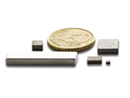
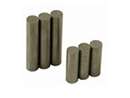
In practical design, it often turns out that the issue is not which magnet to choose, but which shape and pole orientation the specific sensor requires. A disc magnet is suitable for simple axial approach sensing. A cylindrical magnet is useful for holes and housings. A block magnet is practical for linear movement or mounting on flat surfaces. Ring magnets are used where rotation, shafts, or angular position are sensed.
Pole orientation is equally important. Axial and diametrical magnetization create completely different magnetic fields. In rotary sensors, incorrect pole orientation is a common reason why a system does not work as expected, even though both the magnet and sensor appear correctly selected on paper.
What Is Most Often Overlooked During Selection
A common mistake is designing the magnet outside the real installation environment. If a sensor and magnet are tested “on a table” and then the entire system is enclosed in a steel bracket, the result changes. Ferromagnetic parts nearby can divert, distort, or locally strengthen the field. Problems can also be caused by adhesive with a thick layer, inaccurate magnet positioning, or dimensional variations in mass production.
The switching tolerance of the sensor itself is also often underestimated. Two pieces of the same sensor may not switch at exactly the same field intensity. If the design operates at the limit, prototypes may work while mass production starts failing. That is why it is wiser to design with a safety margin rather than exactly at the minimum switching threshold.
How to Choose the Best Magnets for Sensors in Practice
If the application involves simple open/close detection, end-position sensing, or object presence detection, it makes sense to start with the sensor type and installation distance. With short distances and enough space, ferrite may be sufficient. For compact installations or applications requiring a stronger field, neodymium is usually more suitable.
If you are working with a Hall sensor or more precise position sensing, selecting only by material is not enough. You need to know the required field intensity at the operating point, the geometry, movement direction, and environmental influences. In such cases, it is often worthwhile to test several magnet variants directly in the assembly.
In higher operating temperatures, vibrations, or long-term operation in demanding environments, the temperature class, surface protection, and mechanical mounting of the magnet must be verified in advance. Even a very good magnet becomes a weak point if it loosens, cracks, or loses part of its properties outside its operating range.
When a Catalog Selection Is Not Enough
For one-time or less demanding applications, a standard stock magnet is often sufficient. In mass production, specialized electronics, or precise position sensing, however, details that a catalog cannot solve become important. These include pole orientation, dimensional tolerances, material selection according to temperature, and mounting methods in plastic or metal parts.
This is exactly where the difference lies between simply buying a magnet and creating a functional technical solution. If the magnet becomes an active part of measurement or control, it is worth verifying the design before the construction is finalized or a production batch is ordered. In practice, this saves time, complaints, and unnecessary redesigns.
SELOS Magnety has focused on this field for many years from the perspective of real technical applications, not only catalog parameters. In sensor applications, this is crucial because solutions that look similar on paper can behave very differently in operation.
So if you are looking for the best magnets for sensors, do not start with the question of which magnet is the strongest. Start with what the sensor is supposed to do, in what environment, and with what safety margin. A properly designed magnet is usually not the biggest or most expensive one, but the one that gives the system reliable performance in every single cycle.