















Electromagnetic clutch in practice
When a machine requires precise engagement or disengagement of a drive without lengthy mechanical intervention, electromagnetic clutches are often one of the first solutions considered. In practice, they determine whether power is transmitted at the correct moment, at the correct speed, and without unnecessary wear of the surrounding mechanism. For designers or maintenance teams, this is not a minor component on the edge of a project, but a functional element that directly affects the reliability of the entire assembly.
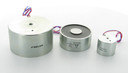
An electromagnetic clutch uses the force of a magnetic field to engage two parts of a drive system. When electric current is supplied to the coil, a magnetic field is created that attracts the armature or friction element and enables torque transmission. Once the power supply is disconnected, the clutch disengages, usually by means of a spring or the design of the air gap itself. This simplicity of operation is exactly why electromagnetic clutches are used in automation, packaging lines, conveyors, machine tools, and auxiliary drives.
How Electromagnetic Clutches Work
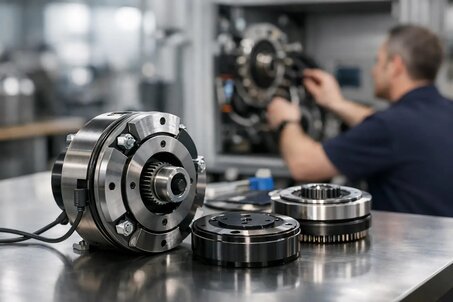
From a technical perspective, an electromagnetic clutch is a combination of an electromagnet and a mechanical power transmission system. Once energized, the coil generates a magnetic flux that closes the magnetic circuit and creates a clamping force between the functional surfaces of the clutch. If it is a friction clutch, the transmitted torque depends on the magnitude of the clamping force, the diameter of the friction surface, the lining material, and the operating conditions. If it is a toothed clutch or form-locking type, the accuracy of engagement and the timing of switching are decisive.
In operation, it is important to understand that the clutch does not react only to an ON or OFF command. Real behavior is influenced by the supply voltage, coil temperature, switching frequency, inertia of the driven masses, and the condition of the friction surfaces. This is why clutch design cannot rely solely on the catalog torque value. Short-term peak operation and long-term repeated operation are two very different disciplines.
Where Electromagnetic Clutches Are Used
They are most commonly used wherever power transmission must be controlled without complicated mechanical intervention. In conveyor systems, they allow individual sections of a production line to be engaged according to the current operating mode. In packaging and labeling equipment, they help synchronize material feeding. In machine tools or auxiliary units, they separate the working and non-working states of a machine.
A separate category includes applications requiring frequent switching and precise timing. In such cases, electromagnetic clutches often replace mechanically controlled solutions that would be slower, less accurate, or more demanding in terms of maintenance. Another advantage is their relatively simple integration into control systems.
However, electromagnetic clutches are not always the best solution. If the application requires continuous transmission of high torque under significant thermal load, another concept may be more suitable. Likewise, in extremely contaminated environments, it is necessary to carefully evaluate protection, cooling, and the lifetime of friction components.
Key Parameters When Selecting a Clutch
Selecting a clutch is not only about defining the required torque. That is just the starting point. It is also necessary to know whether the clutch transmits torque continuously or intermittently, how many switching cycles occur per minute, what the inertia of the system is, and what starting peaks can be expected. The clutch is usually subjected to the highest stress during startup.
Another important parameter is the coil operating voltage and the power supply method. Industrial applications often use DC power supply, but the specific solution depends on the machine and control system. Incorrect power supply can result in insufficient engagement force, overheating, or delayed response. From a practical standpoint, the clutch should therefore be evaluated as part of the entire electrical and mechanical system, not as an isolated component.
Thermal balance is equally important. Every engagement and every slip generates heat. If the heat cannot dissipate efficiently, the service life of both the friction lining and the coil decreases. This is especially critical in compact designs with limited cooling space. In such cases, not only nominal torque matters, but also the permissible energy per cycle and per unit of time.
Torque Is Not the Only Important Value
In technical practice, it is common for a clutch with sufficient nominal torque to fail because the application dynamics were not properly considered. If a large inertia is repeatedly accelerated, the clutch may operate in repeated slip mode. On paper it meets the specification, but in real operation it overheats. That is why it is important to work with a safety margin and realistic duty cycle calculations.
Operating Environment Changes the Result
Dust, oil mist, vibrations, or elevated ambient temperatures influence operating conditions more than it may initially appear. Friction surfaces react to contamination, the coil reacts to temperature, and the mechanical mounting reacts to misalignment. In a clean and stable environment, the clutch may operate reliably for a long time, while in demanding industrial conditions it may require more frequent servicing or a different design concept.
Typical Advantages and Their Limits
The main advantage of electromagnetic clutches is fast and precise control. From an automation perspective, it is important that they can be easily connected to control systems and switched repeatedly without manual intervention. A properly designed solution provides stable torque transmission, predictable response, and good integration into production technology.
On the other hand, this is a component highly sensitive to incorrect sizing. If the clutch operates continuously near its limit, any savings made during selection are quickly lost through downtime and service interventions. In some applications, it is also necessary to account for the natural wear of friction components as part of the maintenance plan.
The requirement for electrical power is sometimes considered a limitation. In reality, this is not necessarily a problem if the electrical system is properly designed. Issues arise when supply stability, surge protection, or engagement/disengagement control are underestimated. In such cases, failures are often incorrectly blamed on the clutch itself, while the real cause lies in the surrounding electrical installation.
What to Consider During Design and Maintenance
During design, attention should be paid to mounting precision. Misalignment, improper installation, or excessive axial load reduce the lifetime of both bearings and the clutch itself. Equally important is checking the air gap, if required by the clutch type. An excessively large gap worsens engagement, while a gap that is too small can lead to unwanted contact and wear.
Maintenance should not begin only after a failure occurs. At regular intervals, it makes sense to monitor operating temperature, the condition of friction surfaces, possible contamination residues, and the electrical parameters of the coil. In high-cycle applications, it is also advisable to monitor engagement time and changes in behavior under load. If the clutch starts behaving differently from when it was commissioned, this is often an early sign of wear or unsuitable operating conditions.
In technical practice, it is beneficial to evaluate not only the component itself, but the entire drive assembly. If the clutch is paired with an improperly designed startup sequence, excessive inertia, or unstable power supply, replacing it with a new unit will usually not solve the issue. The important thing is to identify the root cause, not only the consequence.
When Technical Consultation Makes Sense
For simple applications with clearly defined loads, selection is usually straightforward. However, in variable-duty applications, frequent switching, or systems with higher precision requirements, it is easy to choose an unsuitable variant without technical evaluation. The difference between a merely functional solution and a long-term reliable one often lies in details — thermal reserve, proper power supply design, or realistic duty-cycle assessment.
This is exactly why professional consulting and service support matter in electromagnetic systems. An experienced supplier evaluates not only catalog parameters, but also the real operating conditions inside the machine. For industrial practice, this is particularly important whenever machine downtime means direct production losses. At SELOS Magnety, long-term experience with technical solutions repeatedly confirms that choosing the right magnetic component is less expensive than repeated corrections after installation.
Electromagnetic clutches make sense wherever power transmission must be controlled precisely, repeatedly, and reliably. When real load conditions, environment, and operating method are taken into account, they are not just functional components, but elements capable of stabilizing the entire drive system and reducing unnecessary operational problems.