




















Flexible magnetic tapes in practice
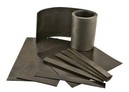
When you need to quickly attach a label, create a temporary closure or fix a lightweight element without drilling or gluing, flexible magnetic tapes are often more practical than solid magnets. This is exactly where their main advantage lies - they adapt to the surface, can be cut to size and, when selected correctly, work reliably in a workshop, warehouse and office.
At first glance, it may seem like a simple product. In practice, however, the type of magnetic material, tape thickness, polarization, carrier and the environment in which it will be used all matter. The difference between a tape that holds without problems and a tape that peels off or does not provide sufficient holding force is often found in a technical detail.
Where flexible magnetic tapes make the most sense
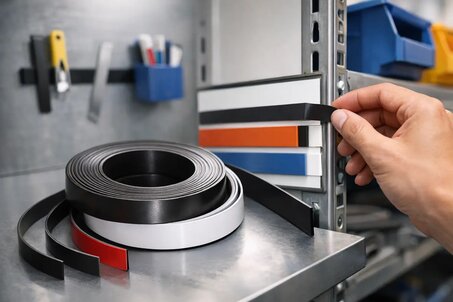
Flexible magnetic tapes are used where a connection to a metal surface is needed without permanent intervention in the structure. Typical applications include shelf markings, interchangeable information labels, presentation systems, advertising carriers, simple door closures or fastening of lightweight covers. In smaller operations, they are also used for organizing tools and accessories.
Their advantage is variability. The tape can be supplied in a roll, cut to the required length or combined with a PVC layer, foam or self-adhesive layer according to the specific application. This is especially important when the solution is adapted to existing equipment and there is no room for intervention in production or assembly.
In advertising and exhibition practice, the possibility of repeated use is important. In warehouse marking, fast replacement of labels and clean fastening are decisive. In technical applications, the precise choice of tape thickness and type is often key so that contact with the substrate is sufficient and the holding force corresponds to the real load.
What flexible magnetic tapes are made of
The basis is usually a mixture of magnetic powder, most often ferrite, and a flexible polymer. The result is a material that is flexible, shape-adaptable and at the same time retains magnetic properties along its entire length. Compared with neodymium magnets, it has lower magnetic strength, but significantly better processability and safer handling in surface applications.
This is an important difference. If someone expects the same performance from a flexible tape as from a compact magnet, the result will most likely disappoint them. This material is not intended for high loads, but for practical and fast solutions where magnetism is needed in the form of a strip or surface.
The magnetic layer can be supplemented with a self-adhesive layer, lamination or protective surface. When selecting, it is therefore necessary to assess not only the magnetic side, but also how the tape will be connected to the second part. In many cases, the limitation is not the magnet itself, but the quality of the adhesive, the cleanliness of the substrate or the influence of temperature.
How to choose flexible magnetic tapes
The most common mistake is choosing by dimension without assessing the application. The width and length of the tape are important, but they are not sufficient on their own. Material thickness, type of magnetization and the surface on which the tape will work are decisive.
A thicker tape usually provides higher holding force, but at the same time requires more space and may be less suitable for fine or visible applications. A thinner tape is easier to integrate into a product, but its performance has its limits. This usually does not matter when marking shelves, but it can matter when closing a cover.
The quality of the contact surface is also important. Magnetic tape achieves the best result on a flat, clean and ferromagnetic surface. If the substrate is painted, wavy, contaminated or made of a material with a low magnetic response, the holding force decreases. In operation, dust, grease and wear are also added, so the laboratory value may not correspond to real deployment.
With a self-adhesive version, the type of material being bonded must also be assessed. Aluminium, plastic, painted sheet metal and powder coating each behave differently. If the tape is bonded to a surface with lower surface energy, standard adhesive may not be sufficient. In such a case, it is advisable to solve the application individually and not rely on universal assumptions.
Axial and anisotropic magnetization
In more technical selection, the orientation of magnetization is often addressed as well. It has a direct impact on how the tape holds on a metal substrate or how it connects with another tape. Not every magnetic tape is intended for pairing with the same type of material.
An anisotropic version achieves higher magnetic performance than an isotropic one with the same dimensions. For more demanding applications, this is often an important parameter. If the tape is to be used as a functional element and not only as auxiliary fastening, this detail is worth paying attention to.
A self-adhesive layer is not an automatic guarantee
Self-adhesive flexible magnetic tapes speed up installation, but only when the substrate is properly prepared. The adhesive needs a clean, degreased and stable surface. If the tape is applied to dusty plastic, heavily textured paint or a substrate with temperature fluctuations, the risk of failure increases significantly.
In industry, it is therefore worth considering a test in real operation. A short test on the specific material often says more than a general technical description. Especially in serial use, verifying compatibility is cheaper than later redesigning the entire application.
When flexible magnetic tapes are the right solution and when they are not
There are situations where this material works excellently. These include interchangeable marking, lightweight advertising elements, cover strips, closures with low load or workplace organization. The advantage is fast installation, easy adjustment of dimensions and the possibility of repeated handling without damaging the substrate.
There are also cases where another magnetic element is more suitable. If the application requires high holding force, a precisely defined position, resistance to higher temperature or long-term mechanical stress, flexible tape may no longer be optimal. In such cases, solid magnets, magnetic systems or structurally designed clamping elements come into play.
The environment is also important. Higher temperature, UV radiation, humidity or chemical load can affect both the magnetic material and the carrier layers. Indoors and in normal operation, it is often a trouble-free solution, but in a technological environment, the parameters need to be verified more precisely.
Practical applications in production, warehouse and operation
In production, flexible magnetic tapes are used mainly for auxiliary fastening of covers, workplace marking, temporary fixing of lightweight elements and visual management. They are not a substitute for safety or load-bearing connections, but as an assembly and organizational element, they can significantly simplify everyday practice.
In warehouses, they have their place on shelf labels, position identification and seasonally changed marking. Compared with fixed fastening, they offer quick change without damaging the shelf. This is appreciated especially by operations where the stock layout changes regularly.
In offices, schools and presentation spaces, clean handling is a benefit. The tape can be cut, combined with foil or a lightweight board and adapted without complicated tools. That is why it is a product that combines technical functionality with very simple use.
What to consider before ordering
If the tape is only to perform an orientation or presentation function, selection is usually simpler. However, if it is a repeatedly used technical element, it is worth defining several basic conditions: what the weight of the part will be, what substrate the tape will be applied to, whether the load will be static or dynamic, and what environment will be present at the place of use.
It is equally important to know whether the tape is to hold on steel or whether it is to connect with another magnetic tape. This is not a detail, but a parameter that fundamentally changes the suitable type of product. In technical practice, it is worth addressing these questions in advance, not only when dealing with a complaint about a non-functional application.
This is exactly where expert advice matters. With a broader range of magnetic materials, it is not only about size availability, but about correctly matching the product to real use. SELOS Magnety has been working in this field for a long time, and for specific applications, a technical consultation is often the fastest path to the right solution.
Flexible magnetic tapes are not a universal material for everything. However, if they are selected with regard to the substrate, load and environment, they offer exactly what is expected of them - fast, clean and practical magnetic fastening without unnecessary structural interventions.