














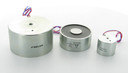



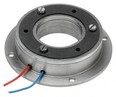


Guide to magnetic lifting of loads
If you handle sheets, cut parts, profiles, or workpieces in operation, choosing the right handling method is not only a matter of performance, but also of safety, time, and process repeatability. This guide to magnetic lifting of loads is intended for technicians, buyers, and plant operators who need to understand when magnetic lifting makes sense, what its limitations are, and how to choose the right solution.
Magnetic lifting of loads is one of the proven methods for handling ferromagnetic materials. In practice, it can significantly speed up loading, transfers between workstations, and the operation of machining or cutting stations. At the same time, the load capacity stated in a catalog is not sufficient on its own. Real operating conditions are decisive — material type, thickness, contact surface, surface treatment, temperature, and gripping method.
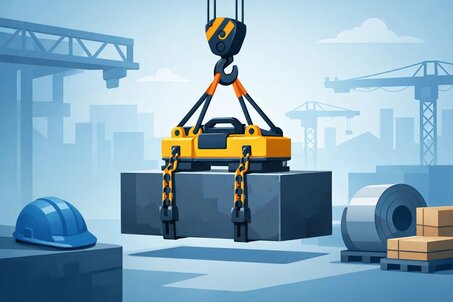
When Magnetic Lifting of Loads Makes Sense
Magnetic lifting delivers the greatest benefit where steel parts of a similar type are handled repeatedly. Typical examples include steel warehouses, metalworking and welding workshops, steel structure manufacturing, cutting centers, machining operations, and maintenance facilities. Compared to slings and conventional lifting tools, handling is usually faster, operation simpler, and — with the right solution — more precise.
Another advantage is reduced contact with the load. With metal sheets or machined parts, this often lowers the risk of mechanical surface damage. In small-batch or custom production, this means shorter preparation time, while in repetitive operations it improves workflow efficiency.
However, it is not a universal solution for every material. A magnet only works with ferromagnetic metals, and its behavior changes depending on the properties of the load. What can be reliably lifted with low-carbon steel and a clean surface may not work the same way with alloyed materials, thin sheets, or parts with a larger air gap.
Guide to Magnetic Lifting of Loads in Practice
When selecting a solution, the process should start with the load itself, not with the magnet. The first question is weight, but immediately after that come shape, contact surface, and material thickness. A magnetic lifter achieves its declared performance only under defined conditions. If the material is thin, part of the magnetic flux cannot close efficiently and the actual holding force decreases.
The surface condition is equally important. Paint, scale, rust, grease, or unevenness create a gap between the magnet and the load. Even a small contact imperfection can significantly affect some applications. That is why technical design evaluates not only maximum lifting capacity, but also contact quality.
Special attention is required when handling long profiles and bars. In such cases, it is not enough to assess whether the magnet can lift the load. Stability during transport, the risk of tipping, and weight distribution must also be considered. For longer parts, it may be more appropriate to use two lifting points or a specialized solution designed for the specific material type.
With metal sheets, separating individual pieces is often a challenge. If sheets are thin, oily, or tightly stacked, multiple layers may unintentionally stick together. In such cases, not only the lifting operation but also the precision of picking and the method of releasing the material must be considered.
Permanent and Electromagnetic Solutions
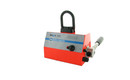
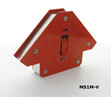
In basic classification, lifting systems are divided into permanent magnetic lifters and electromagnets. Permanent solutions are attractive where simplicity, independence from power supply, and lower operating complexity are priorities. The operator mechanically activates and deactivates the magnetic circuit, which is practical and reliable for many common applications.
Electromagnets are particularly useful in automated or high-frequency operations, when handling larger formats, or wherever remote control and integration into technology are required. On the other hand, they require power supply systems, protection circuits, and safety measures in case of power failure. Their selection is therefore always tied to a specific operating environment.
What Load Capacity Means and Why It Cannot Be Read in Isolation
The stated load capacity is not a universal value valid for every steel object. Manufacturers usually specify it under test conditions, for example with flat low-carbon steel of sufficient thickness and a clean contact surface. In real operating conditions, the actual result is often lower.
That is why the correct approach is the opposite of what is common in quick purchasing decisions. Instead of asking “which magnet has a 500 kg capacity,” it is better to ask “which magnet is suitable for handling this specific part with this gripping method.” The difference between these approaches is critical, because safety margins and operating conditions are part of the decision.
Safety in Magnetic Lifting of Loads
Magnetic lifting is safe only when operating conditions are respected and operators understand the limitations of the equipment. The most common mistake is overestimating a magnet based solely on nominal load capacity without considering material properties and surface condition. Another issue is attempting to lift loads with an unsuitable center of gravity or shape, where shifting or detachment may occur.
Before every use, it makes sense to check contact surfaces, the mechanical condition of the lifter, and the cleanliness of the contact area. With manually operated permanent lifters, the correct activation position and confirmation that the locking mechanism is engaged are also important. If one type of lifter is used for multiple different parts, operators must know which parts are still within the safe operating range and which are not.
Safety also includes workplace organization. Operators should never stand under the load or within the possible swing path. When moving through confined areas or placing loads onto storage racks, it is necessary to expect slight movement during placement. This is a normal operating situation, not a defect of the magnet, which is why the entire process must include a safety margin.
Factors That Most Commonly Reduce Holding Force
In practice, the same causes of reduced performance appear repeatedly. These include insufficient material thickness, uneven or contaminated surfaces, elevated temperatures, poor steel quality, and unsuitable load geometry. Gaps caused by coatings, scale, or thick paint layers are also critical.
With rolled profiles and pipes, the smaller contact area becomes a major factor. The magnet may still attract the material, but the holding force will not compare to that of a flat workpiece. For round or curved surfaces, the specific application must always be evaluated individually rather than relying only on general material categories.
How to Choose the Right Solution for Your Operation
To make the right selection, more information is needed than just the weight of the heaviest part. It is important to know what is lifted most frequently, how often handling occurs, what the workspace looks like, and whether the operation uses manual handling, a crane, a gantry, or integrated automation. A workshop moving cut steel segments has completely different requirements from a maintenance facility handling machined blocks in confined spaces.
In frequent handling operations, ergonomics should also be evaluated. If lifter activation is uncomfortable or the magnet does not allow quick and repeatable positioning, the limitation is not lifting performance but operator handling. In practice, this results in wasted time and a higher risk of improvisation.
Maintenance and serviceability are equally important. Magnetic equipment often operates in demanding environments with dust, metal particles, and mechanical stress. That is why it makes sense to choose a solution with clear technical documentation, available service support, and the possibility of professional consultation. In industrial applications, long-term reliability matters more than the lowest purchase price.
When Consultation Makes More Sense Than a Quick Purchase
For standard flat parts and clearly defined applications, the selection process can be relatively straightforward. However, if you handle thin sheets, profiles, cut parts with holes, welded assemblies, or materials with variable geometry, technical consultation saves both time and the risk of choosing the wrong solution. The same applies when operating temperatures, suspension methods, or cycle performance requirements change.
This is where the difference between simply selling a product and providing a real technical solution becomes clear. SELOS Magnety has long focused on magnetic applications for industrial practice, which is why in more demanding applications it makes sense to work from real operating parameters rather than catalog data alone.
A properly designed magnetic lifting system can speed up operations, improve workflow clarity, and reduce the physical strain on operators. To ensure this remains true not only during the first test but also after months of operation, material properties, operating conditions, and safety principles must all be respected. The best solution is not necessarily the strongest one, but the one that works reliably with your specific load every single day.