












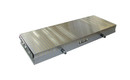
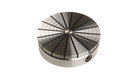
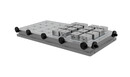




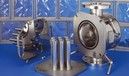

Holding electromagnets for automation in practice
In manufacturing, it is usually not only force that matters, but primarily repeatability. If a workstation needs to grip a part, hold a fixture, or secure a position precisely in line with the production cycle, holding electromagnets for automation are often a more practical choice than mechanical latches or pneumatic solutions. The reason is simple – electrical control integrates easily into machine control systems, the response is fast, and the entire system has fewer moving parts.
However, the advantages do not end there, nor do all the risks begin there. When selecting a solution, it is necessary to consider not only the holding force, but also the working gap, the material of the mating part, load orientation, coil heating, and behavior in case of power failure. These details determine whether the electromagnet works reliably in the long term or only on paper.

Where holding electromagnets for automation make the most sense
Holding electromagnets are used wherever something needs to be attached, fixed, or temporarily locked without complex mechanics. In automation, this often includes fixtures on assembly stations, stops, cover locks, positioning of parts, holding a moving component in a defined position, or simple handling of a ferromagnetic component.
Their strength lies in the fact that they can be precisely controlled by an electrical signal. This is an advantage for designers who need to integrate an actuator with PLC systems, sensors, or safety logic. Compared to pneumatic clamping, part of the distribution system is eliminated, and in some applications, the need for compressed air as well.
However, they are not a universal replacement for everything. If the part is non-magnetic, if large dynamic shocks are involved, or if it is necessary to guarantee holding even during a complete power failure without additional securing, another concept or a combined solution must be considered.
How a holding electromagnet works in real operation
The principle is well known – when voltage is applied, the coil generates a magnetic field that closes the magnetic circuit through a ferromagnetic counterpart. Catalogs often state the nominal holding force, but in practice, this only applies under specific conditions. A clean and flat contact surface, minimal air gap, and a suitable counterpart material are decisive.
If the surface is painted, oxidized, rough, or if even a small gap remains between the poles and the counterpart, the holding force drops significantly. This is a common reason why an electromagnet works during testing but fails to deliver the required margin once deployed in production. It is equally important whether the magnet holds the part in a pull-off direction or must resist shear. Under lateral load, the usable force is significantly lower, and mechanical guidance must also be addressed.
Nominal force is not operating force
The manufacturer’s specification is a good starting parameter, not a final answer. The designer should work with a safety margin because operating conditions vary in temperature, contact quality, and surface cleanliness. If the application runs in multi-shift operation, with oil mist or abrasive dust, performance degradation must be considered already in the design phase.
Power supply, cycle, and heating
Holding electromagnets can be designed for continuous power supply or intermittent operation. This is a fundamental difference. In continuous holding, the thermal regime must be considered, as coil heating changes electrical parameters and may affect lifetime. In some applications, a short high-power activation pulse is used, followed by reduced holding power.
Such a solution saves energy and reduces temperature, but requires properly dimensioned control. It is not enough to simply connect the electromagnet to a power source and expect optimal behavior in all modes.
What to consider when selecting holding electromagnets for automation
In technical design, it is advisable to start from the application, not the component itself. A locking magnet for a cover has different requirements than a clamping element in an assembly fixture or a magnet on a manipulator. If this step is skipped, selection is often reduced to dimensions and catalog force, which is insufficient.
The first criterion is the nature of the load. It is necessary to know whether the magnet only prevents a part from opening or carries weight in motion. Switching frequency is also important. With a high number of cycles per hour, it is advisable to verify not only electrical lifetime but also mechanical effects, such as impacts when the counterpart seats.
The second criterion is power supply and control method. In automation, 12 V or 24 V DC is commonly used, but voltage alone is not sufficient. Available current, switching method, surge protection, and compatibility with the control system output are critical. Without properly designed protection, the electromagnet may negatively affect electronics during switching.
The third factor is the environment. If there is dust, oil, humidity, or higher temperatures, an appropriate design and protection rating must be selected. In more aggressive environments, surface material and corrosion resistance are also important. In food, packaging, or pharmaceutical lines, cleanability requirements may also apply.
When safety during power failure is critical
A standard holding electromagnet only holds when powered. This is an advantage for controlled release, but a problem where power loss would result in a falling part, opening of a cover, or a position change with safety implications. In such cases, a mechanical lock, backup power, or a different holding principle must be considered.
On the other hand, in some machines it is desirable that a power failure results in immediate release. This is typical in certain service or emergency modes. The correct solution always depends on the function within the specific system.
Typical design and installation mistakes
The most common mistake is underestimating the air gap. A coating, contamination, or an inaccurately machined counterpart is enough to significantly reduce the real force. Another issue is misunderstanding the load direction. An electromagnet may have sufficient pull force, but under lateral load, the part may slip.
The counterpart is also often overlooked. Not every steel part has the same magnetic properties. Material, thickness, and shape affect the closure of the magnetic circuit. If the counterpart is too thin or made of unsuitable steel, the electromagnet will not achieve its declared performance.
A separate topic is switching electronics. Without a proper diode, varistor, or other protection element, voltage spikes occur during switching, shortening relay life and potentially interfering with control systems. Sometimes overly simple suppression is used, which protects electronics but increases the release time of the magnet. In fast cycles, this can be problematic.
When to choose a standard solution and when to consult
For simple holding of covers, doors, or non-demanding fixtures, a standard holding electromagnet is usually the fastest and most economical choice. Proper sizing and quality installation are essential. In such applications, availability, fast delivery, and clear technical data are key.
However, if the electromagnet is part of a production node affecting cycle time, safety, or handling quality, technical consultation before ordering is worthwhile. It helps verify force margin, thermal behavior, control type, and failure behavior. This is where the difference lies between buying a component and designing a functional solution. Companies experienced in magnetic applications can highlight limitations not visible in a catalog sheet.
In practice, this is especially evident with non-standard part dimensions, high cycle rates, or operations combining clamping, separation, and handling in a single process. In such cases, it is no longer just about whether the magnet holds, but how it behaves after thousands of cycles and under real production tolerances.
Where a holding electromagnet actually saves time
A well-designed application saves not only machine space, but mainly operator and maintenance effort. Compared to mechanical elements, part of the adjustment and wear is eliminated, and in some cases also the need for more complex pneumatic systems. This does not mean that an electromagnet is always the cheaper option. It means that, when properly designed, it can simplify the entire assembly.
This is exactly the situation where holding electromagnets for automation make both technical and economic sense. Not as a universal component for every line, but as a precisely selected solution for a specific task. If real operating conditions, counterpart quality, power supply method, and safety mode are considered in the design, the result is a stable and maintainable solution.
In automation, it is worth looking at the electromagnet not as a standalone component, but as part of the entire functional chain. That is where it becomes clear whether you have chosen just the right product, or the right solution.