
















How a lifting magnet works in practice
When handling steel sheets or cut parts, seconds matter—but so does the certainty that the load stays exactly where it should. That is why the question of how a lifting magnet works is not only about the principle of magnetism. In practice, it is a combination of the magnetic circuit, contact surface quality, material type, and proper use.
How a lifting magnet works
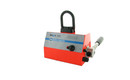
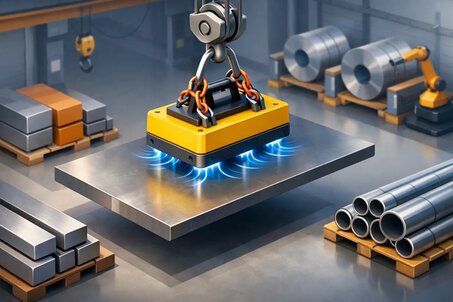
A lifting magnet is a device designed for handling ferromagnetic materials without hooks, chains, or lifting slings. It is most commonly used when handling sheets, blocks, profiles, and machined parts. Its role is to create a sufficiently strong magnetic field that closes through the lifted material and generates the clamping force required for a safe lift.
In a permanent lifting magnet, the force is not generated by electrical power but by permanent magnets housed inside the device body. The operator mechanically switches a lever into the working position. This adjusts the internal magnetic circuit so that the magnetic flux flows through the contact surfaces of the magnet, through the load, and back into the magnet. When the circuit is properly closed, a high holding force is created.
In the released position, the magnetic flux is redirected inside the device, significantly reducing the force on the working surface. Thanks to this, the magnet can be relatively easily detached from the material. This mechanical switching is why permanent lifting magnets are popular where simple operation, independence from power supply, and low operating demands are required.
What happens between the magnet and the load
Contact is critical. A magnet does not hold material just because it is made of steel. There must be a suitable contact surface, sufficient material thickness, and as small an air gap as possible between the magnet and the load. Any dirt, scale, rough coating, rust, or unevenness reduces the efficiency of the magnetic circuit.
From a technical perspective, the air gap is one of the main enemies of load capacity. Magnetic flux travels much worse through air than through steel. Even a small gap can significantly reduce holding force. This is why manufacturers specify load capacity under defined conditions and why a safety margin is used in practice.
The shape of the load also matters. If you are lifting a thick flat block of low-carbon steel, conditions are usually favorable. If it is a thin sheet, a round bar, or a material with a small contact area, the actual usable capacity will be lower. For round bars and pipes, magnets designed for cylindrical surfaces are used, or capacity is evaluated separately.
What determines lifting magnet capacity
The rated capacity stated on the device is not a universal value for every situation. It depends on the specific material type, thickness, geometry, and lifting method. In practice, four key factors must be considered.
The first is material. Lifting magnets are intended for ferromagnetic materials, especially structural steels. With stainless steel, the result depends on the specific type. Austenitic stainless steels are generally non-magnetic or only weakly magnetic, so they are not suitable for lifting with permanent magnets. Cast iron may behave differently from rolled steel, and capacity may be lower.
The second factor is thickness. If the material is too thin, it cannot carry the full magnetic flux. The magnet then does not operate at its maximum. A typical example is thin sheet metal, where catalog capacity cannot be applied directly.
The third factor is surface and flatness. A machined contact surface without layers and contaminants provides better results than a rough, burned, or corroded surface. With flame-cut parts, scale and local unevenness are common issues.
The fourth factor is load direction. A vertical pull on a compact block is different from lateral forces when moving a long profile. If the load tilts, oscillates, or is moved over obstacles, the risk of slipping or detachment increases. That is why technical practice considers not only static holding force but also real handling conditions.
Permanent vs electromagnetic system
When considering how a lifting magnet works in operation, it is not enough to understand only the permanent version. In some applications, electromagnetic lifting systems are used. These create a magnetic field when electric current flows through a coil. Their advantage is controllability, automation, and in some cases the ability to handle large batches or oversized parts.
A permanent lifting magnet is often the more practical choice for standard workshop and production handling. It does not require power, is immediately ready for use, and is easy to operate when in proper technical condition. On the other hand, its use depends on the material type and contact conditions. If the operation involves very thin sheets, large formats, or requires remote control, an electromagnetic solution may be more suitable.
Where lifting magnets are most commonly used
They are most often seen in mechanical engineering production, steel storage, cutting centers, tool rooms, and machining workplaces. They simplify moving semi-finished products to saws, milling machines, grinders, and assembly stations. The advantage is speed and reduced need for mechanical load securing.
They are also useful in maintenance, where steel parts must be moved in confined spaces. In such cases, it is crucial that the magnet can be applied from above without the need for slinging. In piece and small-batch production, this reduces auxiliary operations and makes handling smoother.
However, they are not a universal replacement for all lifting methods. For loads with uncertain center of gravity, very long flexible parts, or materials with questionable magnetic response, caution is required and a different lifting method may be necessary.
Most common usage mistakes
In practice, similar issues repeat. The first is relying on rated capacity without verifying real conditions. If a magnet is rated for 500 kg, it does not mean it will safely lift every steel part weighing 500 kg. Material, thickness, surface, and contact area all matter.
Another common mistake is using magnets on painted, rusty, or dirty surfaces without cleaning the contact area. Also problematic is handling long parts with a single magnet when two lifting points or a different method are required. Sudden crane movement, abrupt stopping, or load swinging are also risk factors.
Wear of contact surfaces and neglected inspection of the switching mechanism are another issue. If the magnet is used intensively, its technical condition must be regularly checked. A weakened or damaged system may not show problems immediately, but failure can occur during lifting.
How to choose the right lifting magnet
When selecting a magnet, it is not enough to look only at maximum capacity. It is essential to know what material will be handled most often, in what dimensions, with what surface condition, and how frequently. A workshop handling machined blocks may require a different type than an operation dealing with thin cut parts or round bars.
A proper selection starts with questions, not a catalog number. Do you need to lift flat or round parts? Is the surface clean and machined, or rough from cutting? Will handling be occasional or part of a production cycle? And what safety margin is required given the working environment?
This is where technical consulting makes sense. A suitable magnetic system is determined not by a single value but by the entire application. With specialized suppliers like SELOS Magnety, the added value lies not only in the product itself but also in evaluating the suitability of the solution for a specific operation.
Safety is not optional
A lifting magnet saves time and simplifies handling, but only when used within its intended limits. Before each lift, it must be clear that the load is made of suitable material, the contact surface is sufficient, and the magnet is in proper condition. It is equally important to follow manufacturer instructions, operational procedures, and not underestimate a test lift before actual handling.
If you look at how a lifting magnet works only in terms of magnetic force, you miss a crucial part of the picture. The real result comes from combining proper design, suitable load, and disciplined use. That is where a technical principle becomes a reliable working tool.