
















How magnetic metal separator works
When an unwanted metal part appears in raw material, the problem is usually not small. In the food industry, it means a risk of complaints; in manufacturing, damage to tools; and in recycling, a lower value of the output. A magnetic metal separator is therefore not an accessory in operation, but a functional element that protects technology, stabilizes quality, and reduces losses.
In practice, however, there is no single universal solution. One separator is suitable for fine powder mixtures, another for bulk materials in pipelines, and another for separating metal particles from conveyors. What matters is the type of material, the size and nature of contaminants, flow rate, temperature, and cleaning method. This is exactly where the difference between a cheap catalog-based selection and a technically well-designed solution becomes evident.
How a magnetic metal separator works
The basic principle is simple. The magnetic field captures ferromagnetic particles, most commonly iron, steel chips, or wear debris from the process. Depending on the design, the separator can operate as a fixed magnetic unit, a manually cleaned system, or an automatic device with continuous removal of captured metals.
It is important to understand that separation does not depend only on how strong the magnet is. The result is also influenced by the distance of the particle from the magnetic field, the flow rate of the material, the layer thickness, and whether the process is dry or wet. For fine metal particles, the intensity of the field near the active surface is critical. For larger pieces, the reach and overall geometry of the device play a greater role.
However, not every metal can be separated in the same way. A standard magnetic metal separator reliably captures ferromagnetic contaminants. For non-ferromagnetic metals such as aluminum, copper, or certain grades of stainless steel, a different technology or a combination of multiple separation stages is required.
Where metal separation brings the most value
The applications are broad, but the technical reason is usually very specific. In manufacturing plants, it is most often about protecting mills, crushers, presses, extruders, and conveying lines. A single loose metal part or long-term wear from guides can cause downtime, damage cutting tools, or ruin an entire production batch.
In recycling and waste processing operations, separation increases the purity of sorted material and thus its market value. If metal components are removed in time, downstream technologies operate more stably and with less wear. In plastics, wood chips, rubber granulates, or construction materials, this is often a critical step.
A separate category is food processing, pharmaceuticals, and chemical production. Here, it is not only about protecting machines, but also about process hygiene, product safety, and traceability of risks. In such applications, not only separation performance is assessed, but also surface finish, material design, cleanability, and integration into the existing process.
Types of magnetic separators by application
Magnetic rods and grids
These are among the most common solutions for hoppers, bins, and gravity-fed systems. Material passes around magnetic elements, and metal particles are captured on their surface. The advantage is a simple design and good efficiency for fine bulk materials. The limitation is the need for regular cleaning and lower suitability for high flow rates without properly designed geometry.
Pipeline separators
They are used where material flows through a closed system, either pneumatically or by gravity. Their advantage lies in the fact that they can be integrated directly into the process line without improvised interventions. When selecting them, it is crucial whether the material is a fine powder, granulate, or a coarser fraction, because this determines both the internal arrangement and the cleaning method.
Magnetic drums and rollers
These are suitable for continuous operation and higher material volumes. Drum solutions are often used in recycling, for separating mixed streams, or wherever ferromagnetic components need to be removed continuously. Their advantage is more automated operation and lower demands on operators. On the other hand, they require more precise adjustment to the conveyor path and material properties.
Overbelt separators
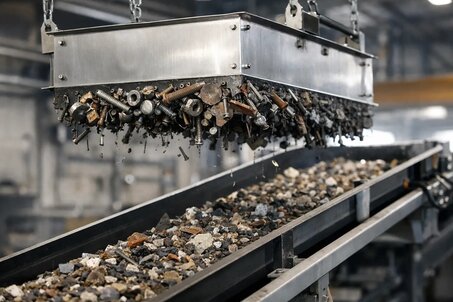
For conveyor systems, this is a proven solution for capturing metal particles from a moving material layer. The key factors are the installation height above the belt, layer thickness, and conveyor speed. If the separator is too high or the layer too thick, efficiency naturally decreases. In such cases, simply using a stronger magnet is not enough – the entire system configuration must be adjusted.
How to choose the right magnetic metal separator
In technical design, it is worth starting with the question of what exactly needs to be captured. There is a difference between coarse pieces of iron, fine metal dust, bearing wear, or randomly introduced maintenance parts. Each of these cases requires a different field intensity and contact surface.
Equally important is the nature of the processed material. Dry powder behaves differently than moist crushed material. Sticky or greasy mixtures can reduce separator performance because deposits build up on the magnetic surface and captured particles are harder to remove. For abrasive materials, the mechanical resistance of the device must also be evaluated.
Flow rate and real operating conditions are often underestimated. If a line is designed for a certain capacity, the separator must not create a bottleneck. The opposite problem also applies – an oversized solution is not automatically better if it cannot work efficiently with a thin material layer or is unnecessarily demanding to operate.
When selecting, it is therefore important to consider these parameters: type and size of metal contaminants, material type, flow rate, temperature, cleaning requirements, spatial constraints, and level of automation. If these inputs are neglected, the result is often a device that works on paper but does not deliver the expected performance in operation.
Manual or automatic cleaning
This decision has a direct impact on operation. Manually cleaned separators are simpler in design, more affordable, and make economic sense for lower loads. They are suitable where metal capture is occasional and access for operators is easy.
However, if the process runs continuously or the amount of captured contaminants is higher, automatic cleaning is usually the more rational choice. It reduces operator intervention, minimizes downtime, and maintains more stable separation performance. The disadvantage is a higher initial cost and more demanding integration into the line. In long-term operation, however, this difference is often offset by lower labor and maintenance costs.
Material, hygiene, and service practice
In many industries, it is not enough to focus only on magnetic strength. The design of the separator body, weld quality, surface finish, and safe cleanability are also critical. In applications involving food or pharmaceutical materials, this is a given, but it also matters in standard manufacturing. The simpler the maintenance, the lower the risk that cleaning will be postponed.
Service practice shows that separation efficiency does not decline only due to wear. A common issue is process changes without adapting the separator. Line capacity increases, material fractions change, or conveyor routes are modified, and the originally effective solution becomes insufficient. Therefore, it makes sense to regularly check separation points and reassess the design when process conditions change.
In more technically demanding operations, it is also advisable to verify the actual nature of captured particles. If wear debris appears regularly, it is not only a task for the separator but often a signal that a specific part of the technology requires maintenance.
Most common mistakes when implementing a separator
The first mistake is selecting based on price without understanding the application. A magnetic metal separator must match the material flow and type of contamination, otherwise it will only work partially. The second mistake is incorrect placement. Even a high-quality separator loses efficiency if it is outside the main flow or too far from the material.
The third mistake is neglected cleaning. Captured metal particles reduce the active surface and thus the performance of the device. For manual cleaning, a realistic service interval must be set, not just a formal plan. Finally, a common problem is expecting the magnet to solve everything. If non-ferromagnetic metals are present in the process, a multi-stage solution must be designed.
When technical design matters more than the product
Industrial metal separation may seem like a simple topic, but in practice, details determine the outcome. The difference between average and reliable results lies in the correct assessment of material, flow rate, line design, and maintenance capabilities. Therefore, the selection should involve not only the product itself but also technical consultation, design, and ongoing operational support.
This is exactly where the value of an experienced supplier becomes evident – one that does not just offer stock items, but understands what is really happening in the process. If the separator is meant to protect production and not just look good on a datasheet, it must be designed according to real operating conditions. That is the path where precision matters more than a quick estimate.