



















How powerful a magnet I need in practice
When you ask how strong a magnet you need, you are usually already dealing with a specific problem. The magnet is meant to hold a door, fix a fixture, capture a steel component, separate metal particles, or lift material in operation. The specific application matters more than the size of the magnet or the pulling force stated in the catalog.
The most common mistake in selection is simple – the customer looks only at the number stated for the magnet, for example 20 kg or 50 kg, and assumes they will get the same result in real use. In reality, this value is usually measured under ideal conditions. That means on smooth, clean, sufficiently thick steel, with full contact and detachment in a direction precisely defined by the manufacturer. A small air gap, thinner material, painted surface, or side load is enough for the real force to drop significantly.

How to determine how strong a magnet you need
In technical design, it’s not enough to know just the weight of the object. Material, contact surface shape, direction of force, and working environment all matter. A magnet for holding a sign is designed differently than a magnetic chuck for machining, and very differently from a separation magnet in a processing line.
The first step is always to define what the magnet should do. Should it simply hold an object in place, or resist shocks and vibrations? Should the part be easy to remove, or should fixation be as strong as possible? Will the magnet operate indoors, in humidity, at elevated temperatures, or in a dusty environment? Without this information, selection is guesswork rather than engineering.
The second step is to determine the type of load. Under direct pull (perpendicular to the contact surface), the magnet performs best. Under shear (sideways movement), the usable force drops significantly. This is critical for applications like doors, covers, panels, or mounting elements on steel structures.
The third step is to include a safety margin. In practice, magnets are not selected right at the limit. If reliability is required, a safety factor must be applied based on risk and operating conditions. For simple holding of light objects, a smaller margin may suffice. For handling, vibration, imperfect contact, or safety-critical applications, the margin must be higher.
What really affects magnet strength
Magnetic force is not just a property of the magnet itself. It is the result of the entire magnetic circuit. That’s why two magnets of the same size can behave completely differently in real applications.
Counter-material
Magnets work best with ferromagnetic materials, especially standard steel. If the counter surface is stainless steel, aluminum, plastic, wood, or composite, the magnetic attraction will be zero or negligible. Even stainless steels vary — not all are magnetic.
Thickness and quality of the contact surface
Thin sheet metal cannot carry magnetic flux as effectively as solid steel, resulting in lower holding force. Uneven, rusty, painted, or dirty surfaces have a similar effect. Even a very small air gap significantly reduces performance.
Magnet type and dimensions
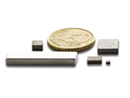
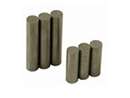
Neodymium magnets provide very high force at small sizes. Ferrite magnets are weaker but more economical and more resistant to certain operating conditions. SmCo magnets are used where temperature stability and resistance are critical. AlNiCo has its place in specific technical applications, but it is usually not the first choice for standard holding or clamping.
Temperature and environment
Higher temperatures can reduce magnet performance and, in extreme cases, cause permanent damage. This is especially true for neodymium magnets if the correct temperature grade is not selected. Humidity, chemical exposure, and mechanical stress affect the durability of the coating and the overall solution.
Catalog force is not real operating force
This is the most commonly misunderstood point. The stated holding force is typically a laboratory or standardized value. In real applications, multiple factors reduce it at the same time. If the magnet holds through paint (0.2 mm), foil, paper, or slightly uneven steel, the actual force can drop by tens of percent.
Under shear load, the difference is even greater. A magnet may have strong pull force, but if the object tends to slide, friction between the magnet and the surface becomes critical. That’s why rubber-coated magnetic systems, mechanical stops, or combined solutions are often used.
How to approach selection for common applications
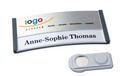
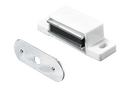
For light covers, doors, or display elements, magnets are often selected based on user comfort. If a cover needs to be opened easily, an overly strong magnet becomes a problem. The goal is not maximum force, but consistent and appropriate holding strength.
In mounting and fixing applications in manufacturing, stability is more important. The part must not move, but it must still be removable without damage. Here, a magnetic system in a steel housing is often effective, directing magnetic flux and increasing performance at the contact surface.
For metal particle separation, it’s not just about whether the magnet attracts something. Particle size, weight, distance, flow speed, and material type all matter. These solutions must be designed according to the process, not based on a single universal value.
For lifting and handling, maximum caution is required. You cannot rely on estimates or online comparisons. Lifting magnets and safety applications must consider material, thickness, contact area, shape, detachment forces, and required safety factor.
When a smaller magnet is enough — and when it isn’t
A smaller, stronger magnet is not always the best solution. Neodymium offers high force in compact size, but also increases the risk of sudden attraction, difficult handling, and damage to brittle magnet surfaces. In some cases, a larger magnet with a smoother force curve or a steel-housed system is better.
If you need to bridge a larger gap, simply increasing force may not help as expected. Magnetic force decreases rapidly with distance, so a different approach may be required.
SELOS Magnety
SELOS Magnety focuses not only on supplying magnets, but also on technical consulting. This is crucial where the magnet is not just a product, but a functional part of a system or process.
If you should take away one thing: the right question is not “what is the strongest magnet,” but “which magnet will reliably work in your real conditions.”