













How to choose a ferrite magnet without error
A ferrite magnet often looks like a simple component. In practice, however, its function is not determined only by whether it is round, square, or “strong enough”. If you are deciding how to choose a ferrite magnet for a specific application, the dimensions, magnetization direction, working gap, temperature, and the material to which the magnet is attached all matter. It is precisely in these details that the most common mistakes arise during design and purchase.
Ferrite is among the most widely used permanent magnetic materials. It is stable, corrosion-resistant, and suitable for a wide range of common and industrial applications. At the same time, however, it is not a universal answer to every requirement. If you expect very high holding force from a magnet at small dimensions, another material will often be more suitable. But if you need a cost-effective, long-term stable, and operationally reliable solution, ferrite is usually the right choice.
Tu je EN preklad 1:1, so zvýraznenými modrými časťami zo screenshotov:
How to Choose a Ferrite Magnet According to Use
The most reasonable starting point is not choosing the shape, but choosing the application. A different ferrite magnet is suitable for attaching doors, another for teaching aids, another for separation, or for a simple industrial fixture. Customers often start with the question “what magnet force do I need”, but the more correct question is: what should the magnet actually do, under what conditions, and with what reserve.
With contact attachment to a clean, flat, and sufficiently thick steel surface, the magnet achieves a significantly better result than when working through an air gap, paint, plastic, paper, or an uneven surface. Even a small gap noticeably reduces the effect. This is important especially where a specific holding force is expected according to catalog data, but in operation the magnet behaves more weakly.
It is also necessary to distinguish whether the magnet holds in the direction of pull-off, displacement, or shear. A magnet that holds an object during direct pull-off does not necessarily work equally well under side load or vibrations. In handling and production applications, it is therefore suitable to consider a safety reserve and not rely on limit values.
What Is More Important with a Ferrite Magnet Than “Force” Itself
Ferrite magnets have a lower energy density than neodymium magnets. However, this does not mean they are weak in an absolute sense. It means that, to achieve the same effect, they usually need a larger volume. If you have space in the application, ferrite can be a very good solution. If the space is limited to a minimum, it starts to become limiting.
The three most important parameters are dimensions, shape, and magnetization direction. A larger diameter or a larger contact surface may have greater importance in a specific application than the thickness itself. With disc and cylindrical magnets, it is usually decisive whether they are magnetized axially or diametrically. With blocks, it depends on which surfaces the poles are formed on and how the magnet will be oriented toward the counterpart.
In technical practice, the brittleness of the material is also often forgotten. Ferrite is hard, but at the same time relatively brittle. It is not suitable where impacts, mechanical shocks, or rough assembly are expected. If the magnet is inserted into a fixture or housing, tolerances must be taken into account, as well as ensuring that it is not stressed by splitting during assembly.
Shape and Dimensions: Disc, Block, Ring
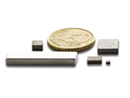
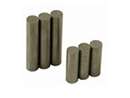
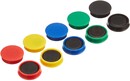
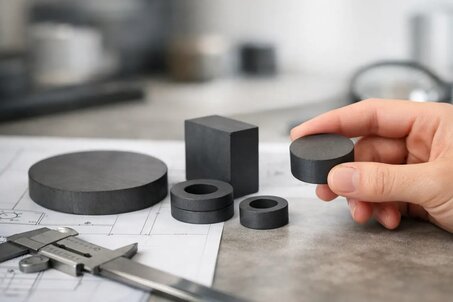
When considering how to choose a ferrite magnet, the shape is directly related to the function. Disc magnets are used where a circular contact surface and simple installation are advantageous. Blocks are practical for linear attachment, stops, fixtures, or mounting into grooves. Ring magnets make sense in applications with an axis, pin, or screw passage, or where a specific magnetic field geometry is needed.
The magnet size cannot be selected only according to what fits. A magnet that is too thin may have a sufficient diameter, but it will not achieve the required effect. Conversely, an unnecessarily thick magnet may not bring proportional improvement if the limiting factor is the contact surface or the quality of the steel counterpart. In practice, it is therefore worth evaluating the magnet as part of the entire magnetic circuit, not as a standalone piece of material.
If it is serial production or repeated assembly, it is reasonable to verify not only the nominal dimension, but also manufacturing tolerances. In more precise fits, tenths of a millimeter can be decisive. This applies especially to smaller magnets, where even a small deviation affects mounting clearance or pressure.
Temperature, Environment, and Service Life
Ferrite magnets have one significant operating advantage – they resist corrosion very well. Unlike some other magnetic materials, they do not require surface protection due to ordinary humidity. They are therefore also suitable for environments where metal coatings could degrade over time.
Temperature stability is also important. Ferrite withstands higher working temperatures than neodymium in its standard version, which is an advantage in mechanical engineering, electrical engineering, or near heat sources. However, this does not mean that temperature can be ignored. If the magnet operates close to limit values, it is necessary to monitor not only short-term peaks, but also the long-term thermal regime. Permanent overheating can worsen magnetic properties or reduce the reliability of the entire assembly.
In a dusty, vibrating, or mechanically stressed environment, it is also advisable to consider whether the magnet will be freely seated, glued, or mechanically secured. The material itself may be magnetically stable, but the whole assembly can fail because of the method of attachment.
Ferrite Magnet and Steel Counterpart
Many problems do not arise on the side of the magnet, but on the side of the material to which it is attached. A ferrite magnet works best with a ferromagnetic counterpart of sufficient thickness. If the steel sheet is too thin, part of the magnet’s potential is not used. Similarly, if the surface is dirty, coated with a thick layer of paint, or uneven, the holding force decreases.
In practice, this means that the same magnet may behave differently in two seemingly similar places. During design, it is necessary to know not only the magnet, but also the counterpart material, its thickness, flatness, and surface treatment. If this is underestimated, the impression arises that the magnet is weak, even though the problem is in the contact.
When higher holding force is required, the solution is often a magnetic system with a steel shell or a precisely designed circuit. A ferrite segment itself has its limits, but in the correct assembly it can work significantly more effectively than a free magnet without field guidance.
When Ferrite Is the Right Choice and When It Is Not
Ferrite makes sense where corrosion resistance, operating stability, a reasonable price-performance ratio, and not every millimeter of space being critical are important. Typical examples include common clamping, sensors, speakers, teaching aids, marking, simple mechanical fixtures, or selected industrial applications.
It is less suitable where very high force is needed at a small volume, minimum weight with maximum effect, or a very compact design. In such cases, comparison with neodymium is usually more suitable, or comparison with other magnetic materials according to temperature and operation.
The decision is therefore usually not about which material is “better”, but which one is more suitable for the specific task. A technically correct choice always comes from the conditions of the application, not from an isolated parameter in the catalog.
The Most Common Mistakes When Choosing a Ferrite Magnet
The first mistake is choosing only according to size without regard to magnetization direction. The second is expecting catalog holding force under real conditions with a gap, paint, or side load. The third is underestimating the mechanical brittleness of the material.
A common mistake also arises when materials are confused. The user knows they need a “magnet”, but no longer distinguishes whether ferrite, neodymium, or a magnetic system is suitable for their task. In technical practice, this is a fundamental difference. If the magnet also becomes part of a product, tolerances, repeatability, and mounting method are also important.
For more demanding applications, it is worth consulting the selection before ordering the first series. This saves time during testing as well as costs for reworking fixtures. At SELOS Magnety, we encounter this regularly – especially in assignments where the customer knows what they need to achieve, but is not sure about the suitable magnetic material or design solution.
How to Choose a Ferrite Magnet in Practice
If you want to choose the correct type, start with four questions: what should the magnet hold or affect, what material will it act on, what space do you have available, and under what conditions will it work long term. Only then should you address the specific shape and size.
In simple applications, it is often enough to verify the contact surface, counterpart thickness, and mounting limitations. In more technical assignments, the magnetic circuit, temperature, vibrations, and safety reserve also need to be assessed. This is where the difference between a quick estimate and a reliable solution becomes clear.
If the magnet is to work in operation without repeated adjustments, it is worth perceiving it as a technical component, not as a small accessory. A correctly selected ferrite magnet remains inconspicuous only as long as it works exactly as it should. And that is the best situation from both an industrial and operational point of view.