












How to choose a neodymium magnet without error
When a magnet appears to be a minor detail in a technical drawing, in real operation it often determines whether a fixture will function reliably or cause issues from day one. That is why choosing a neodymium magnet is not about selecting “the strongest piece available,” but about correctly matching size, shape, surface coating, operating temperature, and the specific application.
Neodymium magnets are among the strongest permanent magnets on the market. Even in a small volume, they can generate high holding force, which is an advantage in clamping, positioning, sensing, closing, and separation. At the same time, their strength can become a drawback in the wrong application. If a magnet is difficult to detach, cracks on impact, loses performance at elevated operating temperature, or corrodes in a humid environment, the issue is usually not the material itself, but the selection.

How to Choose a Neodymium Magnet Based on Application
The first step is simple—don’t choose a magnet based on intuition, but based on the application. A different type is suitable for cabinet doors, another for assembly fixtures, another for sensing technology, and a completely different one for separating metal particles in production. The key question is whether you need to attract an object, hold it in position, allow repeated detachment, or create a stable force at a specific distance.
In practice, holding force is often confused with real-world performance in an assembly. Catalog values are typically measured under ideal conditions—on contact with a thick, smooth, and clean steel plate. If there is paint, an air gap, surface irregularity, or thin sheet metal between the magnet and the steel, the resulting force drops significantly. That’s why you always need to base your choice on real mounting conditions, not just on a number in the product description.
For industrial applications, it’s also critical to consider dynamics. Static holding of a component on a workbench is a completely different scenario than vibrations, shocks, or repeated motion in automated equipment. A magnet that holds sufficiently at rest may fail under acceleration or lateral load.
Shape and Size Matter More Than the Material Itself
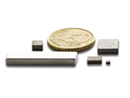
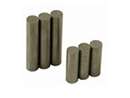
A neodymium magnet can come in the form of a cylinder, block, disc with a hole, ring, or a custom segment. Shape is not just about mounting—it directly affects the magnetic field, the mounting method, and mechanical durability.
Cylindrical magnets are suitable where a compact form factor and a good strength-to-volume ratio are required. Block magnets are often used in fixtures, closures, and linear applications. Rings and magnets with a hole make sense where mechanical fastening with a screw is needed, but it’s important to account for the fact that the hole alters the magnetic field distribution and reduces the effective active area.
Magnet size should not be selected based only on available space. A smaller magnet can deliver high force at direct contact, but even a small gap will significantly reduce its performance. On the other hand, a larger magnet is not always better if it complicates installation, increases the risk of damage, or unnecessarily raises costs. The right design is always a trade-off between force, space, cost, and safe handling.
Don’t Underestimate Magnet Thickness
Thickness is often overlooked, yet it has a major impact on how deep and stable the magnetic field is. A very thin magnet may “grab” well on contact, but quickly loses effectiveness even at a small فاصلة from the metal surface. If your application involves any gap at all, thickness cannot be treated as a secondary parameter.
Magnet Grade and Operating Temperature
Neodymium magnets are commonly labeled with grades such as N35, N42, or N52. This number relates to the material’s energy properties. A higher grade generally means higher magnetic potential at the same size. However, the highest grade is not automatically the best choice.
A critical parameter is operating temperature. Standard neodymium magnets have a limit beyond which they begin to irreversibly lose part of their magnetic properties. If the magnet is located near a motor, in a paint shop, near a furnace, inside a mold, or in any thermally stressed environment, it’s essential to select the appropriate temperature grade. An incorrect choice may not fail immediately—the magnet will work, but over time it will weaken, and the root cause can be difficult to identify.
This is where the difference between hobby use and engineering design becomes clear. In an office or workshop, force and size may be the main factors. In industrial environments, long-term stability is just as important.
Surface Coating Is Not Just Cosmetic
A neodymium magnet is made from NdFeB material, which is prone to corrosion. That’s why it is typically coated—most commonly with nickel. This provides protection under standard conditions, but it does not guarantee resistance to water, chemicals, or permanently humid environments.
If the magnet will be used outdoors, in washdown areas, in food processing, or in environments with condensation, protection must be addressed more carefully. In some cases, a different coating is sufficient; in others, it’s better to use a magnet housed in a protective enclosure or to choose a complete magnetic assembly. A strong magnet without structural protection may have a limited lifespan in demanding conditions.
Brittleness and Mounting Method
Neodymium magnets are strong, but also brittle. They are not structural components that can withstand impact, overtightening, or dropping onto a steel surface. When two strong magnets come into contact, chipping or complete fracture can occur. This is a common issue during installation when magnets are handled without proper fixtures or control.
If the magnet is bonded, the adhesive type, surface cleanliness, and load direction all matter. If it is mechanically fastened, care must be taken to avoid introducing local stress. For magnets with a hole, controlled tightening and proper support are essential. If the assembly needs to be serviceable and durable, it is often better to use a magnetic system in a steel housing, which protects the magnet and directs the magnetic flux where needed.
Design for Steel, Not for Air
A magnet behaves very differently in contact with ferromagnetic material than it does in free space. This is especially important in sensors, closures, display applications, and separation systems. When working against steel, a magnet can generate high holding force. When acting across a gap, plastic, wood, or another non-magnetic layer, its effectiveness changes rapidly.
That’s why it’s important to define what the magnet will act against. Thick steel, thin sheet metal, stainless steel, painted surfaces, or multi-layer combinations all lead to different results. Stainless steel is a special case—not all grades are magnetic, and this must be considered during design. The direction of force is also critical. Sliding along a surface requires significantly less force than pulling off perpendicularly.
A Common Selection Mistake
A customer selects a magnet rated at 20 kg holding force, installs it under a plastic cover, and expects the same performance. In reality, the effective force may be only a fraction—not because the specification is incorrect, but because the test conditions differ from the actual use case.
Standalone Magnet or Magnetic Assembly
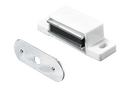
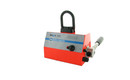
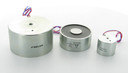
A standalone neodymium magnet is not always the best choice. If you need quick installation, higher durability, and predictable performance, a magnetic assembly is often a better solution. A steel housing increases efficiency in the desired direction and protects the magnet from mechanical damage.
This is beneficial for cabinet doors, fixtures, mounting boards, advertising panels, and industrial clamping. A standalone magnet makes sense when you are designing your own assembly and have full control over geometry, placement, and surrounding materials. However, if you need a reliable solution without trial and error, a magnetic system is usually the safer option.
Don’t Underestimate Safety
Strong neodymium magnets can pinch fingers, damage fragile components, and produce sharp fragments upon impact. With larger sizes, this becomes a real safety risk, not just a minor inconvenience. It’s also important to consider their effect on electronics, measuring equipment, sensors, and data carriers.
Handling multiple magnets at once requires special attention. They can attract each other uncontrollably, and improper separation can lead to damage very quickly. That’s why it’s important to address not only magnet selection, but also packaging, storage, and installation procedures.
When to Seek Consultation
If you’re choosing a magnet for simple tasks like holding notes or a light closure, basic parameters are usually sufficient. However, in technical applications, it is often more cost-effective to consult in advance than to later change the size, grade, or entire design. This is especially true for high temperatures, vibrations, serial production, and any application where failure leads to downtime or claims.
At SELOS Magnety, the same pattern appears repeatedly—customers don’t need the “strongest magnet,” but the one that will work reliably over time in a specific application. That’s the key difference.
A good selection doesn’t start with a catalog number, but with a clear definition of what the magnet is supposed to do, in what environment, and with what safety margin. Once these three factors are defined, choosing the right neodymium magnet becomes significantly more precise—and avoids costly trial and error.