




















Industrial Electromagnet guide
When an electromagnet in operation fails to hold, separate, or starts overheating, the problem is rarely caused by a single parameter. It is usually a combination of power supply, duty cycle, workpiece shape, air gap, and operating environment. That is exactly why a guide to industrial electromagnets makes the most sense for technicians, buyers, and designers who do not want to choose based only on a catalog name, but according to the real application.
An industrial electromagnet is not just a coil with a steel core. In practice, it is a functional part of a system that must work together with the power supply, control system, mechanics, and operational safety requirements. The difference between a solution that works reliably for years and one that causes downtime is usually the quality of the design itself.
Where Industrial Electromagnets Deliver the Greatest Benefits
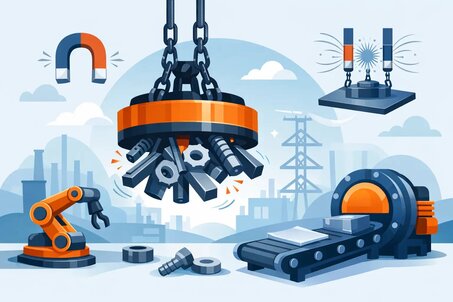
Electromagnets are used in industry wherever it is necessary to attract, hold, lift, release, or separate ferromagnetic material in a controlled way. Compared to permanent magnets, they offer one major advantage — the magnetic force is controllable. This is important in automation, dosing, part handling, mechanism locking, or in the separation of metal particles in technological processes.
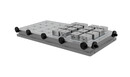
In handling technology, electromagnets are often used for lifting sheets, cut parts, profiles, and steel material. In manufacturing, electromagnetic chucks, locking elements, and controlled magnetic systems in feeders or sorting equipment are common. In recycling and metal separation, electromagnets are used where the material flow, fraction size, or cleaning requirements of the transported mixture change.
It is also important to say that an electromagnet is not automatically better than a permanent magnet. If the application requires continuous holding without energy consumption, a permanent solution may be more advantageous. However, if you need precise switching, fast release, or integration into an automated cycle, an electromagnet is usually the better choice.
Guide to Industrial Electromagnets by Function
When selecting a solution, the function is usually more important than the product name itself. In technical practice, electromagnets are primarily used for holding, lifting, clamping, motion control, and separation.
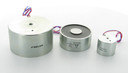
Holding electromagnets are designed for fixing doors, covers, mechanical parts, or technological positions. Here, the holding force at a specific contact surface is critical. The catalog value usually applies only under ideal conditions — smooth material, minimal air gap, and the correct force orientation. In real operation, the actual result may be significantly lower.
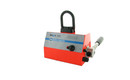
Lifting electromagnets operate under completely different conditions. Knowing the load weight alone is not enough. It is necessary to consider the material shape, surface, thickness, possible deformation, residual magnetism, and the release method during unloading. With sheet metal, the question is often whether one sheet or multiple sheets will be lifted at the same time.
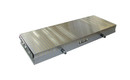
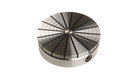
Clamping electromagnets are used in grinding, milling, measuring, or assembly operations. Here, not only force matters, but also flatness, magnetic field distribution, and thermal stability. In precision manufacturing, it is not enough for the part to hold. It must hold repeatedly and without deformation.
Separators and electromagnetic sorting elements form a separate category. Their performance is not evaluated only by force, but also by material throughput, particle size, conveyor layer thickness, and the required cleanliness of the output. This is a typical area where universal solutions usually do not work well.
Key Parameters That Determine the Correct Selection
The most common mistake in inquiries is narrowing the selection only to supply voltage and maximum force. That is not enough. An industrial electromagnet must be sized according to its actual operating conditions.
The first parameter is the duty cycle. An electromagnet may be designed for short activation, intermittent operation, or continuous duty. If a component designed for short pulses is used continuously, overheating becomes only a matter of time. On the other hand, an oversized solution may unnecessarily increase power consumption, dimensions, and cost.
The second parameter is the air gap. Magnetic force drops sharply even with a small distance between the core and the attracted material. Paint, scale, surface irregularities, dirt buildup, or mechanical inaccuracies can change system behavior more than it initially seems.
The third point is the material and geometry of the workpiece. Thin sheet metal, perforation, uneven profiles, or alloys with weaker magnetic response reduce efficiency. If the part is small and the contact area is limited, catalog values must be treated with caution.
The fourth area is power supply and control. Not every electromagnet behaves the same with AC and DC power supply. In automated lines, activation speed, release time, demagnetization after switching off, or the need for electronic power control are often important factors.
Finally, there is the environment. Dust, oil mist, moisture, high temperatures, vibrations, or outdoor installation significantly affect service life. Under such conditions, insulation quality, protection rating, surface treatment, and service accessibility become critical.
What to Consider When Designing an Application
A good design does not start with the question of which electromagnet to buy. It starts with the question of what exactly the system must do and under what conditions. Should the part only be held during movement? Should it self-center after activation? Must it remain safely held during a power failure? Or should it release immediately after switching off without residual adhesion?
These details determine whether a standard holding electromagnet, an electromagnetic chuck, a combined solution with mechanical locking, or another type of magnetic system should be used. In safety-critical applications, the response to power loss must also be considered. An electromagnet alone may not be suitable wherever a falling part could endanger operators or technology.
It is also worth designing with a reasonable safety margin. Too little reserve leads to instability under real operating conditions. Too much reserve can complicate release, increase heating, or overload the power supply system. Proper sizing is therefore always a compromise between force, cycle rate, temperature, space, and cost.
Operation, Maintenance, and Service
Even a high-quality electromagnet requires inspection. In industry, the condition of contact surfaces, cable outlets, and supply voltage under load is often underestimated. If the contact area is dirty or damaged, the holding force decreases. If the power supply fluctuates, the electromagnet may behave unpredictably.
In equipment operating continuously or under demanding conditions, regular inspection of temperature, insulation condition, and mechanical mounting is important. In separation systems, cleaning and buildup inspection are critical because deposits change the working gap and therefore the separation efficiency.
Service is not only about repairing failures. It is often about verifying whether the originally selected electromagnet still matches the current production conditions. Production changes over time — part dimensions, line speeds, and material characteristics evolve. What worked five years ago may no longer be optimal today. Technical consultation before replacing a component can therefore prevent repeated purchases and unnecessary downtime.
When Professional Consultation Is Worthwhile
For simple holding applications under standard conditions, the selection process is usually straightforward. However, in lifting, automation, clamping, and separation applications, far more variables are involved than a short catalog description can show. In such cases, it makes sense to work with a supplier who understands not only the product range, but also operational realities.
This is especially important when you need a combination of product supply, technical consulting, and long-term service support. For industrial companies, reliable operation within the production line is often more important than the initial purchase price of the component itself. That is why, with industrial electromagnets, it is worth evaluating the complete solution — from selection and commissioning to long-term maintenance. This is exactly where a supplier’s experience since 1991 has practical value rather than merely marketing value.
Industrial electromagnets can significantly simplify handling, clamping, and separation — but only when they are designed according to the real task. If you ask the right technical questions from the beginning, the electromagnet will not become the weak point of the technology, but a reliable part of its performance.