











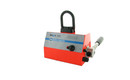







Industrial magnetic separators guide
Metal contamination in the material stream rarely causes problems right at the input. More often, it appears later at the press, crusher, conveyor, or during complaints about the final product. That is why a guide to industrial magnetic separators is particularly useful for operations that do not want to deal with consequences but with the root cause. Well-designed separation is not an add-on to technology. In many applications, it is the foundation of equipment protection, production quality, and process stability.
A magnetic separator may seem simple at first glance. In practice, what matters is what material you are separating, in what layer, at what speed, humidity, and from what conveying distance. The difference between a functional solution and a formally installed component lies precisely in these details.

What industrial magnetic separators do in practice
The role of a separator is to capture ferromagnetic particles from the material stream. These can include coarse pieces of iron, fine wear debris, chips, nuts, nails, wires, or metal dust. Depending on the application, this means protecting process equipment, reducing wear, improving product purity, or meeting internal quality standards.
They are most commonly used in food production, plastics, chemical mixtures, feed processing, wood processing, recycling, bulk material handling, and conveyor systems. However, each of these segments behaves differently. Fine flour behaves differently from crushed material. Dry granulate behaves differently from sticky sludge. That is why there is no universal separator for everything.
Guide to industrial magnetic separators by application type
When selecting a separator, it is more practical to think in terms of material flow rather than just device names. The key factor is whether the material falls freely, moves through pipelines, travels on a conveyor belt, or is processed in a liquid medium.
Separators for bulk and granular materials
In free-fall systems or pipeline systems, magnetic grates, rod magnets, and magnetic boxes are commonly used. Their advantage is the direct exposure of the material to the magnetic field. If the flow is uniform and the material layer is not too thick, they can very effectively capture even fine ferromagnetic contaminants.
However, maintenance is critical. In applications with a higher content of captured metal, easy cleaning must be ensured, otherwise efficiency gradually decreases. In such cases, automatically cleaned designs may be more suitable, especially in continuous operations where downtime is costly.
Overband and conveyor belt separators
When material is transported on a conveyor, suspended magnets or magnetic drums are most commonly used. A suspended separator removes ferromagnetic parts from the moving material layer, and its effectiveness depends on the suspension height, layer thickness, and belt speed. If the separator is installed too high or above a layer that is too thick, it will only capture part of the contamination.
A magnetic drum is suitable where continuous separation of metal from the material stream is required. This is typical in recycling or in sorting bulk mixtures. Its advantage is continuous operation, but the design must consider fraction size, line capacity, and the required output purity.
Separation in liquids and viscous media
In liquid systems, magnetic filters and rod assemblies inside pipelines are used. In these applications, the priority is fine separation of metallic wear particles that would otherwise circulate in the system and damage pumps, valves, or precision dosing components.
Here, it is particularly important to consider pressure conditions, medium viscosity, and hygiene requirements. What works for technical fluids may not be suitable for food or pharmaceutical production.
Permanent or electromagnetic separator
Most standard industrial applications can rely on a permanent magnetic system. It does not require power supply, has stable parameters, and offers low operating costs when properly designed. If correctly implemented, it provides a reliable long-term solution.
Electromagnetic separators make sense in applications involving greater conveying distances, thicker material layers, or demanding operating conditions. Their advantage is stronger magnetic fields and, in some cases, controllability. On the other hand, they require power supply, cooling, and more rigorous maintenance. Therefore, the decision is not only about performance but also about operating costs and service requirements.
What to focus on when selecting
The first parameter to consider is not the magnet type, but the material stream itself. Important factors include particle size, volume, bulk density, moisture, stickiness, temperature, and whether the material is fed in a single or multiple layers. It is also often overlooked what type of metal actually needs to be captured. A magnetic separator works reliably with ferromagnetic contaminants but is not suitable for non-magnetic metals such as aluminum, copper, or non-ferromagnetic stainless steel.
The second critical factor is installation location. A separator is most effective where the material is spread in the thinnest possible layer and positioned as close as possible to the active magnetic zone. In practice, operations often try to retrofit solutions into existing systems. This is possible, but not always without compromise. Sometimes it is better to adjust the material flow path or change the installation position rather than install a stronger separator in an unsuitable location.
The third area is service and cleaning. Captured metal must be safely and regularly removed. If cleaning is complicated, operators will delay it. The result is reduced efficiency and unnecessary risk to the process. Therefore, accessibility, cleaning frequency, and handling safety must be considered during the design phase.
Most common design mistakes
The first mistake is focusing only on declared magnetic force. A higher value does not automatically mean better performance. Geometry, distance from the material, flow speed, and the nature of captured particles are decisive.
The second mistake is underestimating the material layer thickness. The magnetic field acts over a certain distance, but its effect decreases significantly as distance increases. If the material layer is too thick, particles at the bottom may be captured while those at the top are not.
The third mistake is having unrealistic expectations in dirty or sticky environments. If buildup forms on active surfaces, the actual field effect and flow capacity change. In such applications, it is necessary to consider not only the magnet type but also surface design, protection, cleaning method, and inspection frequency.
When catalog selection is not enough
In simple applications, a standard separator is often the right and economical choice. In more demanding operations, however, critical details are not visible in catalogs. A typical example is the combination of high dust levels, limited space, the need for automatic cleaning, and continuous operation. In such cases, it is more reasonable to design a solution based on the specific process conditions.
This also applies when a separator is already installed but does not deliver expected results. The issue may not lie in the magnet itself. Often it is due to improper placement, changes in material flow after process adjustments, or poorly defined maintenance routines. In such cases, technical evaluation saves more than blindly replacing equipment.
How to think about return on investment
An industrial magnetic separator is not evaluated solely based on purchase price. Real ROI comes from reduced downtime, lower risk of machine damage, fewer rejects, and more stable output quality. In recycling operations, it also directly affects the purity of separated fractions and their market value.
A cheaper solution may be suitable for simple applications with low load. In demanding operations, however, it often leads to more frequent cleaning, faster clogging, or lower efficiency. In such cases, the economics change. A more expensive but properly designed separator may result in lower total cost of ownership.
Where technical consulting matters most
The greatest benefit comes when the type of separation is decided before final installation of the technology. This allows the separator to be designed as an integral part of the process rather than an added component. In practice, this means higher efficiency and fewer compromises in installation, service, and operation.
This is where cooperation with a technical supplier makes sense—one who understands not only the product range but also material behavior in real operation. SELOS Magnety has long-term experience in this field, and in industrial applications, the difference between selling a product and designing a functional solution is significant.