















Magnetic chucks and machining in practice
With thin-walled parts, ground surfaces or serial production, it is often not only the machine and the tool that are decisive, but also the method of clamping. This is exactly where magnetic chucks keep machining significantly under control - they can shorten preparation times, make more sides of the workpiece accessible and reduce deformations caused by mechanical clamping.
However, this does not mean that a magnet is always the right choice. With an incorrectly selected type of chuck, a small contact surface or an unsuitable machining technology, the result may be the opposite. That is why it makes sense to look at magnetic clamping not as a universal replacement for vises and fixtures, but as a precise tool for specific applications.
Where magnetic chucks make the most sense in machining
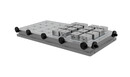
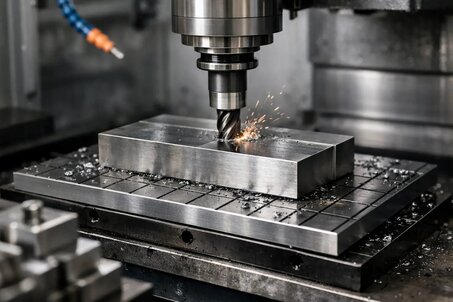
In practice, magnetic chucks prove themselves especially where it is necessary to clamp a ferromagnetic part quickly, repeatedly and without point mechanical pressure. A typical example is grinding, milling of flat components, machining of thinner burnouts, preparatory operations on toolmaking parts or finishing operations where parallelism and minimal deformation matter.
Their major advantage is free access to the surface of the workpiece. When the part is not held by vise jaws or mechanical stops from the upper side, the machining space is more open. This simplifies both operation programming and operator handling. In serial production, the benefit is also reflected in shorter downtime between individual pieces.
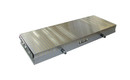
Magnetic clamping also has a stable place in surface grinding. Here, even distribution of the clamping force is essential because the workpiece must not lift or twist during material removal. With a correctly selected pole pitch and sufficient contact surface, a magnetic chuck can ensure very precise and repeatable conditions.
How magnetic clamping works in machining
From a technical point of view, it is about creating a magnetic circuit between the chuck and the workpiece. The clamping force does not depend only on the nominal value of the chuck, but on several variables - the material of the part, its thickness, the flatness of the contact surface, the quality of seating and how the magnetic flux closes through the workpiece.
This is why the same chuck holds a solid steel plate differently from a thin pressed part or a narrow strip. If the part is too thin, the magnetic flux does not close through it optimally and the real clamping force decreases. The same applies to an uneven, contaminated or partially relieved surface.
In practice, therefore, it is not enough to know only the dimensions of the magnetic plate. It is important to know what type of parts will be machined, what cutting forces enter the process and whether machining will take place dry, with emulsion or under higher thermal loads.
Permanent, electro-permanent and electromagnetic solutions
In the topic of magnetic chucks for machining, three principles are most often compared. Each has its place, and the differences between them are not only in price, but mainly in operation and safety.
Permanent magnetic chucks
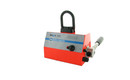
Permanent chucks work without continuous power supply. They are activated mechanically, while the magnetic field is created or redirected inside the system. Their advantage is simple operation, low maintenance and independence from electrical energy during machining. This is beneficial in workshops where reliability and stable operation without additional cabling are important.
The limitation is lower flexibility with very diverse parts and in applications where the clamping force needs to be controlled more finely or the system integrated into automation.
Electromagnetic chucks
Electromagnetic solutions require power supply during active clamping. Their advantage is simple control and the possibility of integrating them into the technological process. On the other hand, it is necessary to account for dependence on power supply, solve protection in the event of a power outage and consider heating during longer operation.
For some operations, this is fully acceptable; for others, it represents unnecessary operational risk. It depends on the character of production as well as safety requirements.
Electro-permanent chucks
Electro-permanent systems combine the advantages of both principles. They need a short electrical impulse to switch state, but after activation they hold the workpiece without continuous power supply. In modern machining workplaces, this is often a very interesting solution, especially where emphasis is placed on safety, repeatability and integration into automated processes.
Their use makes sense mainly in higher-performance production and in more demanding applications. For simple workshop use, however, such a system may not always be economically justified.
What the real clamping force depends on
The most common mistake when selecting a chuck is focusing only on the catalogue value of holding force. In real operation, the decisive factors are mainly the contact surface between the workpiece and the poles, the material thickness and the direction of the forces acting during machining.
If you are machining a low steel segment with a sufficient seating surface, the magnet will work effectively. However, if it is a thin or complex-shaped part with a small contact surface, it may be necessary to use technological pads, intermediate pieces or a special positioning method. It is equally important whether the cutting forces act mainly perpendicular to the plate or create a shifting moment that tries to move the part along the surface.
During milling, it is often the lateral component of force that is critical. A magnet holds very well in the direction of pull-off, but sliding load is a different discipline. That is why mechanical stops are added in many applications; they do not take over the main clamping force, but prevent the part from shifting during the cut.
When a magnetic chuck is better than a vise
Magnetic clamping has the upper hand wherever mechanical clamping would deform the part or unnecessarily limit tool access. With thin plates, flanges, knives, flat segments or when placing multiple smaller components on one surface, a magnet is often more efficient.
Speed is also an advantage. The operator does not have to repeatedly set jaws, support the part and check clamping pressure. In repeated series, this means not only time savings, but also less dependence of the result on the individual procedure of the worker.
However, a vise or mechanical fixture remains more suitable for non-ferromagnetic materials, spatially complex parts and operations with significant lateral cutting forces. Here, a magnet is simply not a universal answer.
What to watch out for when designing the application
Cleanliness of the contact surfaces is key. Even fine impurities, burrs or deposits of emulsion can worsen seating and thus reduce the efficiency of the magnetic circuit. The flatness of the workpiece base is equally important. If the part seats only partially, the assumed holding force and stability will not be achieved.
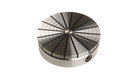
For smaller or irregular parts, pole configuration must be considered. Fine pole pitch is suitable for thinner and smaller workpieces, while coarser pole pitch works better with more massive parts. An incorrect choice will show either as weak holding or unused potential of the chuck.
Demagnetization after the operation is also important. In some production processes, residual magnetism does not cause problems; elsewhere, it can complicate measurement, chip handling or subsequent assembly. If this is relevant, it must be considered already when designing the workstation.
Magnetic chucks and machining of thin-walled parts
It is precisely with thin-walled components that the main benefit of magnetic clamping becomes clear. Mechanical jaws create local pressure that can pull or deform the part even before the operation begins. After the clamping is released, a deviation then appears that was not visible on the machine.
A magnetic chuck distributes the force more evenly over the surface. This does not mean that deformation cannot occur at all, but the risk is usually lower and the process more predictable. During grinding or lighter milling of thinner steel parts, it is often a more reliable solution than classic point clamping.
Here too, however, the specific part is decisive. If it is very thin, narrow or perforated, it may be necessary to add a support plate or auxiliary intermediate piece so that the magnetic flux closes correctly.
Selection is not only about the product, but about the application
In industrial deployment, it is not worth selecting a magnetic chuck only according to the size of the machine table. It is necessary to know the material of the parts, their minimum and maximum thickness, the character of machining, the required precision and the method of operation. The difference between a functional solution and problematic operation is often precisely in the details.
That is why technical consultation has real value. In practice, it often determines whether a permanent system, an electro-permanent solution or a combination of magnetic clamping with stops and auxiliary elements will be more suitable. An experienced supplier can also point out limits that are not obvious from the catalogue.
SELOS Magnety has long been involved in magnetic materials and industrial applications, so when selecting, it is possible to rely not only on the product range, but also on technical experience from real operation.
If magnetic clamping is to bring precision, speed and stability, it must be designed according to the specific process. Only then does the magnetic chuck become not just a machine accessory, but a full-fledged part of the machining technology.