













Magnetic film for advertising: what decides
An advertising carrier on a car, shelf, or metal panel often fails not because it is a bad idea, but because the wrong material was chosen. Magnetic advertising foil may seem simple, but in practice the details matter – thickness, surface, type of print, quality of the substrate, and method of use. If the advertisement is to hold reliably, remain readable, and be easily removable, it pays to choose based on technical criteria, not just price per meter.
Where magnetic advertising foil makes sense
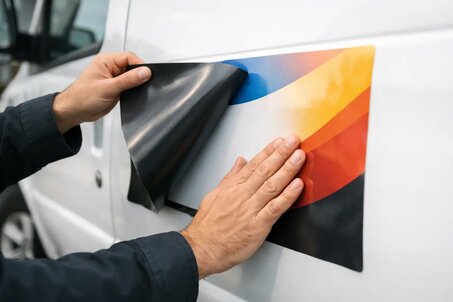
It is most commonly used for temporary or removable vehicle branding. A typical example is a company car that is used for business meetings during the week and for private purposes on weekends. Instead of a permanent wrap, a magnetic panel is used, which can be applied and removed without affecting the paint.
It is equally practical in exhibitions, retail, and warehouses. On metal surfaces, it allows quick changes of campaigns, prices, technical information, or navigation elements. Compared to adhesive solutions, the advantage is clear – the surface remains clean, the change is immediate, and the material can be reused multiple times.
However, it is not a universal solution for every surface. Magnetic foil works only on a ferromagnetic substrate, meaning steel or another magnetically conductive material. It will not adhere to aluminum, certain grades of stainless steel, plastic, or painted composites, even though they may look similar visually.
What it consists of and why it matters
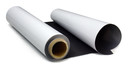
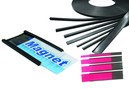
In advertising applications, people often focus only on size and graphics, but the key factor is the material construction itself. The base consists of a flexible magnetic layer that ensures adhesion to metal. On top of that, there is usually a surface suitable for printing, lamination, or mounting graphics.
The difference between individual foils lies mainly in magnetic strength, thickness, and surface stability. A thin foil may be cheaper and sufficient for indoor signage, but on a vehicle body at higher speeds, it may not provide the required safety margin. A thicker magnetic foil generally holds better, but it is stiffer, heavier, and not always necessary for smaller formats.
The top surface is also important. If the foil is to be printed, it must have good dimensional stability and flatness. With low-cost materials, warping, peeling of the graphic layer, or reduced adhesion may occur over time.
Vehicle advertising has different requirements than indoor signage
This is where most mistakes happen. A foil designed for a price tag in a shop may not be suitable for the door of a van. When a vehicle moves, the magnetic panel is exposed to air pressure, vibrations, temperature changes, water, and dirt. If the material is not designed for such conditions, problems will appear quickly.
For vehicles, not only the magnetic force matters, but also the contact area and the shape of the surface. Magnetic advertising works best on flat or only slightly curved metal surfaces. On pronounced embossings, edges, and areas with double curvature, the contact area is reduced, and so is the reliability of the attachment.
Another important factor is the paint. The surface must be clean, dry, and fully cured. Magnetic foil should not be used on freshly painted parts without consultation. If dust or moisture gets under the foil and the panel remains in one place for a long time, it may leave marks or cause local changes in the paint surface.
Thickness of the foil and operating speed
For static indoor use, a thinner material may be sufficient. For vehicle advertising, a thicker foil is usually safer, as it provides higher holding force and better shape stability. However, thicker is not always better. For smaller panels on slightly curved doors, material that is too stiff may reduce edge contact.
The result depends on the combination of size, application location, and usage conditions. A vehicle used mainly in the city has different requirements than a van regularly driven on highways.
How to choose magnetic advertising foil
If the result is to be reliable, it is not enough to choose the first available product. It is worth starting from the specific application. A different material is suitable for magnetic signs, another for interchangeable graphic panels, and another for vehicles.
First, it is important to determine what substrate the foil will be applied to, how often it will be removed, and whether it will be exposed to weather conditions. Then comes thickness and surface finishing. For advertising, print quality is also important, as magnetic foil often serves as a representative element of the brand, not just a carrier of text.
When selecting, it makes sense to focus on four key aspects: holding force, suitability for outdoor use, surface quality for graphics, and dimensional stability. If one of these is missing, the issue will show either during installation or after a few weeks of use.
Size is not just a graphic parameter
A larger area improves visibility but also increases demands on both material and application. A panel that is too large on a complex car body may not fit properly. For smaller formats, readability and graphic contrast become critical.
In practice, a smaller, well-fitted, and high-quality printed magnetic panel is often more effective than a large one that does not fully adhere. The advertising function depends as much on aesthetics as on technical reliability.
Most common usage mistakes
Many advertising applications fail due to maintenance, not production. Magnetic foil should be regularly removed, cleaned on both sides, and reapplied to a dry surface. This prevents the accumulation of moisture and dirt.
Applying the foil to a dirty or wet surface is also a mistake. It may appear to hold at first, but the contact will not be uniform. During driving, this increases the risk of edge lifting.
Another issue is storage. Magnetic panels should not be bent or tightly rolled in the opposite direction of their natural lay. Improper storage causes deformation and reduces contact quality with metal surfaces.
For vehicles, placement is often underestimated. The panel should not overlap trims, embossings, or sharp edges. Even a high-quality foil loses effectiveness if applied in the wrong place.
When magnetic foil is the right choice and when it is not
If you need to change advertising frequently, move it between vehicles, or use it occasionally, this is a very effective solution. The advantages are quick installation, no adhesive, and reusability. This is useful for service companies, sales teams, craftsmen, and event organizers.
However, if you need permanent vehicle branding for several years without handling, a traditional wrap may be more suitable. It adapts better to complex surfaces and creates a continuous visual result. Magnetic foil offers flexibility but comes with limitations in surface geometry and operating conditions.
Indoors, the situation is simpler. Magnetic advertising foil is often a very practical solution for shops, showrooms, schools, or production facilities where content changes regularly. The only requirement is that the surface must be magnetically conductive and reasonably flat.
A technical detail that affects the result
When selecting, it is worth checking the direction of magnetization and the quality of the magnetic compound. Low-cost materials may have weaker or inconsistent holding force across the surface. For a small sign, this may not matter, but for a larger panel on a vehicle, it does.
Thickness tolerance and surface uniformity are equally important. If the foil is used as a base for high-quality graphics, it must not have local irregularities that would become visible after printing or mounting. In technical practice, it is not only about whether the foil sticks, but also whether it delivers a stable and professional result over time.
This is why, for more demanding applications, it is worth consulting the specific use in advance. An experienced supplier can determine whether a thinner indoor foil, a stronger automotive-grade material, or a completely different solution is more suitable. In magnetic materials, the difference between a good and a poor choice often appears not at purchase, but during operation.
SELOS Magnety has long specialized not only in supplying magnetic materials but also in technical consulting. In advertising applications, choosing the right material saves time, costs, and unnecessary complaints.
If advertising is to work without compromise, magnetic foil should not be treated as a consumable accessory, but as a functional technical element. When the material, substrate, and method of use are aligned, the result is simple – the advertising holds where it should and can be removed when needed.