











Magnetic griper vs vacuum: what to choose
When a robotic cell handles burnouts, sheet metal or parts from a press, the choice of gripper determines cycle time, stability and downtime. When it comes to the question of magnetic gripper vs. vacuum gripper, this is not theory, but a very practical decision - what will work reliably with your material, speed and operating conditions.
In practice, these two principles are often compared too simplistically. A magnetic gripper is usually perceived as a solution for metal and a vacuum gripper as a universal option for everything else. However, this division is only the basis. The details are decisive - the surface of the part, its thickness, the presence of oil, perforation, weight, the required acceleration of the robot and also what should happen in the event of a power failure.
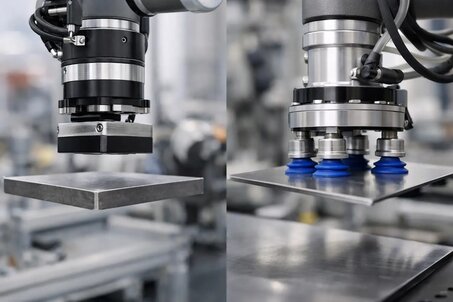
Magnetic gripper vs. vacuum gripper in practice
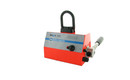
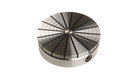
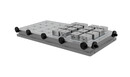
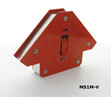
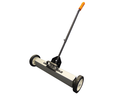
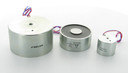
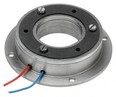
Magnetic gripper uses permanent magnets or an electromagnetic principle to hold ferromagnetic material. Typically, this includes steel sheets, pressed parts, semi-finished products, tubes or other parts that react to a magnetic field. The advantage is direct contact without the need for a perfectly sealing surface.
A vacuum gripper works in the opposite way. It is not concerned with the magnetic conductivity of the material, but with the ability to create negative pressure between the suction cup and the surface of the part. This means broader material use - from sheet metal through glass and plastic to cardboard or composites. At the same time, however, it is more sensitive to leaks, porosity and surface geometry.
If you are therefore looking for an answer to the question magnetic gripper vs. vacuum gripper, the first filter is simple. If you are handling a ferromagnetic part, magnetic gripping is a candidate. If not, the magnetic solution usually drops out and vacuum or another mechanical principle remains. But the selection does not end there.
When a magnetic gripper makes sense
A magnetic gripper is very strong where steel parts with repeatable geometry are handled. It has a significant advantage with thin sheets, which can deform when using vacuum, or with surfaces with holes, relief or grease, where the suction cup loses tightness. In pressing plants, during laser cutting, when loading sheets into machines or when removing pressed parts, a magnet is often the more stable solution.
Dynamics are also important. Magnetic gripping can be very fast, without waiting for negative pressure to build up in the system. This plays a role in short cycles and repeated handling. Lower sensitivity to minor dirt or an oil film on the surface is also an advantage.
However, it is not without limitations. A magnetic gripper needs material that is magnetically conductive. Stainless steel can be problematic depending on the specific material grade, while aluminium and non-ferrous metals are out of the game. Limits also become apparent with parts that have a very small contact surface, with air gaps or when there is a requirement for precise separation of one thin sheet from a stack. In such cases, several pieces may be lifted unintentionally at once if the system is not well designed.
Strengths of magnetic gripping
In the right application, a magnetic gripper brings high operational simplicity. There is no need for a vacuum circuit, suction cups, filters or leak management. This reduces the number of components that wear out and simplifies servicing.
Safety in the event of a power failure is also a major topic. Permanent magnetic systems can be designed to hold the part even without continuous power supply and release it only by a controlled pulse or mechanical switching. This is a fundamental difference compared to purely vacuum systems, where loss of negative pressure means an immediate decrease in holding force unless the system is supplemented with backup elements.
When a vacuum gripper is better
A vacuum gripper is the first choice where the material is not ferromagnetic or where a very diverse range of parts is handled. Glass, plastic mouldings, chipboard, packaging, films, cartons, aluminium parts or composite panels - these are all typical applications for vacuum gripping.
Its advantage is flexibility. A correctly selected number, diameter and material of suction cups makes it possible to grip parts of different sizes as well as more delicate surfaces. With fragile parts, vacuum can be gentler because it distributes forces across multiple points and does not introduce local magnetic action into the part.
Here too, however, theory and operation do not always match. A vacuum gripper is sensitive to porous materials, perforated surfaces, rough textures and heavily contaminated surfaces. Handling sheet metal covered with a thin oil layer can also be problematic if the suction cup does not have stable contact. During fast robot movements, it is necessary to take into account not only the weight of the part, but also the lateral forces during acceleration and braking.
Where vacuum reaches its limits
The most common problem is not the load capacity itself, but repeatability. One part is gripped without problems, while another with a slight surface deviation is not. In automation, this is a worse scenario than lower nominal force because it reduces the predictability of the process.
At the same time, a vacuum system depends on the quality of the distribution system, hose tightness, the condition of the suction cups and the function of the vacuum generator. If the operation does not have well-set maintenance, performance deteriorates over time subtly but continuously. The result is occasional dropping of parts or failures when removing them from a conveyor, which are difficult to diagnose because the problem is not always visible at first glance.
Comparison according to key criteria
If you are deciding between a magnetic and a vacuum gripper, it is important to look at the whole application, not only at the catalogue load capacity. The catalogue states ideal conditions. Real operation almost never has them.
With material, the decision is the clearest. A magnetic gripper belongs to steel and other ferromagnetic parts. A vacuum gripper is more suitable for mixed materials and non-ferromagnetic parts.
With the surface, the advantage is more often on the side of the magnet when oily, perforated or slightly uneven steel parts are involved. Vacuum, on the other hand, wins on smooth, flat and non-magnetic surfaces. In terms of energy, the answer is not completely straightforward. A permanent magnet can have very low consumption, especially if it needs energy only for switching. A vacuum system consumes energy continuously according to the type of generator and leaks in the system.
In maintenance, the magnetic solution is often simpler, but only if it is properly protected against mechanical damage and if the application does not require complex demagnetization or separation elements. A vacuum solution has more consumable parts. On the other hand, it can be easily modified by replacing suction cups and changing the layout of gripping points.
Safety and reliability are not the same
In technical practice, these two terms are often confused. A reliable solution is one that works repeatedly under real conditions. A safe solution is one that minimizes the risk of falling or damage even in the event of a failure. When handling parts above a work area or at higher weights, both must be addressed.
A magnetic gripper may have the advantage of holding without continuous power supply, but this does not automatically mean a safe application. The size of the air gap, material thickness, direction of forces and possible detachment during impact are decisive. A vacuum gripper can be safe if it is supplemented with a vacuum reservoir, sensors, double securing or mechanical support of the part. Without these elements, however, it is more vulnerable in critical applications.
That is why, during design, the question is not only whether the gripper can lift the part, but with what reserve, at what acceleration and in what failure mode. This is the difference between a functional prototype and a solution that will work reliably in production.
How to decide without unnecessary mistakes
The most practical procedure is to start with the part, not with the preferred technology. You are interested in the material, weight, thickness, surface, temperature, presence of oil, number of pieces per cycle and orientation of handling. Horizontal transfer of a burnout has different requirements than vertical removal from a stack, and loading a part into a CNC workplace has different requirements again.
If the part is steel, has a complicated surface and you require a fast cycle, a magnetic gripper is usually a very strong candidate. If the parts are made of different materials, have a smooth surface and you need greater versatility, the vacuum system usually leads. In some applications, a combination of both principles also makes sense, for example when the position of the part needs to be stabilized or when separation of a piece from a stack and subsequent precise placement must be solved.
In industrial practice, it is not worth relying only on estimation. It is reasonable to verify the gripping on a real part, not only according to a drawing. This is exactly where it becomes clear whether an edge reduces the sealing surface for the suction cup, whether the surface treatment changes magnetic efficiency or whether an oil film affects repeatability.
SELOS Magnety has long been involved in magnetic systems and technical consulting for industrial applications, and in exactly these types of decisions, the greatest value is often the correct assessment of the specific operation, not a general recommendation.
Magnetic gripper vs. vacuum gripper according to type of operation
In a pressing plant, cutting operation or when handling steel sheets, the magnetic solution is often operationally more reliable. In packaging, when working with board materials or with a diverse assortment, vacuum is usually more practical. In recycling or in dusty environments, it depends on whether the surface of the part allows the suction cup to seal and whether unwanted metal particles will accumulate on the magnet.
The correct answer, therefore, is not which principle is generally better. The correct question is which principle is better for the specific part, cycle time and failure mode. If you set this precisely at the beginning, the gripper will not be the weak point of the line, but its reliable component.