








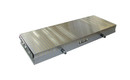
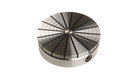
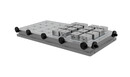





Magnetic table for grinding in practice
When grinding flat components, fractions of a millimeter and repeatability matter. If the workpiece moves, lifts, or does not hold evenly across the entire surface during clamping, the result quickly shows in surface quality, parallelism, and the time required to complete the operation. This is exactly where a magnetic grinding chuck has a clear role – it enables fast, stable, and repeatable clamping without mechanical jaws or unnecessary adjustments.
For workshops and production, this is not just about operator comfort. A properly selected chuck affects grinding accuracy, machine utilization, and work safety. At the same time, there is no single solution for all cases. The key factors are the material of the workpiece, its dimensions, thickness, shape, and the nature of the operation itself.
When a magnetic grinding chuck makes the most sense
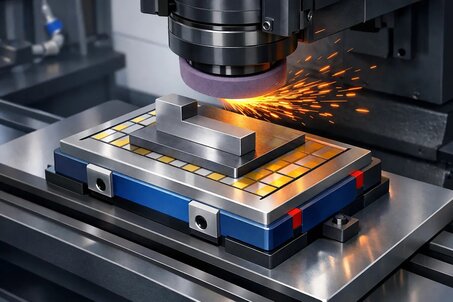
Magnetic clamping is best applied where you need to clamp a ferromagnetic workpiece across the entire contact surface while keeping the top side fully accessible for grinding. This is a key advantage compared to conventional mechanical clamping, which often takes up space, creates local stress, or complicates precise positioning of thinner parts.
In practice, this mainly includes grinding plates, flanges, backing plates, knives, strips, stampings, and precision machine components. The advantage is fast loading, easier handling, and good repeatability in serial production. If the operator clamps dozens of similar parts daily, the time difference is significant.
It is also important that the magnetic force acts across the surface. With properly selected pole configuration and sufficient contact area, the workpiece does not deform as it can with point-based mechanical tightening. This is especially important for thinner parts, where improper clamping can distort the final geometry even before the first grinding pass.
How a magnetic chuck works in grinding
From a technical standpoint, it is a clamping plate in which magnetic flux is generated and controlled. The flux passes through the working surface and closes through the workpiece. If the workpiece is made of a suitable ferromagnetic material and has sufficient contact area, a clamping force is created that holds it on the table during machining.
The difference between individual solutions lies mainly in how the magnetic field is generated and controlled. In practice, you will encounter permanent, electro-permanent, and electromagnetic systems. Each has its place.
A permanent magnetic chuck is mechanically simple, reliable, and does not require continuous power supply. This is an advantage in standard workshop environments where simple operation and low maintenance requirements are expected. An electromagnetic solution allows convenient control and, in some applications, very precise process adjustment, but it requires electrical power and appropriate safety measures. An electro-permanent system combines the advantages of both approaches but is usually more technically and financially demanding.
Permanent, electromagnetic, or electro-permanent type
In grinding, not only the activation method matters. The pole configuration of the working surface is also very important. For smaller and thinner parts, a fine-pole magnetic chuck is usually more suitable, as it distributes the magnetic flux better over a smaller area and improves holding of smaller workpieces. For larger components and more massive parts, a standard pole pitch may be more appropriate, providing sufficient holding force without unnecessary compromises.
If very thin parts are being ground, the selection must be considered carefully. The thinner the workpiece, the harder it is to reliably close the magnetic flux. The result may be weaker holding or local lifting. In such cases, pole extensions, technological spacers, or a change in the way multiple parts are arranged at once can help.
When selecting, it is therefore not enough to look only at the stated maximum clamping force. It is important, but by itself it does not indicate how the chuck will behave with a specific part, its thickness, and the grinding conditions.
What to focus on when selecting
The most common mistake is selecting based on table size without evaluating the real application. The chuck size must match the machine, but the type of workpieces, material, and working conditions are just as important.
The first parameter is the material of the component. A magnetic chuck is intended for ferromagnetic materials. For some stainless steels, cast irons, or heat-treated parts, behavior may vary depending on the specific composition. If the material is borderline, it is wise to verify clamping in advance.
The second parameter is workpiece thickness. Very thin parts behave differently from solid blocks. Often, a thin part with a large surface will hold better than a thick part with a small contact area, but this is not always the case. Flatness of the contact surface is also important. If the surface is uneven, dirty, or has burrs, clamping efficiency decreases.
The third area is the type of grinding. Fine finishing has different requirements than more aggressive material removal. If the process generates higher lateral forces or vibrations, sufficient clamping force reserve and proper workpiece positioning must be ensured.
The accuracy of the chuck surface itself is also critical. Parallelism, flatness, and surface quality are essential in grinding. If the result is to be a precise part, the base must be as accurate as the process itself.
Where problems arise in operation
Magnetic clamping is reliable, but not unconditional. Problems usually do not arise in the chuck itself, but in improper use. A very common issue is contamination of the working surface. Grinding sludge, fine dust, metal particles, or small burrs create a gap between the plate and the workpiece. This reduces the efficiency of the magnetic flux and the workpiece may not sit evenly.
Another mistake is relying solely on magnetic force without a mechanical stop where longitudinal movement is possible. The magnet holds the part toward the surface, but depending on the grinding forces and geometry, lateral forces may occur. Therefore, stops or support elements are sometimes used to improve stability.
Temperature effects are another factor. Grinding generates heat, and its impact depends on process intensity, cooling, and material. High temperatures can negatively affect accuracy and, in extreme cases, the magnetic system itself. Proper process setup is therefore essential.
Maintenance and service determine lifespan
Even a high-quality magnetic grinding chuck requires regular inspection. The base must be clean, without metal residue, sludge, or emulsion remnants. A damaged or neglected surface reduces both clamping efficiency and positioning accuracy.
It is also important to monitor the condition of the control mechanism, sealing, and overall plate geometry. In electromagnetic and electro-permanent systems, electrical components and control functions must also be checked. If reduced performance or uneven holding appears, it should not be handled improvisationally.
This is where the difference between simple sales and technical support becomes clear. In industrial use, it is important to have not only a product but also consultation, application assessment, and service. SELOS Magnety focuses on this long-term, which is a practical advantage when selecting specialized magnetic systems.
When a magnetic chuck is not the right choice
Magnetic clamping is not a universal solution. If you machine non-ferromagnetic materials, very small contact areas, complex shapes, or parts with a high risk of lateral movement, mechanical or hybrid clamping may be more suitable. Similarly, for some one-off jobs, investment in a specialized solution may not provide real operational benefit.
It is also important to distinguish between theoretical holding and stable repeatable production. Just because a workpiece sticks to the plate does not mean it will remain stable throughout the entire operation. In borderline cases, testing is better than relying on catalog values.
What a properly designed solution brings
If a magnetic chuck is selected correctly, the benefits are noticeable across multiple areas. Setup time is reduced, access to the grinding surface improves, repeatability increases, and in many cases surface quality improves. For production, this means fewer downtimes, less reliance on operator improvisation, and better process predictability.
The best result, however, does not come from catalog selection alone. It is always a combination of chuck type, part characteristics, grinding technology, and maintenance level. When these align, magnetic clamping is not just more convenient—it is more precise, stable, and economically efficient in the long term.
In grinding, many problems appear to be machine or tool issues, even though they originate in clamping. That is why a magnetic chuck should not be seen as an accessory, but as an active part of the technological result.