

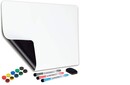







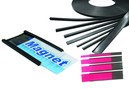








Magnetic tags for storage without chaos
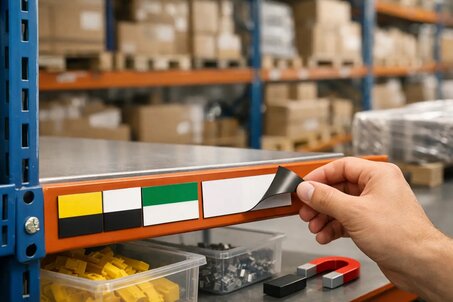
When positions, assortment, and stock levels change in a warehouse faster than shelf maps, fixed paper labeling starts to hinder rather than help. Magnetic labels for warehouses solve exactly this problem – they allow continuous changes in the identification of racks, boxes, metal shelves, or handling zones without glue, without residue, and without unnecessary downtime.
In warehouse labeling, it is not just about order. Proper labeling affects picking speed, error rates during replenishment, onboarding of new employees, and overall discipline in logistics. If labels cannot be easily updated, inaccurate data is often left in place. And that is where losses occur, which are not immediately visible.
Where magnetic warehouse labels bring the most value
They work best in environments where layout or assortment changes regularly. A typical example is a dynamic warehouse with position rearrangements based on turnover, seasonality, or order type. They are equally useful in production, where unfinished batches, material containers, storage spots, or temporary workstations need to be labeled.
Their advantage is simple – the label holds on a metal surface but can be moved without damage. On racks, metal cabinets, pallet racking, or handling carts, this is far more practical than adhesive labels. These tend to peel off over time, leave residue, or require time-consuming removal.
In office or lighter operational environments, they are often used for labeling drawers, archive systems, and planning boards. In an industrial warehouse, however, stricter requirements apply – material thickness, magnetic strength, readability, and resistance to daily handling all matter.
What determines the right choice
At first glance, all magnetic labels look similar, but differences show up quickly in real use. The first parameter is the base surface. For a standard indoor steel rack, a basic solution is usually sufficient. If the label is placed in a high-traffic area with vibration, contact with packaging, or frequent repositioning, it is worth choosing a more robust and dimensionally stable material.
The second factor is the labeling method. Some applications work well with handwritten labels, for example for temporary positions or short-term organization. Others require clean printed output, barcodes, or standardized internal labeling. In that case, the surface must support insert labels or high-quality printing.
The third aspect is label size. If it is too small, information gets lost and operators take longer to find the correct position. If it is too large, it takes up unnecessary space and reduces clarity. The size must match viewing distance, rack type, and the amount of information needed.
Magnetic warehouse labels and surface type
This is where most misunderstandings occur in practice. A magnetic label requires a ferromagnetic surface, typically steel. It will not attach by itself to aluminum, certain types of stainless steel, plastic, wood, or cardboard. If different materials are combined in a warehouse, this must be considered before ordering, otherwise a mixed and inconsistent labeling system will result.
The condition of the surface is equally important. Dusty, greasy, or uneven surfaces reduce adhesion. On thin sheet metal, magnetic force may be weaker than on thicker steel. If labels are used on doors, containers, or moving parts, it is necessary to check whether they shift during operation.
In some cases, it is useful to complement the system with metal carrier rails or magnetically active surfaces only where flexible labeling is required. This is especially relevant when modernizing older warehouses where not all elements allow direct magnetic attachment.
When they are better than adhesive labels
If labeling does not change for years, adhesive labels may be a cost-effective solution. However, when positions are frequently moved, item names change, new internal codes are introduced, or temporary zones are used, magnetic labeling is operationally more efficient.
The difference is not just convenience. With adhesive labels, layers of old and new labels accumulate, surfaces get damaged, and readability decreases. A magnetic label can simply be removed, updated, or repositioned. This shortens changeover time and reduces the risk of outdated information remaining in place.
In environments focused on 5S, visual management, and workplace organization, this is a strong advantage. The labeling system should support operations, not slow them down. Flexibility is the key reason magnetic solutions perform well in dynamic warehouses.
How to design a system that works long-term
A label alone does not solve the problem if it is not part of a structured system. First, define what information the label should contain. In some cases, a name and position are enough; in others, codes, EANs, internal numbers, batch data, or maximum quantities are needed. The more data on a label, the greater the pressure on readability and update discipline.
A good practice is to prioritize information. The most important data should be clearly visible at first glance. Additional information can be smaller but must remain readable. Color coding can help, but only if applied consistently. Without clear rules, it creates visual noise.
When designing the system, future changes must be considered. A warehouse with a few hundred items today may have double that in a year. Label format, placement, and update method should allow expansion without a complete redesign.
Durability in real operation
In office environments, magnetic labels are almost maintenance-free. In warehouses, they face wear. They come into contact with boxes, packaging, operators’ hands, cleaning agents, and humidity. That is why initial cost alone should not be the deciding factor. More important is how long the label remains readable and structurally stable.
If insert paper labels are used, they must be protected from dirt and damage. In environments with frequent changes, label replacement must be quick and tool-free. In more demanding operations, it is advisable to choose solutions that withstand repeated handling without edge deformation or weakening of the magnetic layer.
Temperature conditions also matter. A standard warehouse has different requirements than a cold storage or a facility near machinery. These details should be addressed during selection, not after installation.
Where mistakes are most common
The most common mistake is choosing based on price without considering real use. This often leads to insufficient magnetic strength, wrong dimensions, or surfaces unsuitable for writing or printing. Another issue is inconsistency – mixing magnetic labels, paper tags, and adhesive labels creates confusion.
Placement is also underestimated. Even a high-quality label loses value if hidden behind goods or placed too low. Labeling that is not updated consistently after changes also fails. In such cases, the issue is not the material, but the process.
It is also important to distinguish between temporary and permanent labeling. Not every location requires the same level of durability. A practical solution is often a combination of fixed labels for stable zones and flexible labels for dynamic areas.
When to consult a supplier
For smaller warehouses, selection is straightforward. In larger operations, more variables come into play – rack types, change frequency, printing requirements, visibility, and durability under operational load. In such cases, consulting a technically capable supplier is beneficial.
An experienced partner can identify limitations, recommend suitable sizes, and advise where standard products are sufficient and where customization is needed. In magnetic materials, real-world experience matters more than catalog specifications. That is why working with a specialist like SELOS Magnety is often the right approach.
Magnetic warehouse labeling is not complex, but it can significantly improve daily operations. When properly designed, it becomes almost invisible – because it works exactly as it should: quickly, cleanly, and without unnecessary corrections.