





















Magnetic tape selection guide
Magnetic tape can solve fastening, labeling, and temporary joining without drilling or complicated installation. That is why a guide to selecting magnetic tapes is useful not only for the hobby segment, but also for manufacturing, warehouses, advertising operations, and technical maintenance. The difference between a tape that works reliably and one that peels off after a few days or fails to hold the required object is often hidden in details that are not obvious at first glance when purchasing.
Magnetic tape is not a universal material for every application. In practice, the key factors are whether the tape will be used on a metal surface, whether it needs to be self-adhesive, how much weight it must hold, the environment in which it will operate, and whether it will be frequently removed and reapplied. If these conditions are overlooked, the problem is usually not the magnet itself, but the wrong type selection.
Guide to Choosing Magnetic Tapes by Application
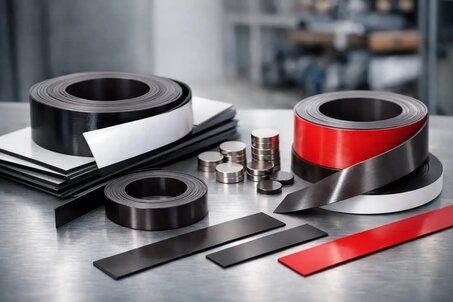
The first question should be simple – what exactly should the tape be used for? One product is suitable for attaching lightweight graphics, another for creating interchangeable labels in a warehouse, and another for technical fastening of covers or panels. Magnetic tape is a flexible material with ferrite magnetic powder embedded in a plastic carrier, so its advantages are adaptability, easy cutting, and quick application. On the other hand, it is important to understand that it does not have the properties of solid neodymium magnets and is not intended for heavy loads.
In advertising and exhibition applications, quick installation of graphics, panels, or smaller display elements is often the priority. Here, low thickness, clean adhesion, and the ability to remove the material without damaging the surface are important. In warehouses, offices, and manufacturing, the focus is often on shelf labeling, interchangeable markings, and workplace organization. In technical applications, holding force, adhesive type, and stability in temperature or dusty environments matter more.
If you only need to attach a lightweight object to a metal surface, a standard magnetic tape is usually sufficient. However, if the tape must create a connection between two non-magnetic parts, a combination of magnetic tape and an steel counterpart is often used, or a pair of tapes with opposite polarity. This is an important distinction because many customers expect two ordinary magnetic tapes to automatically attract each other strongly. In reality, it depends on the magnetization pattern and pole orientation.
Which Parameters Matter Most
When choosing magnetic tape, it is not enough to look only at width and price per meter. The final result depends on a combination of parameters that must be evaluated together.
Tape Thickness and Width
Tape thickness directly affects magnetic strength. In general, a thicker tape provides higher holding force, but it also takes up more space and may be less suitable for delicate or visually exposed applications. For thin advertising materials or paper labels, a slimmer profile is often more practical. For more technical use, choosing a greater thickness is usually reasonable if the design allows it.
Tape width affects the contact area. If you need greater stability or want to prevent the attached part from rotating, a wider tape usually performs better than a narrow one. However, one wide strip is not always necessary. In some cases, using two parallel strips is more precise, especially if you want to distribute the force along the edges of a component.
Magnetic Strength in Real Conditions
The catalog value for holding force is only indicative. It is measured under ideal conditions on a smooth, clean, and sufficiently thick steel surface. Real-world conditions are different. Painted sheet metal, uneven surfaces, gaps between the tape and metal, or thin substrates often reduce the resulting force much more than customers expect.
That is why it is sensible to work with a safety margin. If your calculation is close to the limit, it is better to choose a wider or thicker tape, or to test the application with a sample. This is especially important for vertical mounting, where not only pull-off force acts on the connection, but also sliding and vibration.
Adhesive Layer
Self-adhesive magnetic tape is very practical, but the adhesive is often the weakest part of the entire assembly. The magnet itself may hold sufficiently, but if it is applied to a greasy, dusty, or otherwise unsuitable surface, the failure will occur at the adhesive layer. It also matters whether the tape is applied to plastic, painted surfaces, wood, glass, foam materials, or cardboard.
For lightweight applications, a standard adhesive layer is usually enough. In more demanding conditions, the adhesive system, surface preparation, and curing time must be considered carefully. A common mistake is applying load immediately after installation. The adhesive needs time to achieve full strength.
Polarity and Magnetization
Not every magnetic tape is designed to connect with another tape. Some types are optimized for contact with a ferromagnetic surface, while others are manufactured as paired profiles. If the goal is closing, repeatable connection, or precise positioning of two parts, the polarity must be selected correctly.
This is especially important for doors, covers, interchangeable panels, or advertising strips. If the wrong combination is chosen, the tapes may repel each other or hold only weakly.
How to Choose Magnetic Tape Without Unnecessary Mistakes
The safest approach is to start with the surface and the load. First determine what the tape will be attached to or placed against. Then decide whether it is only a static label or a functional connection that will be opened, moved, or mechanically stressed.
For labeling shelves, boards, metal cabinets, or planning surfaces, ease of handling, the ability to cut the tape to size, and sufficient holding force for lightweight carriers are key factors. For installation and maintenance tasks, vibration, temperature, and long-term aging of the adhesive layer must also be considered. In these cases, choosing solely by the lowest price is usually a mistake. Real operating conditions matter more.
For larger formats, it is useful to consider whether the magnet should carry the entire component or only fix its position. If the tape must hold a larger panel or cover, the correct solution may sometimes be a combination of multiple strips, a steel counterpart, or a completely different magnetic system. Magnetic tape is an excellent helper, but not a replacement for a structural fastening method in every application.
When Magnetic Tape Is Suitable – and When It Is Not
Flexible magnetic tape has clear advantages. It is easy to cut, simple to store, quick to apply, and well suited where adaptability is important. In smaller workshops, schools, advertising studios, or offices, it is often the most practical solution.
Its limits appear under higher loads, with larger gaps from the substrate, or in demanding environments. If the application involves elevated temperatures, grease, frequent movement, or a requirement for precise and long-term fixation, the solution must be evaluated more carefully. In such cases, it is often worth consulting the suitability of the tape before ordering, because even a small parameter change can significantly affect the result.
Typical Selection Mistakes
The most common mistake is underestimating the weight and type of load. Customers see that an object is lightweight but fail to consider that forces act differently during vertical mounting, handling, or vibration than when the object rests statically on a horizontal surface.
The second common issue is an unsuitable surface. Magnetic tape performs best on smooth steel. On stainless steel, thin sheet metal, or surfaces with larger gaps, holding force may decrease significantly. The third problem is incorrect adhesive application – without degreasing, at low temperatures, or without sufficient pressure during bonding.
Guide to Choosing Magnetic Tapes for Companies and Smaller Operations
In professional environments, repeatability and predictable results are important. Buyers or technicians usually do not need just “some magnetic tape,” but a material that can be reliably used in serial production, maintenance, or a specific process. That is why it is worth evaluating not only dimensions, but also availability, manufacturing quality, and the possibility of obtaining technical recommendations for a specific application.
For smaller workshops, advertising studios, or schools, ease of processing and versatility are often more important. If the tape will be cut with scissors, reapplied to different surfaces, or used for marking, it matters how cleanly it cuts, whether it peels, and whether it keeps its shape.
This is where working with a specialized supplier becomes an advantage. A supplier who understands the difference between office use and technical operation can prevent many problems. SELOS Magnety has long specialized in magnetic materials and industrial solutions, so in unclear applications it makes sense to choose products according to the real application, not only by a catalog photo or basic product name.
If you ask the right questions during selection – what the tape should hold, on what surface, in what environment, and for how long – you will usually reach the correct solution quickly. Magnetic tape looks like a simple product only at first glance. When chosen precisely for its purpose, it works reliably and without unnecessary compromises.