














Magnetic tape to label shelves in practice
In a warehouse, the problem usually does not arise because the rack lacks space. The problem arises when the space is not labeled clearly, legibly, and in a way that allows immediate changes without glue, scraping, or downtime. This is exactly where magnetic tape for shelf labeling has practical value – it speeds up orientation, reduces picking errors, and makes every layout change easier.
When storage positions, product lines, or internal codes change, fixed adhesive labels quickly become a disadvantage. Replacing them is slow, they leave glue residue on metal racks, and over time they reduce workplace clarity. Magnetic labeling works differently. It stays where you need it, and when reorganization occurs, it can be moved within seconds.

Where magnetic tape for shelf labeling makes the most sense
It is most commonly used in warehouses, shipping areas, production, service workshops, and in retail or exhibition spaces with metal shelving. Anywhere you work with location addresses, internal codes, item names, stock levels, or temporary material sorting, it is a simple and functional solution.
The advantage is flexibility. A shelf can serve today for small fasteners, next month for a different product group, and during inventory for temporary zones. If the labeling is not permanently fixed, a change does not require any intervention in the shelf surface or the need to produce new plastic holders.
It also has its place outside the traditional warehouse. In offices and archives, it is used for labeling metal drawer systems, in schools or workshops for organizing tools, and in retail for flexible division of seasonal assortments. The key requirement is a ferromagnetic surface and the need for frequent changes.
How magnetic shelf labeling works
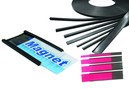
Magnetic tape or a magnetic label is attached directly to the metal surface of the shelf. At first glance, it is a simple element, but from an operational perspective it solves several problems at once. The labeling is movable, reusable, and, when the right material is chosen, clearly readable even in intensive use.
In practice, several variants are used. Some tapes serve as a base for handwritten descriptions using markers or chalk pens, while others function as a base for printed labels. The difference is not only in the method of labeling, but also in how quickly you can change the data and what level of durability you expect in daily handling.
If shelf contents change continuously during the week, a writable solution is usually the most practical. If you need a unified visual standard, barcodes, or precise location labeling, a combination of a magnetic base and a printed label works better. It is not a question of what is generally better, but what is more suitable for a specific operational setup.
How to choose the right tape
The first criterion is the surface. Magnetic tape for shelf labeling is primarily intended for metal shelves, cabinets, and drawer systems. If you have painted or powder-coated surfaces, this is usually not a problem, but the magnetic force must match the weight and size of the label. For longer strips or frequent contact with packaging, it is worth considering a safety margin.
The second criterion is width and format. A narrow tape is sufficient for a simple location code. However, if you need an item name, internal number, EAN, or multi-line description, a larger labeling area is necessary. Too small a format may be space-saving, but unreadable for operators. This is a common mistake in warehouse labeling design.
The third point is surface finish. A smooth white surface is suitable for printed labels and a clean visual appearance. A matte writable surface makes more sense where text is frequently rewritten. However, it is important to consider that with an unsuitable marker or poor maintenance, slight staining may remain over time. In technical practice, choosing a compatible labeling method from the beginning is essential.
Material thickness and the quality of the magnetic layer are also important. In light applications, a basic solution is sufficient, but in high-traffic warehouses, where boxes lean against shelves or operators frequently handle items near label edges, a more durable version is recommended. Cheap alternatives often fail not because of the magnet, but because of surface durability.
When magnetic tape is better than adhesive labels
Adhesive labels have their place, especially when labeling does not change over time. In fixed locations with low reorganization frequency, they may be sufficient. However, in a dynamic warehouse or production environment, conditions change quickly.
Magnetic solutions are more suitable where assortments, package sizes, layouts, or internal labeling systems change. Removing an old label does not require surface cleaning, and a new label does not have to be applied over residue from the previous one. This saves both time and the appearance of the workplace.
There is also a difference in maintenance. A metal shelf with magnetic labels can be cleaned and relabeled more easily during inventory, audits, or layout changes. On the other hand, if you use non-metal shelves, magnetic tape does not make sense without an additional ferromagnetic backing. Here as well, the suitability of the solution depends on real conditions, not the product itself.
What to consider for labeling and readability
A good tape alone will not create order. What matters is how the labeling system is designed. The text should be readable from a standard working distance, the font size adapted to placement height, and the labeling method consistent across the entire operation.
If different labeling styles, abbreviations, and label positions are combined, confusion arises even with high-quality material. In practice, a simple logic works best – consistent label width within one shelf row, a unified data format, and clearly defined placement. In fast picking environments, color coding of zones or material types can also help.
For handwritten labeling, it is advisable to check whether the chosen marker leaves residue and whether the text is resistant to abrasion. In dusty or greasy environments, it makes sense to use solutions with inserted printed labels or surfaces that can be regularly cleaned without damage.
Typical operational mistakes
The most common mistake is underestimating label size. On a screen, a warehouse code may look sufficient, but on a shelf in an aisle it may not. Another issue is an unsuitable combination of surface and marker. If text is hard to erase or smudges easily, operators will quickly create workarounds and the system becomes unreliable.
It is also common to use magnetic labeling on unsuitable surfaces, or on perforated or uneven shelf sections where there is insufficient contact area. The result is not a material failure, but incorrect application. That is why it is important to consider profile shape, label position, and handling method before ordering.
Operational load must also be considered. If boxes, carts, or operators’ hands frequently hit the labels, edge placement may not be ideal. A recessed or less exposed position works better, even at the cost of slightly reduced visibility. In such cases, it is not about a universal rule, but about balancing readability and durability.
When technical consultation pays off
For a small warehouse, selection is usually straightforward. However, if you are dealing with a large number of shelf positions, combinations of different widths, printed labels, or specific operating conditions, consultation has real value. It is not just about the tape itself, but how the system will perform after months of use.
In technical practice, it is effective to choose a solution based on change frequency, shelf type, and operator workflow. This is where the difference between standard office labeling and industrial-grade labeling becomes clear. That is why companies often choose suppliers who understand magnetic materials in detail and can recommend the right solution without unnecessary trial and error.
SELOS Magnety has long specialized in magnetic materials, and in these applications it is crucial that selection is based not only on dimensions, but also on real use. Well-designed labeling is not just a minor shelf accessory. It is a component that directly affects orientation, work speed, and operational discipline.
If labeling is to work long-term, it should be selected as carefully as the warehouse equipment itself. Magnetic tape is a small detail, but such details often determine whether a shelving system remains clear and efficient even after further reorganization.