



















Magnets for recycling lines in practice
In a recycling line, millimeters, material flow speed, and correctly positioned separators often make the difference. That is why magnets for recycling lines are not just auxiliary technology. When properly designed, they directly influence the purity of sorted material, the protection of shredders and conveyors, and the economics of the entire operation.
In practice, it is not only about whether the magnet captures ferrous metal. The type of processed waste, material layer height, belt width, conveyor speed, particle size, and the presence of moisture or sticky contaminants also matter. If these parameters are underestimated, the result is usually weaker separation, equipment clogging, or unnecessary service interventions.
Where magnets for recycling lines bring the greatest benefit
Recycling operations work with very different input materials. Municipal waste has different requirements than construction debris, wood chips, plastic mixtures, or metal scrap. Magnetic separation is therefore not designed universally, but according to the specific position within the technology.
Magnets are most commonly used before shredders and mills, where they protect equipment from damage caused by ferromagnetic objects. They are equally important after the crushing stage, where they separate released iron parts from already shredded material. At other points in the line, they help increase the purity of the resulting fraction, which is essential for further sale or technological processing.
With properly configured separation, the goal is not only a higher metal yield. Operational stability is also important. Fewer metallic impurities in the material flow mean lower wear of the technology, reduced risk of unplanned downtime, and more accurate sorting in subsequent stages.
Which solutions are most commonly used in recycling
The choice of equipment depends on whether it is necessary to capture large pieces of iron, fine particles, or separate metal from a thick and uneven layer of material. That is why several types of magnetic systems are used in recycling lines.
Overband magnetic separators
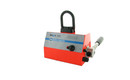
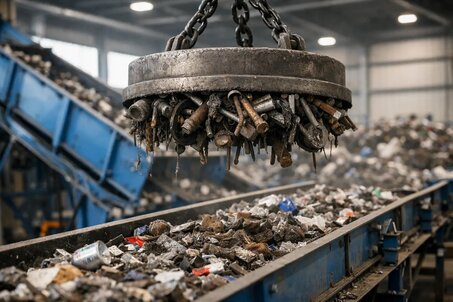
An overband magnet is one of the most common solutions. It is installed above a conveyor and captures ferromagnetic particles from moving material. It is suitable wherever continuous separation without operator intervention is required.
The cleaning method is important. In smaller or less demanding applications, a manually cleaned magnet may be sufficient. In most industrial operations, however, a self-cleaning overband separator is more suitable, automatically removing captured metal outside the main material flow. With higher line capacities, this is usually essential.
Magnetic drums
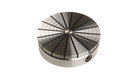
A magnetic drum is used where material falls through or is continuously fed into a technological unit. It is highly effective in separating ferromagnetic particles from granular or bulk materials. Its advantage is continuous operation and stable separation performance.
For drum systems, uniform material feed is critical. If the input is uncontrolled or subject to sudden overloads, separation efficiency may fluctuate. That is why a connected hopper or suitable dosing system is often required.
Magnetic plates, grids, and pipeline separators
These components are mainly used in more enclosed technological routes, transfer points, or pipeline systems. In recycling, they are especially useful where finer or already sorted fractions are processed and where smaller metallic impurities must be captured before the next processing stage.
They are not ideal for every coarse and heavily contaminated mixture. If the material is bulky, fibrous, or tends to bridge, it is necessary to choose equipment that will not clog and that allows easy cleaning.
How magnets for recycling lines are selected
The most common mistake is choosing based on dimensions or on the assumption that a stronger magnet automatically solves everything. Real efficiency depends on the entire application.
The first parameter is the nature of the material. Crushed construction waste with high bulk density behaves differently from a light plastic fraction with occasional iron contamination. Heavy materials require consideration of greater separation distance, while lighter materials may excessively stick to the magnet or create an uneven layer.
The next factor is the material layer height on the conveyor. If metallic particles are hidden deep inside the material, even a high-quality separator may capture only part of them. In such cases, adjusting the conveyor route, reducing layer height, or changing the installation point may help. It is often more effective to solve separation in several stages rather than expect maximum performance from a single device.
The size and shape of captured metals also matter. Large reinforcing bars, nails, sheet metal fragments, and fine filings represent completely different tasks. If the line must also capture small ferromagnetic particles, the magnetic field, distance, and construction design must be adapted accordingly.
Operating temperature, dust, and humidity are also important. In recycling, the challenge is not only the separation itself, but also the long-term durability of the equipment. The construction must withstand impacts, vibrations, and contaminated environments. That is why technical practice focuses not only on the magnetic core, but on the entire separator design.
Permanent magnet or electromagnet
This question appears regularly, and the answer is not universal. Permanent magnetic separators have the advantage that they do not require electrical power to generate the magnetic field. This reduces operating costs and simplifies installation. Under stable conditions, they are very reliable solutions.
Electromagnets make sense where large separation distances, higher material variability, or specific control requirements are needed. On the other hand, they require power supply, monitoring, and servicing. In dusty and mechanically demanding environments, regular maintenance must also be expected.
In practice, the decision is therefore not based only on performance, but on the overall operating conditions. In a well-designed line, a permanent separator may be the technically and economically better option. Elsewhere, an electromagnet may be the only reasonable choice.
Correct placement is often more important than paper specifications
Even high-quality equipment can deliver poor results if installed in the wrong position. Typical problems include excessive mounting height above the conveyor, an unsuitable conveyor angle, or fluctuating material layers. In such cases, the magnet operates outside its optimal distance and selectivity decreases.
For overband separators, it matters whether they are mounted transversely or longitudinally relative to material flow. Each solution has its place. Transverse mounting is usually suitable for wider belts and continuous metal discharge. Longitudinal mounting may help where better coverage of a specific flow is required or where dictated by line layout.
It is equally important to design sufficient space for removing captured metal. If the waste discharge route is not properly designed, separated material may fall back or complicate operator access to the equipment. This is a detail that may not seem critical on a drawing, but in operation it is decisive.
Service, cleaning, and real lifetime
In recycling operations, equipment is not judged only by purchase parameters, but by how it behaves after months and years of operation. A magnetic separator must be easy to clean, mechanically durable, and serviceable without long shutdowns.
With manually cleaned solutions, it is necessary to realistically evaluate whether operators will actually have the time and capacity for cleaning. If the line is heavily loaded, neglected cleaning quickly reduces separation efficiency. Self-cleaning systems have higher technical demands, but in many applications they provide more stable results.
Availability of service and technical support is also important. Industrial customers do not need only catalog parameters, but a partner able to evaluate the application, propose a suitable solution, and assist with commissioning. This is where the difference between ordinary component sales and a true technical supplier becomes clear. In Central European industrial conditions, this support is often decisive.
When one separator is not enough
For more demanding lines, multi-stage separation is worth considering. The first magnet captures larger iron pieces before crushing, the second cleans the output after grinding, and the third works with finer fractions before final sorting. Such a solution is technically more demanding, but with variable input materials it delivers better results than trying to solve everything with one device.
Similarly, magnetic separation does not solve all metals. If the operation also needs to separate non-ferrous metals, the magnetic stage is only part of a broader technological chain. That makes it even more important for the system to be precisely designed and coordinated with the other parts of the line.
At SELOS Magnety, a technical approach based on evaluating the specific material, installation point, and operating conditions has proven effective in such applications. In recycling, universal answers rarely work.
If a separator is expected to truly deliver performance on a line, it is not enough to look only at magnetic force. What also matters is how well it integrates into real operation, how much maintenance it will require, and whether it can reliably function with material that changes from shift to shift. That is where the difference arises between equipment that is merely installed and a solution that works in your favor over the long term.