




















Metal separation in recycling without losses
On a sorting line, it is often not only the performance of the crusher or the capacity of the conveyor that determines the result. What also matters is whether ferrous and non-ferrous metals can be separated from the rest of the material at the right moment and using the right technology. Metal separation in recycling has a direct impact on the purity of the output fraction, equipment wear, and the overall economics of the operation.
In practice, this is not a single operation but a sequence of steps that follow one another. The requirements differ for municipal waste processing, construction debris, wood waste, and entirely different for automotive or electronic waste. If the result is to be stable, it is not enough to simply install a magnet above the conveyor and assume the problem is solved. The properties of the material, particle size, layer thickness on the conveyor, moisture, conveying speed, and the actual metals present in the stream all play an important role.
Why metal separation in recycling is technically important
There are more reasons than just selling the separated metal. The first is protection of the technology. Pieces of iron in the material stream damage crushers, mills, blades, and other parts of the line. If ferromagnetic particles are captured in time, the risk of downtime and costly repairs is reduced.
The second reason is output quality. Recycling operations increasingly work with requirements for more precisely defined fractions. If output fuel, plastic regrind, wood chips, or mineral fractions are to be marketable, the content of metal impurities must remain under control. This also applies to further processing, where metal contamination reduces the quality of the final product.
The third factor is economics. Both ferromagnetic and non-ferrous metals have value. If they are separated cleanly and with minimal losses, the result is not just waste but a secondary raw material. The difference between average and well-designed separation is therefore reflected not only in laboratory parameters but also in the operating budget.
What metals are separated in recycling streams
From a technical perspective, the basic division is simple – ferromagnetic and non-ferrous metals. In practice, however, the situation is more complex.
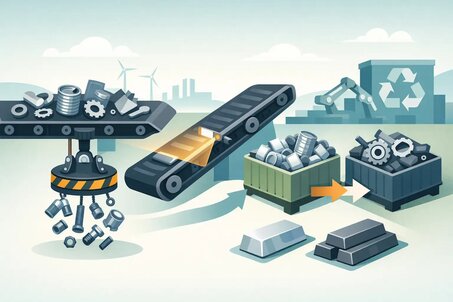
Ferromagnetic metals, especially iron and steel, are separated using permanent magnets or electromagnetic systems. These materials respond directly to a magnetic field, which is why their separation is usually the first and most effective step.
Non-ferrous metals such as aluminum, copper, brass, or zinc cannot be separated using a conventional magnet. In such cases, separation using eddy currents is applied. This technology utilizes the different physical behavior of conductive materials in a changing magnetic field. The result is the ejection of non-ferrous metals from the material stream into a separate fraction.
At the same time, complex items must also be considered. Multilayer packaging, cables, electronic waste, or composite parts contain combinations of plastic, rubber, and metal. In these cases, it is not enough to look only at the type of metal. What matters is the form in which it appears in the stream – whether it is a loose piece, fine chips, dust, wire, or metal firmly bonded with another material.
Basic technologies for metal separation in recycling
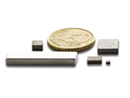
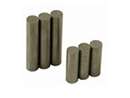
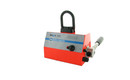
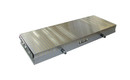
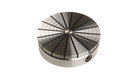
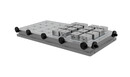
The process most often begins with magnetic separation of ferrous parts. Depending on the application, magnetic plates, overband magnets, magnetic drums, or bar and grid systems are used. The choice depends not only on the amount of metal but also on whether large pieces, fine particles, or metal from bulk and irregular materials need to be captured.
The overband magnet is suitable where material moves continuously along a conveyor and ferrous parts must be removed without interrupting the flow. A magnetic drum is used for separating metals from bulk mixtures where a stable and automated process is required. For finer or more sensitive applications, more precisely configured magnetic assemblies are used.
For non-ferrous metals, induced field separators (commonly known as eddy current separators) are used. These are particularly effective for aluminum packaging, non-ferrous metals from municipal waste, shredded cables, or fragments from automotive recycling. However, their efficiency strongly depends on the particle size and homogeneity of the input material. If the stream is too fine, wet, or unstable, the result is weaker.
In some operations, technologies are combined in multiple stages. Coarse iron is removed at the beginning of the line, fine ferromagnetic particles in the next stage, and non-ferrous metals only after size-based sorting of the fraction. Such arrangements are more investment-intensive, but at higher volumes or where clean output is required, they are often the only reasonable solution.
What determines separation efficiency
The most common mistake is underestimating input conditions. Even a high-quality separator will not perform well if the material layer on the belt is too thick or uneven. Magnetic fields and ejection effects have their limits. If the metal is buried deep in the layer or the material is flowing irregularly, some particles remain in the stream.
Particle size plays a major role. Large pieces of iron are captured differently than fine filings or steel dust. Similarly, aluminum cans behave differently from short pieces of copper wire. That is why it often makes sense to consider pre-sorting, screening, or stream conditioning before the actual separation.
Design details must not be neglected either. The position of the separator relative to the conveyor, the working distance, belt width, conveying speed, and the method of removing captured material all matter. Recycling environments are often dusty, humid, and mechanically demanding, so durability and ease of maintenance are also critical.
Separation efficiency cannot be judged only by whether the magnet captures something. What matters is how much metal remains in the output, what the losses of usable material are, and whether performance remains stable despite fluctuations in input material. A system that works well only under ideal conditions is not well designed in practice.
When a standard solution is sufficient and when a custom design is necessary
In simpler applications, such as removing ferrous contaminants from bulk material with predictable characteristics, a standard magnetic separator may be sufficient. This is especially true where the material flow is stable and the required output purity is not extreme.
However, if the operation processes variable waste, multiple fractions, or high volumes, a universal solution is usually not enough. The system design must consider the specific process, spatial constraints, integration with other equipment, and maintenance requirements. Service availability is also important, because a separator is not an isolated unit but part of a line that must operate daily without unnecessary downtime.
In practice, it often turns out that the problem is not the strength of the magnet itself, but incorrect positioning or an unsuitable type of equipment. A stronger magnet does not automatically mean better results. If the field geometry is incorrect or the unit is placed outside the optimal zone, efficiency will remain low regardless of declared parameters.
Operational trade-offs to consider
Higher separation efficiency usually means higher demands on investment, space, or maintenance. Multi-stage lines deliver better results but increase operational complexity. Automatic cleaning reduces manual intervention but requires proper setup and servicing.
Similarly, aggressively removing metal can in some cases increase losses of processed material. This is especially sensitive in light fractions, where part of the non-metal material may be unintentionally removed along with the metal. A good solution therefore seeks not only maximum metal recovery but an optimal balance between purity, performance, and losses.
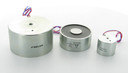
The choice between permanent magnets and electromagnets also depends on the application. Permanent solutions are stable, energy-efficient, and suitable for a wide range of operations. Electromagnets may be advantageous where larger distances, specific material flows, or active field control are required. However, this is not a universal rule. Without understanding the process, the correct choice cannot be made from a desk.
Where recycling practice is heading
Recycling lines are moving toward higher precision, not just higher volumes. This means greater pressure on combining technologies, better monitoring of output quality, and more precise adaptation of separation to specific materials. Magnetic technology remains a foundation because it solves the problem directly, reliably, and without unnecessary process complexity.
For operations aiming to reduce equipment wear, improve output purity, and stabilize processing economics, separation is not an add-on. It is a key part of the technology. That is why it makes sense to view it not as a catalog component but as a functional part of the entire line.
If metal separation in recycling is to work long-term and not just on a test sample, details of design, correct integration into the process, and operational discipline are what matter. That is where average solutions are separated from those that truly deliver results.