













NdFeB magnet guide
When deciding on the type of magnet for a fixture, closure system, or separation component, neodymium is often the first choice. This guide to neodymium magnets is intended for technicians, buyers, and smaller professional users who need to understand not only that a magnet “holds strongly,” but also why it succeeds in a specific application — or why it fails.
Neodymium magnets belong to the group of permanent magnets with very high energy density. In practice, this means they achieve significant holding force even at small dimensions. That is why they are used in fixtures, sensors, motors, closures, advertising applications, manufacturing, and automation. Their advantages are obvious, but it is equally important to understand their limits — especially temperature resistance, corrosion, brittleness, and proper integration into the application.

What makes neodymium magnets exceptional
Neodymium magnets are made from an alloy of neodymium, iron, and boron. Compared to ferrite magnets, they provide significantly higher magnetic performance at the same volume. This is crucial wherever space is limited or where high holding force is required in a compact solution.
However, their strength is not universal under all conditions. If the application operates in a humid environment, at higher temperatures, or with a risk of mechanical impacts, the holding force alone is not enough. In such cases, material quality, surface coating, dimensional tolerance, and the mounting method within the assembly become decisive.
In technical practice, a common mistake is comparing magnets only by diameter and height. The real behavior of a magnet is also influenced by the magnetization direction, the air gap between the magnet and the counterpart, the quality of the steel contact, and whether the magnet is used independently or within a magnetic circuit.
Guide to neodymium magnets by shape and application
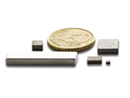
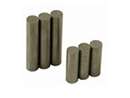
The shape of a magnet is not just a catalog detail, but a parameter that directly changes the function of the entire solution. Disc magnets are suitable where compact point pressure or mounting on a flat surface is required. Cylindrical types are often used in holes, fixtures, and precision assembly applications. Block magnets are suitable for larger contact surfaces and structural assemblies. Ring magnets make sense when mounted on a shaft, screw, or in assemblies with central guidance.
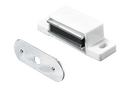
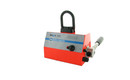
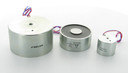
A separate category consists of magnetic components with countersunk holes, threads, or steel housings. These are intended more for operational use than for workshop experimentation. Mechanical mounting reduces the risk of damage while simplifying assembly. In addition, the steel housing directs the magnetic flux and increases holding force on the contact side.
When selecting a magnet, it is therefore not enough to answer the question, “How strong a magnet do I need?” A more accurate question is: what should the magnet do, on what material, at what gap, at what temperature, and how will it be integrated?
Disc, cylinder, block, or housing
If the goal is simply attaching a lightweight object to steel, a disc magnet is often sufficient. If the magnet needs to be embedded into a body or operate in a precise position, a cylinder is usually more suitable. Block magnets are chosen where contact area and stability are important. For operational solutions, however, a magnetic system in a steel housing is often the most practical because it handles manipulation and repeated loading better.
Surface coating and environmental resistance
Most neodymium magnets have a surface coating, most commonly nickel plating. The reason is simple — the material itself is prone to corrosion. If the coating is damaged and the magnet operates in a humid environment, it may degrade over time. This is a common problem when magnets are incorrectly used outdoors, in cold conditions with condensation, or in manufacturing environments with fluctuating humidity.
For more demanding conditions, other coatings are also available, such as epoxy finishes that provide better environmental resistance. However, even these do not solve everything. If the application is continuously wet, chemically aggressive, or mechanically abrasive, it is necessary to consider whether neodymium is the right choice or whether another magnetic material or enclosed magnetic system would be more suitable.
Brittleness is the second underestimated factor. A neodymium magnet is not a tough metal component. When two pieces snap together suddenly, they may crack or chip. In assembly, this means the need for stops, bonded seats, inserted housings, or controlled contact.
Temperature matters more than it seems
One of the most common causes of complaints or performance loss is operating temperature. Standard neodymium magnets have a limited operating temperature, and exceeding it leads to a reduction in magnetic properties. In some cases, part of the loss is reversible; in others, it results in permanent demagnetization.
The problem is that users often monitor only ambient temperature. The magnet itself may be locally heated by a motor, friction point, nearby component, paint-curing oven, or process cycle. If the device is exposed to temperature peaks, a safety margin is necessary. A higher temperature-grade magnet is technically a better solution, but not always economically necessary. It depends on exposure duration, magnet size, and the stability of the entire application.
When to choose a higher temperature grade
If the magnet operates in motors, sensors near heat sources, closures exposed to paint-curing processes, or industrial production with fluctuating temperatures, it is reasonable to verify the correct material grade. “Eyeball engineering” is often more expensive here than consultation before production.
How to correctly interpret holding force
The holding force specification is useful, but only under precisely defined conditions. It is typically measured under ideal contact between the magnet and a thick, flat, clean steel plate, along the pull-off axis and without any gap. Real operating conditions are often far from this.
If there is paint, plastic, paper, an air gap, or surface unevenness between the magnet and the counterpart, the force decreases significantly. It also drops under lateral loading, shear forces, and vibration. As a result, a magnet that performs excellently on a test plate may behave noticeably weaker in the finished product.
In design practice, it is therefore safer to work with a reserve and evaluate the type of loading involved. A magnet behaves differently under direct pull-off than under sliding, impacts, or cyclic separation. If the application involves safety-sensitive handling, a permanent magnet alone without additional securing elements may not be sufficient.
Mounting, bonding, and integration into assemblies
A neodymium magnet performs best when it is part of a well-designed assembly. During bonding, the correct adhesive type must be selected according to substrate material, temperature, and dynamic loading. The smooth nickel-plated surface may require preparation before bonding, and the seat design should minimize shear loading.
For mechanical mounting, it is advisable to avoid direct compression of the magnet with a screw or an inaccurate seat that creates point stress. If the component will be handled frequently, magnetic systems with steel housings are usually more suitable. They protect the magnet itself and improve repeatability in operation.
For serial applications, dimensional and material consistency are also important. Magnets with the same name may not behave identically when sourced from different suppliers. In products where repeatability matters, it is important to consider not only dimensions, but also grade, tolerance, coating, and magnetization direction.
Safety when handling neodymium magnets
Strong neodymium magnets require caution. Risks include pinched fingers, flying fragments during impact, and unwanted attraction of metal objects within the workspace. In workshops and manufacturing environments, it is also necessary to consider their effect on electronics, sensors, and certain measuring devices.
Special attention should be paid when handling larger pieces or groups of magnets. At that point, this is no longer an office accessory, but a component capable of damaging a part, fixture, or operator if handled carelessly. Protective equipment, safe distances, and proper storage are practical necessities when working with strong magnets.
When neodymium is not the best choice
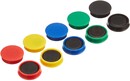
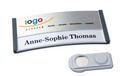
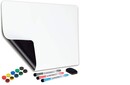
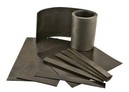
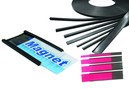
Although neodymium magnets are exceptionally powerful, they are not the answer to every requirement. At high temperatures, SmCo may be more suitable. In simpler and less demanding applications, ferrite is often the more economical solution. For flexible labeling, advertising surfaces, or presentation systems, magnetic foils and strips are usually better options.
It is important to view the application as a whole, not just the magnetic material itself. The right solution may sometimes mean a smaller magnet in a better-designed system, a different material, or a modified counterpart design.
In practice, it is worth consulting the selection whenever the magnet is not merely an accessory, but a functional part of a device. This is where the difference lies between buying a catalog item and implementing a solution that remains stable in operation. SELOS Magnety has specialized in this field since 1991 and can help even where parameters on paper do not yet tell the full story.
If a neodymium magnet must work reliably, do not start by asking which one is the strongest. Start with what exactly it must withstand in your application.