




















Office magnets on the board: how to choose
On a board, a sheet of paper, a note, or even a production plan holds only as reliably as the magnet itself. That is why office magnets for boards should not be chosen based only on color or price per pack. In practice, diameter, core material, backing thickness, and whether the magnet is used on a standard whiteboard, planning board, or a metal cabinet in production all matter.
For simple office use, selection is usually quick. However, if multi-page documents, laminated notices, or daily use in high-traffic environments are involved, the difference between a standard and a properly chosen solution becomes immediately visible. The magnet either holds firmly or shifts, falls, and unnecessarily complicates the work.

When office magnets for boards are truly suitable
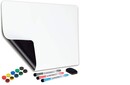
A magnetic board is one of the most practical information tools in offices, schools, warehouses, and workshops. It allows quick content changes without adhesives, without damaging the surface, and without waste. For this system to work, the magnet must match the real load.
For a single A4 sheet, a smaller magnet is often enough; for two or three sheets, higher holding force is needed. If you are dealing with glossy or laminated paper, keep in mind that the surface can reduce stability. Likewise, not every board has the same magnetic properties. A solid steel base behaves differently than thinner painted sheet metal.
That’s why in an office, it pays to treat a magnet not as a small consumable, but as a functional part of work organization. This is especially important where boards are used for shift planning, job tracking, visual management, or daily operations.
How to choose office magnets for boards
The key is a combination of three parameters – magnet size, magnetic material type, and grip shape. These determine whether handling is comfortable and whether the magnet performs well in both regular and intensive use.
Diameter and contact area
Smaller magnets look unobtrusive and save space on the board, but they have limits. If you need to hold multiple documents or thicker paper, a small diameter may not be enough. A larger magnet usually provides better contact area and greater stability, especially with frequent repositioning.
However, bigger is not always better. On densely filled planning boards, oversized magnets can cover important information. In such cases, it is better to choose a smaller size with a higher-quality magnetic core.
Magnet material
In office use, ferrite magnets are common due to their affordability and sufficient performance. If higher strength is required in a smaller size, a more powerful magnetic material may be beneficial. At the same time, the housing and overall durability must be considered.
A stronger magnet is not always an advantage without compromise. With small plastic grips, handling may become less comfortable, especially when removing the magnet from thin metal surfaces. The key is balancing strength and usability.
Shape and ergonomics
If magnets are used several times a day, shape matters more than it first appears. A flat magnet may hold well but is harder to remove. A magnet with a plastic head or grip is generally more comfortable, which is appreciated in offices, schools, and operations with frequent updates.
In production or warehouse environments, gloves are often used. More pronounced shapes work better there, allowing quick handling without prying with fingernails.
The difference between cheap and reliable solutions
The most common mistake is choosing based only on price. It may seem minor, but weaknesses of cheap magnets appear quickly in daily use. These include low holding force, poor plastic quality, cracking surfaces, or uneven construction that prevents full contact.
The result is always the same – documents fall, boards look messy, and staff deal with a trivial issue that should not exist. In administration, it is an inconvenience. In production environments, where boards carry instructions, deadlines, or safety information, it becomes a real operational problem.
A reliable magnet does not have to be the most expensive. It should offer consistent quality, stable magnetic strength, and a surface that lasts longer than a few weeks of intensive use. This is where it makes sense to buy from a specialist who understands the products technically, not just commercially.
Where they are most commonly used
Office magnets for boards have broader use than the category name suggests. In administration, they are used to hold notices, schedules, organizational charts, and task overviews. In schools, they support teaching, planning, and quick visualization. In smaller operations and workshops, they serve as a simple visual management tool.
They are also very practical in warehouses and service areas, where internal instructions, ID cards, or temporary labels are attached to metal surfaces. In such cases, it is important to verify whether the surface has sufficient ferromagnetic response. Not every painted or stainless surface is suitable.
If magnets are used outside standard boards, it is worth testing the specific combination of magnet and surface. Differences in the base material are often the real cause of dissatisfaction.
Color, design, and clarity
In a business environment, color is not just aesthetic. Colored magnets help organize information by department, priority, job status, or deadlines. Visual order improves orientation and reduces errors.
If the board is part of daily team management, color coding has practical value. Red can indicate critical tasks, blue planned activities, green completed steps. This works only if magnets are consistent in size and readable from a distance.
In formal meeting rooms, a neutral design and limited colors are usually preferred. Again, selection depends on purpose, not general rules.
What to consider when buying in bulk
When purchasing for a company, school, or operation, it is important to think systemically. It’s not just about how many magnets you need today, but whether you can maintain consistent quality and size over time.
Using a unified type across workplaces simplifies replenishment, reduces chaos, and maintains visual consistency. For larger orders, durability and availability also matter.
For companies that require consistent quality and fast delivery, working with a specialist supplier is an advantage. SELOS Magnety builds on long-term expertise in magnetic materials, which makes a difference even in seemingly simple products.
Common mistakes in use
Many problems arise not from poor products, but from wrong expectations. For example, expecting a small decorative magnet to hold multiple sheets on a thin board. Or using office magnets in environments with vibration, airflow, or frequent movement of metal surfaces, where higher holding force is needed.
Another mistake is mixing different magnet types without a system. The board becomes inconsistent, and users cannot judge which magnet is suitable for which purpose. In busy environments, it helps to define simple rules for usage.
Maintenance of the surface is also important. Dust, grease, or damaged surfaces reduce magnetic contact and effectiveness.
When a standard office magnet is not enough
There are situations where standard office magnets are not sufficient. If you need to hold heavier drawings, plastic pockets, thicker labels, or use magnets in demanding environments, a stronger or specialized type is necessary.
This is where the difference between general sales and expert advice becomes clear. The right solution is not always just a stronger magnet. Sometimes a larger diameter, different shape, plastic housing, or an entirely different magnetic system is more appropriate.
If you are choosing office magnets for a place where information changes daily and must hold without compromise, it is better to decide based on use rather than habit. A good magnet is an unobtrusive tool – and that is exactly why it should work without needing your attention every day.