



















Permanent magnet versus electromagnet
If you are dealing with clamping, separation, handling, or position sensing, the question of permanent magnet versus electromagnet is not textbook theory. It is a practical decision that affects energy consumption, operational safety, maintenance requirements, and the overall behavior of the equipment in a real application.
Both principles work with a magnetic field, but each in a different way. A permanent magnet creates a field without external power. An electromagnet requires electric current, and its magnetic effect is generated only when energy is supplied to the coil. At first glance, this seems like a simple difference, but in practice it determines whether the solution will be stable, controllable, safe during power failure, or suitable for continuous operation.

Permanent Magnet versus Electromagnet in Practice
A permanent magnet is a passive source of a magnetic field. Once manufactured and magnetized, it retains its properties over the long term without the need for power supply. This is a major advantage wherever simple construction, low energy consumption, and reliable operation without electrical components are required.
An electromagnet, on the other hand, is an active element. Its advantage is that the magnetic field can be switched on, switched off, and in many cases also regulated. This is essential in automation, dosing, sorting, or handling applications where you need not only to capture an object, but also to release it in a controlled manner.
When deciding between the two, the question is not simply which magnet is stronger. More important is how the system is expected to behave throughout the entire operating cycle.
How a Permanent Magnet Works
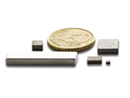
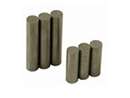
A permanent magnet is made from a material that retains the alignment of its magnetic domains after magnetization. In practice, the most commonly used are ferrite magnets, neodymium magnets, samarium-cobalt magnets, and AlNiCo magnets. Each material has different properties in terms of remanence, coercivity, temperature resistance, and cost.
Ferrite is economical and corrosion-resistant, but has lower magnetic energy. Neodymium provides very high force in compact dimensions, but it is sensitive to temperature and in some versions also requires surface protection. SmCo is stable at higher temperatures and in demanding environments, but it is more expensive. AlNiCo has specific uses where thermal characteristics and shape flexibility are important.
The result is a permanently active magnetic field. This is an advantage in separation systems, passive holding applications, and door or mounting systems. At the same time, it is also a limitation, because the magnet cannot simply be switched off.
Where Permanent Magnets Make the Most Sense
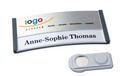
They work best where a long-term and continuously active magnetic field is needed without electrical power consumption. Typical applications include magnetic separators, holding systems, sensors, magnetic closures, mounting fixtures, office and presentation applications, or compact technical solutions in limited spaces.
In industrial applications, operational simplicity is also important. If the system does not need electrical control, there is no need for wiring, power supplies, switching systems, or part of the service intervention. This can significantly reduce failure rates and operating costs.
How an Electromagnet Works
An electromagnet creates a magnetic field only when electric current flows through the coil. The field strength depends on the coil design, core, power supply, duty cycle, and temperature conditions. In this area, the electromagnet is significantly more flexible than a permanent magnet.
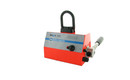
If magnetic force is needed only at a specific moment, an electromagnet is often the right choice. In automated production lines, sorting systems, dispensers, valves, relays, lifting equipment, or electromagnetic chucks, the ability to switch the magnetic effect on and off is essential. The device grips the part at the exact required moment and releases it precisely when needed.
However, this advantage comes at a cost. An electromagnet requires power supply, generates heat, and its operation must respect the duty cycle. Incorrect sizing can lead to overheating, reduced performance, or shortened service life.
Where Electromagnets Outperform Permanent Solutions
Electromagnets are suitable wherever you need to control the strength or timing of the magnetic field. In manufacturing automation, robotic manipulators, locking mechanisms, lifting systems, and applications with frequent release cycles, they are often more practical than permanently active magnets.
Another strong advantage is integration into control systems. An electromagnet can become part of machine logic, safety circuits, or process control. This cannot be achieved with a permanent magnet without additional mechanical systems.
Main Differences: Force, Control, Energy, Safety
When comparing permanent magnet versus electromagnet, four key areas are usually considered.
The first is energy consumption. A permanent magnet does not require energy to create a magnetic field. An electromagnet requires power continuously or at least during activation. In continuous operation, the difference in energy consumption can be significant.
The second is controllability. A permanent magnet essentially has a fixed magnetic field, which can only be influenced through magnetic circuit design, distance, or shielding. An electromagnet can be switched and often regulated by changing the current.
The third is safety during power failure. This depends on the specific application. If the object must remain held even without power, the permanent magnet has a natural advantage. If, on the contrary, the system must automatically release or switch to a defined state during a power outage, the electromagnet may be more suitable — but only if properly designed.
The fourth is thermal and operational stability. Permanent magnets can lose part of their magnetization if a critical temperature is exceeded, sometimes permanently. Electromagnets, on the other hand, suffer from coil heating and reduced efficiency under long-term load. That is why the real operating cycle is always more important than catalog specifications alone.
When the Environment Matters More Than the Principle
In many applications, the decision is influenced not only by whether the system uses a permanent magnet or an electromagnet, but also by the environment in which it operates. High temperatures, humidity, vibrations, dust, chemical exposure, or limited installation space can significantly affect the selection.
For example, in recycling and separation operations, operational simplicity, low maintenance, and continuous functionality are often critical. In such cases, permanent magnetic separation systems work very well. On the other hand, in automated manipulators where parts must be repeatedly gripped and released at precise moments, the electromagnetic principle is often the more logical choice.
The size of the air gap also plays a major role. The greater the distance between the magnet and the ferromagnetic object, the harder it becomes to achieve the required holding force. In these situations, it is not enough to look only at the nominal holding force, but at the entire magnetic circuit, including the surface, part geometry, and contact area.
It Is Not Always Either-Or
In technical practice, combined solutions are often used. A permanent magnet provides the basic holding force, while an electromagnet is used for demagnetization, pulse release, or state switching. Such systems are interesting where you want to reduce energy consumption while still requiring controlled operation.
Some magnetic chucks and specialized handling systems work in a similar way. The principle should therefore never be evaluated in isolation. The overall functional objective of the application, operating cycle, required safety level, and service accessibility are what truly matter.
How to Choose the Right Solution
If the magnet must hold continuously without power supply and with minimal maintenance, a permanent magnet is usually the more efficient choice. If it must be part of a controlled process where the force or state changes according to signals, an electromagnet makes more sense.
When selecting a solution, it is worth evaluating especially the material of the handled object, the required force across the actual air gap, temperature, switching frequency, available power supply, safety requirements, and what should happen during a fault or power failure. The most common mistake is selecting based on laboratory values instead of real operating conditions.
That is why technical consulting in magnetic applications has real value. The difference between a functional and problematic solution often lies not in the product itself, but in the proper magnetic circuit design, material selection, and understanding of the actual operating cycle. This is where the difference between ordinary sales and a professional engineering approach becomes clear — an approach companies like SELOS Magnety have focused on for years.
If you look at the question of permanent magnet versus electromagnet through the lens of real operation rather than just a catalog, the answer becomes much more precise. The right magnetic principle does not begin with the product itself, but with what the equipment must reliably do every single day.