

















Service of magnetic chucks without downtime
A magnetic chuck often starts signaling a problem before production comes to a complete stop. The workpiece no longer holds as it did before, switching becomes more difficult, unevenness appears on the working surface, or clamping repeatability deteriorates. This is exactly when servicing magnetic chucks makes the most sense – not only after a failure, but at the moment when the device still operates, yet no longer works in optimal condition.
In practice, we still encounter the perception that a magnetic chuck is an almost maintenance-free component. This is only partly true. A high-quality permanent or electro-permanent system has a long service life, but with daily exposure to machining, grinding, handling, and contact with coolants, wear will inevitably appear sooner or later. It is not only about mechanical damage. The flatness of the pole plate, the condition of the control mechanism, sealing, cleanliness of the poles, and the actual holding force in a specific application are equally important.
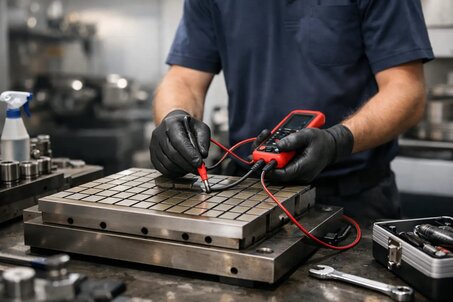
When is servicing magnetic chucks really necessary
The first signal is usually a decline in operational reliability. The operator notices that with the same type of workpiece, greater caution is required, or the behavior changes during finer operations. In grinding, this shows up quickly, because even a small deviation in flatness or weaker clamping affects the result. In milling, the problem may remain hidden longer, but the consequences tend to be more serious.
The second reason for service is damage to the working surface. The pole plate may be locally worn, scratched, or deformed due to improper handling. If the surface is out of tolerance, the chuck may still magnetize, but it will not ensure stable contact across the entire contact surface. The result is weaker fixation, vibrations, or reduced machining accuracy.
The third case involves control-related issues. In permanent chucks, the switching mechanism is often the critical point. If operation becomes stiff, irregular, or shows unusual resistance, it is not advisable to wait until the mechanism seizes. In electro-permanent systems, the condition of electrical components, connectors, pulse control, and overall functional safety are also checked.
What professional servicing of magnetic chucks includes
Servicing is not just about cleaning the surface and performing a basic check. If it is to have technical value, it must involve a set of procedures that verify the actual condition of the equipment. The foundation is visual and functional diagnostics. The working surface, flatness, condition of the poles, mechanical damage, wear of the switching system, and the overall behavior of the chuck during activation and deactivation are assessed.
This is followed by measurement and evaluation. With magnetic chucks, it is not enough to rely on the feeling that it “holds well enough.” The holding force depends on the material type, workpiece thickness, contact area, and the condition of the chuck itself. Therefore, servicing includes verifying whether the equipment meets parameters appropriate to its type and size and whether it shows deviations from normal operation.
An important part is regrinding or restoring the working surface. This solution makes sense when the basic construction of the chuck is in good condition and the issue lies in surface geometry. However, it is not always true that every regrinding is automatically suitable. The remaining structural reserve, plate type, and extent of damage are decisive. Improper intervention can damage the chuck.
In more extensive servicing, refurbishment of mechanical parts, replacement of damaged components, inspection of seals, and verification of operational safety are also carried out. In electro-permanent systems, diagnostics of the control unit and pulse control are added. The goal is not only to restart the equipment, but to return it to a condition in which it can be reliably used in real production.
The most common causes of failures and reduced efficiency
A large portion of problems does not arise from manufacturing defects, but from operation. A typical factor is contamination. Fine metal dust, grinding sludge, oils, and emulsions get onto the working surface and into sensitive parts of the mechanism. If not removed regularly, they reduce the quality of contact between the chuck and the workpiece and accelerate wear.
Another common cause is improper use. A magnetic chuck has its limits and is not a universal replacement for every clamping method. If used for unsuitable shapes, overly thin parts, or applications with unfavorable force distribution, the result may be not only weaker holding but also excessive mechanical stress on the equipment. In such cases, the issue often lies not in a failure itself, but in an incorrectly selected application.
Neglected preventive inspection also plays a role. In many operations, the chuck is checked only when the operator reports a problem. This is understandable, but technically disadvantageous. Minor deviations in flatness, contamination in the mechanism, or gradual deterioration in operation can be addressed much more easily and cost-effectively at an early stage.
Repair or replacement? Condition and application decide
Not every service intervention leads to repair. In some cases, it is economically and technically more reasonable to replace the chuck with a new solution. This is especially true for older equipment with significant wear, previous improper interventions, or when the original type no longer meets current production requirements.
The decision should not be based solely on repair cost. It is important to compare the overall benefit. If refurbishment restores reliable function for several more years and the equipment fits the current technology, servicing is the logical choice. However, if production requires higher accuracy, faster switching, greater durability, or a different pole configuration, replacement may be more effective even with higher initial investment.
In practice, a technical assessment of the specific unit proves most effective. Only then does it make sense to decide whether basic maintenance, surface restoration, more extensive refurbishment, or a completely new clamping system is sufficient. This is where the difference between standard sales and true technical service becomes evident.
How to extend the service life of a magnetic chuck
The greatest impact comes from regular operational hygiene. The working surface must be clean, free of metal dust, burrs, and emulsion residues. This is not a detail, but a fundamental condition for reliable contact. It is equally important not to leave loose ferromagnetic particles on the surface, as they can distort clamping or damage the workpiece.
Operators should also respect the limits of use. If the workpiece does not have sufficient contact area, is too thin, or high lateral forces are expected during machining, an appropriate technological strategy or additional stops and mechanical securing should be used. A magnetic chuck is a highly effective tool, but only when used in accordance with the physics of clamping.
Planned inspection of flatness and functionality also helps. It does not always require a full service, but at least regular verification of the equipment’s condition. In production environments where the chuck is a key part of the process, preventive checks result in fewer downtimes and more stable production quality.
Why postponing service does not pay off
A postponed problem rarely remains the same. A small drop in performance becomes inaccuracy, a stiff mechanism turns into failure, and local surface damage becomes an issue that can no longer be resolved with a simple intervention. In machining, the damage often affects not only the chuck, but also the workpiece, the tool, and production time.
The safety aspect is also important. If clamping is not reliable, the risk of workpiece movement during operation increases. In some applications, this leads only to a poorer result, in others it creates a real operational risk. Therefore, servicing is important not only for the lifespan of the equipment, but also for the stability of the entire process.
A professional approach to servicing is therefore more than maintenance. It is part of production management, quality assurance, and operational reliability. Companies that use magnetic chucks daily usually realize this after the first major failure. It is more effective to set up servicing earlier, before the problem affects deadlines, complaints, or unplanned downtime.
If a magnetic chuck stops performing as it should, there is no need to immediately assume replacement, but neither is it wise to believe the issue will resolve itself. A technically sound assessment of the condition shows what still makes sense to repair, what needs restoration, and when it is time for a new solution. This is where professional servicing has real value – it returns the equipment to operation with parameters that can be relied on even under production load.