



















SmCo magnets to high temperature in practice
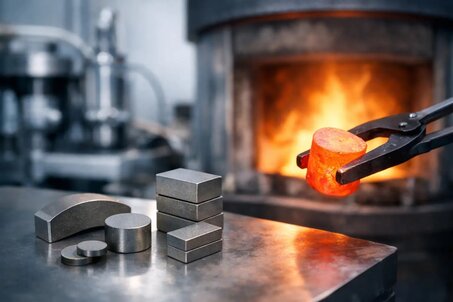
If a magnet operates near a furnace, motor, brake, sensor, or another heat source, a standard material selection is often not sufficient. It is precisely under such conditions that smco magnets for high temperatures have a clear justification, as they maintain their magnetic properties even where other permanent magnets reach the limits of usability.
Samarium-cobalt magnets belong to specialized materials for technical applications where thermal stability, long-term reliability, and resistance to demagnetization are critical. They are not universal magnets for every use. However, if the operation combines higher temperatures, limited installation space, and a requirement for stable performance, SmCo is often a very rational choice.
When Do High-Temperature SmCo Magnets Make Sense
The most common problem in designing a magnetic application is not the magnet’s force at room temperature, but what happens to it after heating. Many devices work reliably under laboratory conditions, but in real operation the temperature changes depending on load, cycling, or the surrounding environment. That is when the difference between materials becomes apparent very quickly.
SmCo magnets are particularly suitable where operation takes place long-term at elevated temperatures or where the temperature changes repeatedly. Typical applications include sensors, servo drives, electric motors, linear systems, measuring technology, vacuum equipment, or specialized clamping and positioning mechanisms. In these applications, parameter stability is more valuable than maximum initial holding force at any cost.
It is also important that in thermally stressed designs, it is not only about immediate performance but about predictability. The designer needs to know how the magnet will behave after hundreds or thousands of operating cycles. This is where samarium-cobalt has an advantage over many alternatives.
How SmCo Differs from Neodymium and Ferrite
In practice, high-temperature magnetic applications are often compared between three materials – neodymium, ferrite, and SmCo. Each has its place, but at higher temperatures the differences cannot be ignored.
Neodymium magnets offer very high magnetic energy and, when the correct grade is selected, are an excellent solution for many compact devices. However, their weaker side is often sensitivity to temperature. High-temperature neodymium grades do exist, but in more demanding conditions the design starts to reach its limits and safety margins decrease.
Ferrite is cost-effective, corrosion-resistant, and sufficient in many cases. However, if a stronger magnetic field is required in a smaller volume or higher stability in a precise technical application is needed, its capabilities are often limited.
SmCo stands between these worlds as a material for specific requirements. It provides high thermal resistance, very good stability of magnetic properties, and strong resistance to demagnetization. At the same time, it is necessary to consider its higher cost and the fact that it is a brittle material requiring proper mounting design.
Temperature Is Not the Only Parameter
When selecting a magnet, it is not enough to look only at the maximum operating temperature value. Although it is one of the basic parameters, without context it can be misleading. There is a difference between short-term heating and continuous operation, between a uniform temperature of the entire component and local overheating, as well as between a freely placed magnet and one enclosed in a metal assembly.
Equally important is the magnetic load in the circuit. A magnet operating in unsuitable geometry or without sufficient magnetic return can be more prone to partial demagnetization. This also applies to materials with high coercivity. Therefore, the design must consider the magnet shape, magnetization direction, air gap, counterpart, and mechanical mounting.
At higher temperatures, differences in thermal expansion of individual materials in the assembly also come into play. If the magnet is pressed, bonded, or mechanically preloaded, stress may appear during cycling. Since SmCo is more brittle than, for example, ferrite, mechanical stress must be addressed already in the design phase.
Advantages of SmCo in Demanding Operation
The biggest advantage is stability. An SmCo magnet maintains its properties at elevated temperatures better than most standard permanent magnets used in industry. In applications requiring precise magnetic fields, repeatability, or long-term operation without maintenance interventions, this is a key argument.
The second important property is corrosion resistance. Unlike neodymium magnets, surface protection is often not required just for the magnet to survive the environment. However, this does not mean that coatings or encapsulation are unnecessary. If the environment is chemically aggressive, abrasive, or hygienically sensitive, protection must be evaluated based on the entire application, not just the magnet material itself.
The third advantage is high resistance to demagnetization. In devices where the magnet encounters external magnetic fields, reverse flux, or dynamic changes in the operating point, this is a very valuable property.
Limitations That Must Be Taken Seriously
SmCo is not without trade-offs. The first is cost. If the application can be handled by ferrite or a properly selected neodymium magnet, samarium-cobalt would be unnecessarily expensive. A technically correct design therefore does not mean automatically choosing the most resistant material, but the one that makes sense in terms of performance, lifetime, and cost.
The second limitation is brittleness. SmCo magnets are not suitable where components are handled roughly, where impacts are likely, or where mounting creates point stress. An improper mounting method can lead to chipping or cracking even if the magnetic parameters are correctly selected.
The third limitation is machining and tolerances. In precise assemblies, it is necessary to know in advance what dimensions, shapes, and manufacturing possibilities are realistic. Not every geometry that looks good in a CAD model is suitable for a mass-produced brittle magnetic material.
How to Select High-Temperature SmCo Magnets
From a technical standpoint, selection should begin with operating temperature, not the catalog designation of the magnet. It is important to know the typical working temperature, peak values, their duration, and the number of cycles. The difference between occasional heating and continuous thermal load is often decisive.
Next comes the question of magnetic performance. Do you need maximum force in a small space, a stable field for sensing, or resistance to demagnetization in a complex magnetic circuit? Each of these requirements leads to a slightly different choice of size, grade, and shape.
The third area is mechanical integration. With SmCo, it is advisable to avoid mounting methods that transfer direct impacts or torsional loads into the magnet itself. Better results are achieved with designs where the magnet is protected by a housing, supported across its surface, and mounted with regard to the thermal expansion of surrounding components.
Finally, the entire operating environment must be considered. Temperature is the main reason for selecting SmCo, but the result is also influenced by humidity, vibration, chemical exposure, positioning accuracy, and maintenance intervals. In industrial practice, the correct material is rarely determined by a single parameter, but rather by a combination of operating conditions.
Where the Most Common Mistakes Occur
A very common mistake is confusing short-term resistance with safe long-term operation. A magnet may withstand a certain temperature, but that does not mean it will maintain the required properties with sufficient margin.
The second mistake is designing based on room-temperature data. Catalog values are necessary, but not sufficient for real applications. If the device operates at elevated temperatures, parameters should be evaluated at the actual operating point.
The third mistake is underestimating mechanical aspects. SmCo may be an excellent choice from a magnetic perspective, but if the component is poorly mounted or exposed to impacts, the problem will arise elsewhere than in the magnetic properties.
When Technical Consultation Pays Off
If it is a simple replacement of an existing component and the operating conditions are clear, the selection is straightforward. However, if the magnet is part of a new design, operates at higher temperatures, in limited space, or under mechanical stress, technical consultation saves both time and cost.
In practice, it often turns out that the problem is not the lack of a stronger magnet, but the need to adjust the shape, mounting, or the operating point of the magnetic circuit. This is where it makes sense to work with a supplier who understands not only the material, but also the real behavior of magnets in operation. That is also why, in more demanding applications, it is not sufficient to purchase based only on size and holding force listed in a catalog.
High-temperature SmCo magnets are not the right choice for every project, but in a properly designed application they provide reliability where cheaper alternatives are no longer sufficient. If a magnet must function after heating, during cycling, and without unexpected performance losses, the details of the design matter more than the material name itself.