















What Ferrite magnets serve in practice
If you are working on a magnetic application and maximum force is not the only priority, the question of what ferrite magnets are used for becomes highly practical. In many cases, they are not a “cheaper substitute” for more powerful magnets, but the right choice for stable, durable, and cost-effective operation. That’s why they are widely used in industry, technical equipment, and everyday products.
What Are Ferrite Magnets Used For
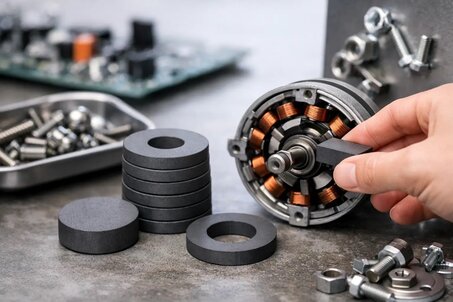
Ferrite magnets are used wherever a reliable permanent magnetic field, good corrosion resistance, and cost efficiency are required. They are typical for mass production, sensors, speakers, simple clamping, holders, separation elements, and various technical assemblies in which the magnet must function long-term without power supply.
Their importance lies mainly in the price-to-performance ratio. Neodymium magnets achieve higher force at a smaller size, but ferrite has its place wherever cost, availability, dimensional stability, and resistance to moisture or standard chemical exposure are key factors. For a designer or a purchasing specialist, this is a crucial difference, because the correct choice of magnetic material affects not only the function of the product but also the cost of the entire assembly.
Where Ferrite Magnets Are Most Commonly Used
One of the most common areas is electrical and mechanical assemblies. Ferrite magnets can be found in small electric motors, speakers, signaling elements, position sensors, and various switches. In these applications, it is usually not essential to achieve extreme holding force in minimal space, but rather to ensure stable performance at a reasonable cost in larger production volumes.
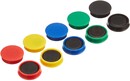
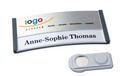
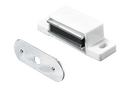
They are also very commonly used in holders and simple fixing elements. This may include door closures, furniture solutions, advertising and presentation systems, educational tools, or office applications. Ferrite is suitable where the magnet operates repeatedly, is not exposed to strong impacts, and where a larger magnet size is not a limitation.
In industrial environments, ferrite is also used in separation systems. In certain types of magnetic bars, grids, or simpler separators, ferrite cores can be used to capture ferromagnetic contaminants. However, this always depends on particle size, material flow rate, and the required separation efficiency. When dealing with fine particles or demanding operating conditions, stronger magnetic materials are often required.
Why Ferrite Is Still Used
From a technical perspective, ferrite has several properties that make it a consistently used material. The first is corrosion resistance. Unlike neodymium, it generally does not require additional surface coatings to protect against common moisture. This simplifies its use in environments where stability and minimal maintenance are important.
The second advantage is cost. In larger volumes or less demanding applications, the difference in cost can be significant. If the device does not require high magnetic energy, using a more expensive material would be technically and economically unnecessary.
The third property is good performance under various common operating conditions. Ferrite magnets can tolerate relatively higher temperatures compared to some standard neodymium magnets. This does not mean they are suitable for every thermal load, but in applications with elevated operating temperatures, they may be a more reliable choice.
When Ferrite Magnets Are Not Enough
This is where most selection mistakes occur. Ferrite is not a universal solution. If you need high holding force in a small space, a compact design, or a very intense magnetic field, ferrite will reach its limits. Its magnetic energy is lower, so achieving the same force requires a larger volume of material.
Another limitation is brittleness. Ferrite is hard but relatively brittle. It can handle normal static operation, but under impact, drops, or improper installation, it may crack or chip. That is why it is important to properly design the mounting, mechanical protection, and handling method.
It is therefore not just a question of “how strong a magnet do I need,” but also “how will the magnet be integrated, what dimensions will it have, what forces will act on it, and in what environment will it operate.” In technical practice, these details determine whether the application works long-term or only during initial testing.
What Ferrite Magnets Are Used for in Industry
In manufacturing practice, ferrite magnets are mainly used where the magnet serves a stable auxiliary function. This can include positioning, simple holding of components, state detection, separation of ferromagnetic impurities, or as part of electrical and electromechanical devices. The advantage is predictable behavior and favorable costs in serial production.
In transport and handling technologies, they can form part of less demanding separation elements. For example, when removing larger iron contaminants from a material flow and there is no need to capture very fine fractions, ferrite may be sufficient. However, in recycling, food processing, or more sensitive technological operations, the required separation efficiency must always be carefully evaluated.
In the field of measurement and sensing, ferrite is used in various sensor and switching applications. The advantage is long-term stability without the need for power supply. In simpler mechanisms, this remains an effective solution, especially when the design allows sufficient space for a larger magnet.
Ferrite vs. Neodymium: The Difference Is Not Only in Strength
In practice, these materials are often compared only based on attractive force, but this is a limited perspective. Neodymium is suitable where space is limited and high performance is required. Ferrite is a reasonable choice where space is available, the application is not extremely demanding, and long-term cost efficiency is important.
There is also a difference in corrosion resistance and sensitivity to certain operating conditions. Ferrite tends to be less problematic in humid environments. On the other hand, it is bulkier and requires consideration of its brittleness under mechanical stress. Therefore, the selection should not be based solely on catalog force, but on the full context of use.
For the purchasing department, unit cost is key. For the designer, dimensions, tolerances, and magnetic performance in a specific geometry matter. For maintenance, reliability in operation is critical. Only when these three perspectives are aligned can the appropriate material be selected responsibly.
How to Choose a Ferrite Magnet for a Specific Application
First, it is necessary to define what function the magnet should perform. A holder, separator, and sensor each have different requirements. Not only the force matters, but also the direction of magnetization, shape, distance from the attracted part, and the nature of the air gap. In practice, it often turns out that the issue is not a “weak magnet,” but an unsuitable shape or poorly designed magnetic circuit.
The operating environment is equally important. If the magnet will be exposed to vibration, it is advisable to consider encapsulation or mechanical securing. If it operates at elevated temperatures, the limits of the specific type must be verified. If it is part of a separation system, the size of the particles, distance, and material flow rate are critical factors.
In serial applications, availability and repeatability of parameters should also be considered. This is where cooperation with a specialized supplier becomes valuable—one that can assess not only the magnet itself, but also the suitability of the material, mounting method, and operational limits. In practice, this often makes the difference between a quick purchase and a functional solution.
Where Ferrite Makes the Most Sense
Ferrite magnets make the most sense in applications where long service life, stability, and reasonable acquisition cost are required together. These include speakers, simple electric motors, holders, closing mechanisms, educational and office tools, presentation systems, as well as certain industrial components. They are not the most impressive choice on paper, but they are often the right choice in real operation.
So if you are considering what ferrite magnets are used for, the answer is not just “for less demanding applications.” They are used wherever a magnetic solution must function reliably, predictably, and economically. And when the selection is made based on real operating conditions, ferrite can be a highly effective material even today—not just a leftover from older designs.
When selecting magnets, it does not pay off to choose based only on tables or unit price. What matters much more is understanding what the application actually needs to achieve and where its limits are. That is what determines whether ferrite will be just a simple component or a reliable part of a well-designed technical solution.