














What magnets to choose for automation
Which magnets for automation make technical sense usually becomes clear only when the line stops, the gripper does not hold repeatedly or the sensor reacts inaccurately. In automation, the strength of the magnet alone is not decisive. Temperature, distance, type of movement, surrounding material, cycling and whether the system is supposed to operate without maintenance intervention for months or years are all decisive.
When selecting, it is therefore not enough to look only at dimensions or declared holding force. A magnet in automation is a functional element of the system. If selected correctly, it speeds up handling, stabilizes the process and reduces mechanical wear. If selected incorrectly, it brings inaccuracy, downtime and unnecessary service interventions.

Which magnets are most commonly used in automation
In practice, we encounter several groups of solutions. Each has different advantages and different limits. What works in a fixture for fixing a part may not be suitable for a high-cycle pick-and-place system or for separating metal particles in a technological operation.
Most often, these are permanent magnets, electromagnets and complete magnetic systems. Permanent magnets are used where the effect is to be permanent and without power supply. Electromagnets are suitable where the magnetic effect needs to be switched on and off. Magnetic systems then combine the magnet itself with a steel circuit, housing or functional elements so that the result is stable and safe in a specific application.
Permanent magnets for stable and passive function
Permanent magnets are a frequent choice in automated fixtures, stops, positioning points or simple retaining mechanisms. The advantage is zero energy consumption, simple integration and high reliability. The disadvantage is that their effect cannot be switched off, so when handling ferromagnetic parts, it may be necessary to solve pull-off, shielding or precise guiding of the part.
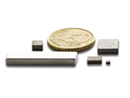
The strongest are usually neodymium magnets. They offer high magnetic energy in small dimensions, which is advantageous where there is little space. However, it is necessary to account for sensitivity to higher temperatures and the fact that with unsuitable surface treatment or in an aggressive environment, corrosion may be a problem.
Ferrite magnets are mechanically and economically suitable where extreme force is not required and operation takes place at normal or elevated temperatures. In automation, they are used more in auxiliary functions, simpler separation or less space-critical applications.
SmCo magnets have the advantage of higher temperature resistance and good parameter stability. They are suitable for more demanding environments where neodymium would already be working at its limit. Their use is technically justified in precision equipment, measuring technology or production with higher thermal requirements.
Electromagnets where control is needed
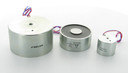
If the system is to hold the part only at a specific moment, an electromagnet is the natural choice. In automation, it is used for sorting, shifting, blocking, locking and handling. The main advantage is the possibility of control via PLC or other higher-level logic. The process is therefore repeatable and easier to synchronize with the other elements of the line.
However, an electromagnet also brings additional technical questions. Power supply, coil heating, duty cycle, residual magnetism and behaviour in the event of a power failure must be solved. In some applications, the reaction to loss of power is key. In some cases, the part should drop immediately; in others, it must remain safely held.
Magnetic systems and assemblies
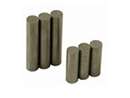
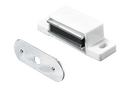
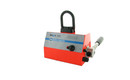
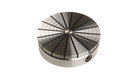
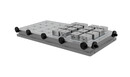
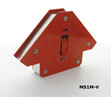
The magnet itself is often not enough. In industrial practice, magnetic housings, magnetic cylinders, magnetic bars, clamping systems, separators or special structural assemblies are more often used. The steel circuit directs the magnetic flux and increases efficiency in the required direction. This is especially important where you need to concentrate force on a small surface or limit the effect on the surroundings.
In automation, simple mounting, serviceability and resistance to vibration are also often decisive. A ready-made magnetic system therefore often brings a better result than an improvised installation of the magnet itself into a holder.
How to choose a magnet according to the application
The question of which magnets to choose for automation cannot be answered without the context of use. The approach is different when gripping sheet metal, different when detecting position and different when separating metal particles from a material flow.
Clamping and fixing of parts
When clamping, it is essential whether the magnet holds the part at rest or resists lateral forces, vibrations and repeated impact. Catalogue holding force is usually measured under ideal conditions - on thick, flat, clean steel and with axial pull-off. In real production, contact is usually worse, the part may be painted, oily or thin-walled. The actual holding force is therefore usually lower.
If a thin sheet is clamped, the magnetic circuit does not close as well as with a massive part. With stainless materials, it is also necessary to distinguish whether it is a ferromagnetic or non-magnetic type. When clamping fixtures and stops, it is also advisable to think about disassembly. A magnet that is too strong can complicate operation and servicing.
Handling and gripping
In robotic gripping, the cycle rhythm, part orientation and required certainty of placement matter. A permanent magnet is simple, but it may not be suitable where parts must be released without mechanical stripping. An electromagnet or electro-permanent solution is often better where precise control of gripping is required.
The shape of the contact surface is also important. A flat magnet may not work well on perforated, curved or roughly machined parts. In such cases, adjustment of pole extensions or the design of the entire gripping module helps.
Sensing and positioning
In automation, magnets are also used for contactless position sensing, end points or presence control. Here, it is usually not about maximum force, but about a stable magnetic field at the correct distance. A magnet that is too strong can interfere with neighbouring elements or cause an inaccurate sensor response.
In sensing, it is important that the magnetic field does not change due to temperature, shocks or incorrect mounting. The polarity and orientation of the magnet relative to the sensor are also decisive. It is precisely in this area that position tolerance is often underestimated, resulting in random errors during fast operation.
Metal separation in the process
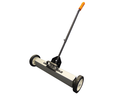
If automation includes conveyors, crushing, dosing or recycling, magnetic separators protect the technology and increase process cleanliness. Here, the main factors are the type of metal being captured, particle size, material layer height and flow speed. A strong magnet without correct placement may not capture what you need.
In separation, a well-designed magnetic system is often more effective than just higher magnetic induction. Geometry, distance from the flow and the possibility of cleaning are decisive. In continuous operation, service access is just as important as the performance itself.
Magnet material is not a detail
Choosing between neodymium, ferrite, SmCo or AlNiCo is not an academic question. It is an operational decision. Neodymium is suitable where you need high force in a small space. Ferrite is stable and suitable for less demanding applications or higher temperatures with larger dimensions. SmCo is suitable for thermally demanding environments. AlNiCo has its place mainly in specific technical and measuring applications where its characteristic magnetic properties are used.
The material must be assessed together with surface treatment, mechanical stress and environment. A brittle magnet in a place with impacts or in a steel assembly without stops can fail mechanically even when it appears correct in terms of magnetic force.
The most common mistakes in design
Several mistakes are repeated in automation. The first is selection according to table force without verifying real conditions. The second is underestimating the air gap, surface unevenness and the type of counterpart. The third is ignoring temperature and duty cycle, especially with electromagnets.
A common problem is also that the magnet is solved only at the end of the project as a small component. In reality, it affects the construction, safety and maintenance. If it is included in the design earlier, mounting, field shielding, service access and long-term reliability can be solved better.
When standard is enough and when a technical solution is needed
For simple fixing, sensing or basic retaining functions, a standard magnet or common magnetic system is often sufficient. However, if high production speed, safety-sensitive handling, a non-standard part or a demanding environment is involved, it is worth designing the solution precisely for the given application.
Here, experience with magnetic materials and their behaviour in practice is important. SELOS Magnety relies in this area on many years of technical know-how, stock availability of standard solutions and the ability to consult specific industrial deployment. For the customer, this means fewer trials and errors and greater confidence that the magnet will not be the weak point on the line.
If a magnet is to work reliably in automation, do not start with the question of which one is the strongest. Start with the question of what exactly the system is supposed to do in real operation. This is what determines the correct choice of material, construction and the entire magnetic assembly.