










When to demagnetize parts
Residual magnetic fields in manufacturing often appear more as an annoying detail than as an obvious failure. The workpiece attracts fine chips, measurements fluctuate, metal particles stick to the surface during assembly, and grinding or turning operations create problems that are often searched for elsewhere. In precisely these situations, it makes sense to address when demagnetization of parts is necessary and whether the residual magnetism has already exceeded the limit of a normal phenomenon.
Demagnetization is not a cosmetic operation. In technical practice, it is a process that directly affects production cleanliness, inspection accuracy, assembly functionality, and equipment lifetime. Not every ferromagnetic part must be automatically demagnetized after production, but in many operations it is an essential step between machining, inspection, and shipment.
When demagnetization of parts is necessary in practice
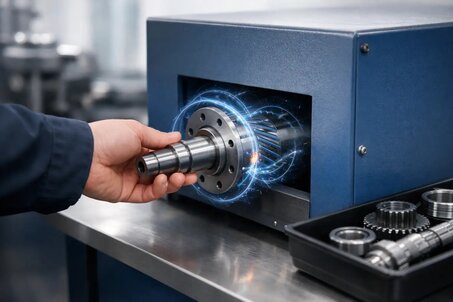
The most common reason is a situation where residual magnetism begins to interfere with the next manufacturing or assembly step. Typical examples are shafts, bearing seats, gear components, molds, knives, stampings, clamped steel parts, or components after grinding. If a part attracts metallic dust, fine filings, or grinding sludge after an operation, this is not just an aesthetic issue. Surface contamination can affect fit accuracy, wear, and in some cases even functional safety.
Another common moment is final inspection. If a precise dimension, roughness, runout, or surface condition is being measured while fine metallic particles are present nearby, the result may be distorted. Residual magnetic fields can hold impurities on the surface even after ordinary cleaning. In such cases, the problem is often blamed on washing, the operator, or the measuring instrument, even though the cause is magnetic.
Demagnetization is also necessary before assembly wherever the attraction of metallic particles could damage contact surfaces, seals, or moving assemblies. This applies especially to precision mechanisms, hydraulic and pneumatic systems, bearing assemblies, or tooling, where even a small metallic impurity can create a problem.
Why a part becomes magnetized at all
Magnetization occurs during several common processes. Strong magnetic chucks, magnetic separators, handling with lifting magnets, some grinding, turning, or milling operations, or even simple exposure to magnetic fields can leave residual magnetization in ferromagnetic materials. This effect is more noticeable in steel parts, hardened components, and geometries that behave like a magnetic circuit.
In practice, it is not enough to consider only whether the part was intentionally in contact with a magnet. The problem often appears secondarily. A part may have been clamped on a magnetic table, passed through grinding, then cleaned and appear visually fine. Only during the next operation does it become clear that it attracts metallic dust or affects measurement. This is a typical situation where demagnetization is added to the process only later, after repeated complaints or internal quality issues.
Signs that residual magnetism is already causing problems
The most reliable approach is measuring the intensity of the residual magnetic field. In many operations, however, the need for demagnetization first appears through practical symptoms. If metallic particles repeatedly stick to the part even after washing, if it is difficult to keep the surface clean before assembly, or if parts slightly “pull” toward each other during handling, residual magnetism is likely present.
A significant signal is also fluctuation in inspection results. This mainly concerns precision measurement and applications where metallic dust on functional surfaces is unacceptable. In some cases, a magnetized part may also affect sensors, magnetically sensitive components, or processes with high demands on stability.
Problems in automation and handling form a separate category. If steel parts unintentionally stick together after separation, feed poorly from a magazine, or reduce orientation reliability within the process, demagnetization may be a more effective solution than mechanical modifications to the feeder.
When demagnetization of parts is not automatically necessary
Not every residual magnetic field is a problem. If a part continues into an application where surface cleanliness, measurement, assembly, or device functionality are not affected, demagnetization may not be necessary. This applies especially to less sensitive structural parts or where the following process does not work with fine metallic contaminants.
The decisive factor is therefore the effect, not the mere existence of magnetization. In technical practice, it makes sense to evaluate a part according to its application, material, geometry, and the following operation. The situation is different for a rough cut piece going into a welded assembly than for a precision-ground component intended for a bearing assembly.
This is precisely where overgeneralization becomes a mistake. Somewhere, everything is demagnetized without distinction, while elsewhere the step is omitted even where it already causes damage. Proper process setup should be based on real risk and measurement, not habit.
How demagnetization works and what the result depends on
Demagnetization is commonly carried out using equipment that generates an alternating magnetic field. Its task is to gradually reduce the residual magnetization of the material to an acceptable level. Effectiveness depends on the size of the part, the type of material, the shape, wall thickness, the original magnetization, and the direction of the magnetic field within the material.
Geometry itself often determines whether the process will be simple or demanding. Long shafts, rings, hollow parts, or components with complex shapes may behave differently from compact blocks. In some cases, a quick pass through the demagnetizing device is not sufficient, and it is necessary to adjust the orientation of the part or repeat the entire process.
It is also important in what condition the part enters the process. If it is contaminated with chips or metallic sludge, demagnetization alone will not solve surface contamination. First, trapped particles must be removed, then the residual field reduced, and finally the result verified by measurement.
Measurement is more reliable than estimation
If the decision is to be technically justifiable, residual magnetism must be measured. Estimating based on the behavior of the part may help reveal a problem, but it is not sufficient for stable process setup. Measurement makes it possible to determine during which operations excessive magnetization occurs, which parts are risky, and whether demagnetization after treatment is actually effective.
What matters is not only the absolute value, but also its relationship to the specific application. A value that is still acceptable during ordinary handling may be unsuitable for precision grinding, inspection, or assembly of a sensitive unit. That is why limits are set according to the function of the part, not generally for the entire production.
In operations where magnetic clamping is used regularly, it is worthwhile to monitor residual magnetization systematically. It saves time when searching for the causes of surface contamination, reduces the number of repeated cleaning operations, and improves production repeatability.
The most common operations where demagnetization becomes an issue
The topic regularly appears in mechanical engineering production, during grinding and machining of precision parts, in tool and mold manufacturing, maintenance, refurbishment, and inspection laboratories. It strongly concerns companies that use magnetic chucks, permanent or electromagnetic handling systems, as well as operations where steel parts are combined with a requirement for a very clean surface.
Demagnetization is also important during servicing of machine components. During repairs, it is often discovered that a component retains residual magnetic fields from previous operation or handling, which complicates cleaning, diagnostics, or reassembly. In such situations, this is not theoretical — it is about quickly removing a specific obstacle in the process.
For companies that need to combine magnetic technologies with precision manufacturing, it is sensible to address demagnetization already during workplace design. That is why, in technical practice, cooperation with a supplier who understands not only the magnets themselves but also what happens before and after their use has proven valuable. This is precisely the area where technical consulting and service provide long-term value.
When not to wait and solve demagnetization immediately
If a part captures metallic particles after processing, if it complicates assembly, if it reduces measurement reliability, or creates problems in automatic feeding, demagnetization should not be postponed. The cost of this step is usually lower than repeated cleaning, inaccurate inspection, damaged assemblies, or searching for the cause where residual magnetic fields are actually responsible.
The question therefore is not whether magnetism on the part is “normal,” but whether it already interferes with the function of the process. If the answer is yes, the right time for demagnetization has arrived. And the sooner it becomes a controlled production step instead of a reaction to a problem, the more stable the overall result will be.