


















When to use AlNiCo magnet in practice
If you are selecting a magnet for a sensor, measuring equipment, or a device with higher operating temperature, the question of when to use an AlNiCo magnet is not academic, but very practical. In many applications, it is not only the maximum holding force that matters, but especially the stability of magnetic properties, resistance to heat, and predictable behavior over time.
AlNiCo belongs among the classic permanent magnetic materials that still hold a firm place in technical practice today. It is not a universal choice for every project. On the contrary – it makes sense where its specific properties solve a precise technical problem better than neodymium or ferrite.

When to Use an AlNiCo Magnet and Why
An AlNiCo magnet is mainly used when the application requires good thermal stability, relatively stable magnetic parameters, and reliable operation within a precisely designed magnetic circuit. Typical applications include sensors, measuring instruments, speakers, certain types of generators, instrumentation, and specialized industrial assemblies.
Its main advantage is not extreme force in a small volume. This role is now often taken over by neodymium. AlNiCo is more interesting because it tolerates higher temperatures well and, with proper design, provides a stable magnetic field. In practice, this means that if a device operates in a more thermally demanding environment, AlNiCo can be a safer and more reliable long-term choice.
It is also important that AlNiCo has high remanence, meaning it can generate a strong magnetic field. At the same time, however, it has lower coercivity than modern rare-earth magnets. This is a key property that determines where it is suitable and where it is not.
Where AlNiCo Really Excels
From a technical perspective, AlNiCo performs well where the magnet is not used as a standalone “strong piece of material,” but as part of a designed system. It works very well in closed magnetic circuits, where the design helps maintain stable magnetic properties and protects it from demagnetization.
An advantage is its high temperature resistance. In applications where temperatures exceed the limits of standard neodymium magnets, AlNiCo can be significantly more suitable. In operation, this is often critical in sensors within motors, measuring equipment, or devices exposed to temperature fluctuations.
Another strong point is long-term stability. If the application is properly designed, AlNiCo provides very consistent parameters. This is important wherever signal, position, speed, or another variable dependent on a stable magnetic field is being monitored.
A third advantage is corrosion resistance compared to some other magnetic materials. In many cases, this means less intensive surface protection is required than with neodymium. Of course, it depends on the environment and specific design.
When AlNiCo Is Not the Best Choice
This is where most selection mistakes occur. If someone expects maximum force in small dimensions, AlNiCo is usually not the first choice. Neodymium magnets offer a significantly higher energy product at the same volume, and therefore stronger performance in compact designs.
AlNiCo is also not ideal where the magnet operates in an open magnetic circuit and is exposed to external demagnetizing influences. Its lower coercivity means it can more easily become partially demagnetized if the design does not respect material limits.
This is why AlNiCo is not selected based only on catalog dimensions and force. It requires technical context. If the application involves simple holding, closing, hobby use, or situations where the highest possible force on a small surface is required, ferrite or neodymium is usually more suitable depending on operating conditions.
Typical Applications Where AlNiCo Makes Sense
In sensors and measuring elements, AlNiCo is used for field stability and good behavior under temperature changes. This applies, for example, in inductive or rotational systems where the output must be repeatable and reliable over time.
In electroacoustics, AlNiCo has a long tradition. It has been and still is used in certain types of speakers where designers require specific magnetic properties and field characteristics. This is not only about technical function but also about precisely defined system behavior.
Another area is laboratory and measuring instruments. Here, stability and precision are often more important than raw force. AlNiCo has an advantage in such applications if the magnetic circuit is properly designed.
It is also used in certain specialized industrial assemblies where the combination of temperature, mechanical space, and required magnetic field makes standard neodymium risky or unnecessarily sensitive.
AlNiCo vs. Neodymium and Ferrite
If you are choosing between the three most common materials, the question is not which is best in general, but which is best for a specific operation.
Neodymium is in most cases the choice for maximum force in small dimensions. It is excellent for compact systems, clamping, holding, and a wide range of industrial and everyday applications. Its weakness can be higher sensitivity to temperature and corrosion if the correct grade and protection are not selected.
Ferrite is an economical and proven solution for many standard applications. It has lower force than neodymium but good corrosion resistance and a favorable price. It is often used where compactness or extreme performance is not critical.
AlNiCo is more specific. It excels where thermal stability, stable magnetic fields, and a properly designed magnetic circuit are crucial. It is usually not the first choice for simple selection based on force. However, for technically demanding applications, it can be exactly the material that prevents operational problems.
What to Consider When Designing an Application
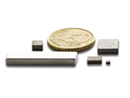
For AlNiCo, the shape of the magnet and the way it is integrated are extremely important. This material is often longer in the direction of magnetization, as this geometry supports more stable performance. Short and improperly loaded shapes can be problematic in terms of demagnetization.
An equally important factor is a closed magnetic circuit. If the design uses pole pieces, yokes, or other ferromagnetic components to guide the flux, AlNiCo can operate very efficiently. If the magnet is left in open space without circuit support, its advantages may not fully manifest.
It is also necessary to consider whether the magnet will be exposed to impacts, strong external fields, or mechanical handling during assembly. AlNiCo is not a problematic material, but it requires more precise design than the universal “just take the strongest magnet” approach.
When to Use AlNiCo Magnets in Industrial Practice
In industry, AlNiCo is worth considering especially when equipment operates long-term, under changing temperature conditions, and with an emphasis on repeatability. This is common in sensing assemblies, inspection devices, speed or position measurement, or in specialized drives and instrument mechanisms.
If service reliability and stable function over years are priorities, the magnet material must not be underestimated. This is often where the difference lies between a solution that works on the bench and one that works after long-term operation in production. An experienced supplier can assess not only the magnet itself but also the suitability of the entire arrangement.
Therefore, it is worth consulting especially in these situations: when the application operates at higher temperatures, when signal stability is critical, when neodymium loses its margin, or when replacing an older type of magnet in an existing device. In such cases, the correct answer is rarely universal, and details matter.
SELOS Magnety has long been involved not only in supplying magnetic materials but also in technical consulting for selecting the right solution. This is even more true for AlNiCo, as the correct choice depends on operating conditions, geometry, and the magnetic circuit.
If you should take one practical takeaway from this article, it is this: AlNiCo is chosen when you need stability and thermal resistance, not when you are chasing the highest possible force at any cost. In a well-designed application, it is a very reliable material that still holds a strong place in technical practice.