

















Where electromagnet is used in practice
When in operation you need to activate the magnetic force only at a precisely defined moment, a permanent magnet is usually not sufficient. This is exactly where the question of where an electromagnet is used makes sense – wherever controlled attachment, release, lifting, clamping, or separation of ferromagnetic material without complex mechanics is required.
An electromagnet is not just a school example from physics. In practice, it is a functional element of production lines, handling equipment, sorting systems, locks, valves, and lifting technologies. Its main advantage is simple: magnetic force is generated when electric current is applied and disappears, or is significantly reduced depending on the system design, when switched off. This gives engineers and designers exactly what they often need – control.

Where is an electromagnet used most often
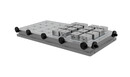
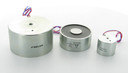
Electromagnets are most widely used in industry because they enable repeatable and automatable movement or holding of parts. In handling technology, they are used for lifting steel sheets, semi-finished products, cut parts, or scrap. With proper design, they can speed up handling and reduce the need for mechanical jaws, hooks, or fixtures.
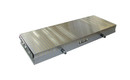
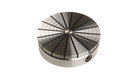
Another typical area is clamping systems. An electromagnet can hold a workpiece during grinding, milling, or other operations, while the choice of a specific solution depends on part size, contact surface, required precision, and the safety mode in case of power failure. It is not suitable everywhere, but for flat ferromagnetic components it is often highly effective.
Electromagnets are also widely used in automation. They serve as part of sorting mechanisms, stops, feeders, locking elements, or linear actuators. In these applications, not only force matters, but also response time, duty cycle, coil heating, and long-term reliability.
Industrial handling and lifting
When handling steel, an electromagnet is particularly useful where material is frequently picked up and placed down. Typical examples include sheet metal warehouses, cutting stations, press shops, or scrap yards. The operator or automated system can grip the material without direct mechanical intervention and place it precisely after transfer.
However, this is not a universal solution for every material. An electromagnet works with ferromagnetic metals, mainly steel and iron. With stainless steel, it depends on the specific type; with aluminum, copper, or brass, it does not apply. It is also necessary to consider that thin sheets, small contact areas, oily surfaces, or an air gap between the magnet and the load significantly reduce efficiency.
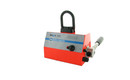
In heavy-duty operations, lifting electromagnets are also used for scrap, bar material, or cut parts. Here it is no longer just about the magnet itself, but the entire system including power supply, safety mechanisms, and operating mode. In design, it is necessary to consider not only load capacity, but also the nature of the load, detachment method, operating temperature, and the character of the operation.
Electromagnets in automation and machinery
In automation technology, electromagnets are used where motion needs to be short, fast, and precisely controlled. This often involves switching, locking, or extending a mechanical element. It can be a simple electromagnetic pin that fixes a position, or part of a more complex feeding system.
The practical advantage is that an electromagnet can be easily integrated into the electrical control of a machine. It responds to signals from a PLC, sensor, or button and, when properly dimensioned, provides stable operation without complex pneumatic systems. On the other hand, during prolonged activation, coil temperature increases, which in some applications limits the duty cycle.
For designers, it is therefore important to monitor rated voltage, power consumption, activation time, force at a given air gap, and mechanical design. The difference between laboratory values and real force in a machine can be significant. For reliable operation, the design must be based on actual operating conditions, not just catalog specifications.
Where electromagnets are used in metal separation
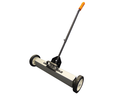
Separation of metal particles is another area where electromagnets have a stable role. In recycling, food processing, plastics industry, and bulk material handling, they are used to separate ferrous contaminants from conveyed materials. The purpose is twofold – protecting equipment and improving output quality.
In some operations, electromagnetic separators are used because the magnetic field needs to be switched on or regulated according to the process. This can be advantageous for maintenance, cleaning, or variable operation. In other cases, separators with permanent magnets are more suitable as they do not require power supply. The decision depends on technology, available space, material characteristics, and service requirements.
When separating fine material, the distance between the magnetic field and the product layer is critical. With coarser material or thicker layers on a conveyor, the performance must be precisely defined. An incorrectly selected electromagnet may fail to capture contaminants at the required depth, even if it appears sufficiently strong on paper.
Locks, valves, and everyday technology
Electromagnets are not limited to heavy industry. They are also commonly used in electromagnetic locks, access systems, relays, contactors, brakes, clutches, and valves. In these cases, the goal is not always high force, but reliable switching or holding.
For example, in door systems, an electromagnet keeps the door closed until the control system allows it to open. In hydraulics and pneumatics, electromagnets control valve mechanisms. In electrical engineering, they function as the basic element in relays or contactors, where magnetic force moves the contact parts.
For users, these components are often unnoticed, but operationally they determine whether a system switches precisely and repeatedly. Here too, selection is not just about voltage. Protection rating, operating frequency, dusty or humid environments, and required lifespan are equally important.
Advantages and limitations of electromagnets
The main advantage of an electromagnet is controllability. Magnetic force can be switched on, off, or in some systems regulated. This is essential wherever material or mechanical elements must be released without manual intervention. From an automation perspective, it is a highly practical solution.
However, an electromagnet is not automatically better than a permanent magnet. It requires power supply, heats up under load, and its function changes or disappears in case of power failure if no safety system is in place. Therefore, in lifting, clamping, and safety applications, it is always necessary to assess power failure risks and required safety levels.
Another limitation is energy consumption and duty cycle. Some electromagnets are suitable for short impulse use, others for continuous operation. If this difference is underestimated, the result can be overheating, loss of force, or premature coil failure.
How to choose the right electromagnet for an application
If you are evaluating where an electromagnet can be used in your operation and whether it makes sense for a specific task, the first step is defining the function. Should it hold, lift, switch, separate, or position? Each function leads to a different design type and sizing approach.
Next comes material and geometry. It matters whether it is a solid steel part or a thin sheet, what the contact surface is, whether the surface is painted, dirty, or uneven, and what air gap is present during contact. These details can affect actual force more than nominal parameters.
Operating conditions are also crucial – temperature, humidity, switching frequency, available voltage, mounting method, and service requirements. In industrial practice, it is advisable not to underestimate technical consultation before ordering. With electromagnets, the outcome often depends not only on the product, but on the entire application setup. That is why companies like SELOS Magnety provide not only products, but also technical consulting and service support.
An electromagnet is a highly effective tool when used where its principle makes real sense. It is not always the first choice, but where precise control of magnetic force is needed, it can significantly simplify technology, speed up handling, and improve process repeatability. The best result usually does not come from the strongest magnet, but from a properly designed solution for a specific operation.