


















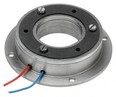



How to choose industrial electromagnet
If an electromagnet is expected to reliably hold a component, actuate a mechanism, or handle material in operation, choosing a “stronger model” is not enough. The question of how to select an industrial electromagnet directly determines the functionality of the entire application, energy consumption, and equipment lifetime. In practice, not only holding force matters, but also the contact method, duty cycle, power supply, temperature, and safety logic of the specific machine.

How to choose an industrial electromagnet according to the application
The first step is not the catalog, but the precise definition of the task. One electromagnet is suitable for short-term activation of a lock or flap, another for long-term clamping of a metal part, and another for handling or separation equipment. If this step is skipped, the result is often an oversized solution with high power consumption or, on the contrary, a magnet that does not hold in real conditions as expected.
First, it is necessary to clarify whether the electromagnet should attract a part, hold it in contact, release it, or perform repetitive movement. There is also a difference between operation in a horizontal position, against gravity, or under vibration. An electromagnet that reliably holds a steel plate on a workbench may behave completely differently on moving equipment exposed to impacts, acceleration, and imperfect contact.
In industrial practice, the selection is therefore always linked to a specific application — clamping during machining, mechanism locking, control of doors and flaps, handling of semi-finished products, material sorting, or integration into automated lines. Each of these tasks has different requirements regarding construction, contact surface, and electrical parameters.
Holding force is not the only parameter
The most common mistake is focusing only on the declared holding force. This value is usually specified under ideal conditions — a flat, clean, smooth ferromagnetic surface with full contact and no air gap. In real operation, however, the material is often painted, oxidized, rough, or touches the magnet only partially.
Even a small air gap dramatically reduces the effect of the electromagnet. This is critical, for example, with uneven parts, painted surfaces, or thin metal sheets. Material quality also matters. An electromagnet behaves differently on low-carbon steel than on stainless steel, where it may not be usable at all if the material is non-magnetic.
When selecting an electromagnet, it is therefore necessary to work with a safety margin and with real contact conditions. If the electromagnet must hold a part vertically or during machine movement, it is not enough to simply compare the object weight with the catalog force. The direction of the load, shear forces, acceleration, and the possibility of incomplete contact must also be considered.
Surface, shape, and material thickness
A thick solid part is usually magnetized more easily than a thin sheet. With thin materials, the magnetic flux has nowhere to close, and efficiency decreases. Perforated parts, embossed components, or curved surfaces are similarly problematic. In such cases, changing the shape of the pole surface may help, while in others a completely different magnetic system is more suitable.
That is why it makes technical sense to evaluate the electromagnet together with the mating part, not as an isolated component. Selection without knowledge of the material and geometry is usually accurate only on paper.
Power supply, duty cycle, and heating
An industrial electromagnet is not just a mechanical component. It is an electrical device whose behavior changes depending on voltage, current, and activation duration. It matters whether it is powered by direct or alternating current, at what voltage it operates, and whether it works in short-term, intermittent, or continuous mode.
If the application requires long-term holding, continuous duty capability and heat dissipation must be considered. The coil heats up during operation, and an unsuitable design may lead to performance loss or reduced insulation lifetime. On the other hand, in pulse applications, a solution with higher instantaneous power may be advantageous, provided the duty cycle allows it.
Behavior during power failure is also important. In some devices, the electromagnet should release the part immediately after power loss, while elsewhere this is undesirable and a different holding logic is required. This is not a minor detail at the end of the project, but one of the basic conditions of safe design.
How to choose an industrial electromagnet for demanding environments
The operating environment is often underestimated during selection. An electromagnet in a clean assembly hall and an electromagnet in a dusty, humid, or thermally stressed environment represent two completely different tasks. Protection rating, surface treatment, resistance to oil, cooling emulsions, or metal dust may matter more than the nominal force itself.
In manufacturing operations, vibrations and repeated impacts are common. In such environments, it is necessary to consider not only the mounting of the electromagnet itself, but also the mechanical stability of power leads and cables. In recycling or during metal separation, resistance to contamination and easy maintenance of pole surfaces are critical.
If the electromagnet is installed outdoors or in a humid environment, attention must be paid to corrosion resistance and sealing. Similarly, at elevated temperatures, it is not enough to monitor only ambient temperature, but also the coil’s self-heating during operation. The combination of both factors may quickly push the device beyond its safe operating range.
Installation and service accessibility
A good selection is also reflected in how easily the electromagnet can be installed and serviced. If the pole surface is difficult to access for cleaning or replacement requires disassembly of machine parts, operating costs increase. In industrial solutions, it is reasonable to think about serviceability already during the design stage.
This also applies to cabling, connectors, and placement of power supply elements. An electromagnet that is technically correct but impractical to service usually does not perform well in long-term operation.
Safety, control, and residual magnetism
In many applications, the electromagnet becomes a safety-critical element. If it holds a part above a workspace, secures the position of a mechanism, or forms part of an automation sequence, it is necessary to precisely define what should happen in the event of a fault, power loss, or overheating.
Residual magnetism is also an important issue. Some materials may remain partially magnetized after power is disconnected, which complicates part release or subsequent production steps. This is particularly sensitive in precise sheet feeding, handling heads, or wherever the part must separate immediately after the magnet is switched off.
In fast-cycle applications, activation and release dynamics must also be considered. Sometimes fractions of a second are decisive. In such cases, it is necessary to address not only the electromagnet itself, but also switching methods, protective circuits, and control of the entire assembly.
When a standard solution is sufficient and when consultation is necessary
If the application is simple, with a clean steel counterpart, known weight, and stable operating conditions, a standard industrial electromagnet is often a fast and reliable solution. Typical examples include locking, holding doors closed, flaps, or simple clamping under precisely defined conditions.
Consultation becomes valuable when multiple variables are combined — thin or uneven material, high switching frequency, thermal load, safety requirements, limited installation space, or uncertain contact conditions. In such cases, technical verification is usually more efficient than later dealing with overheating, insufficient force, or unreliable release of parts.
In practice, it is useful to prepare basic input data: material type, dimensions and weight of the part, required function, activation time, supply voltage, operating environment, and a mounting sketch. Even these basic details significantly improve selection accuracy and often reveal whether a catalog component is sufficient or whether a modified solution is required.
Technical consulting has real value with electromagnets mainly because the difference between a functional and a problematic solution is often not visible at first glance. SELOS Magnety has long specialized in industrial magnetic applications, and in such cases not only component availability matters, but also the ability to correctly assess its use.
Most common selection mistakes
The same problems appear repeatedly. Electromagnets are selected according to catalog force without considering the air gap, ideal material conditions are assumed, heating during continuous operation is ignored, or the quality of the contact surface is underestimated. Another common issue is that the design does not account for power failure, and only during testing does it become clear that releasing the part creates a risk.
Another mistake is trying to replace proper mechanical design with a stronger electromagnet. If the contact is poor or the part guidance is inaccurate, higher power only masks the problem and often results in higher temperature, increased power consumption, and shorter lifetime. Better results usually come from more precise mechanics and a correctly selected magnetic component.
When selecting an industrial electromagnet, it is better to think less in catalog terms and more in operational terms. Once you know the material, duty cycle, environmental conditions, and safety logic of the device, the correct solution can be selected far more accurately. And that is precisely the difference between a component that works during testing and a solution that works reliably every day.