









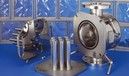

How to use magnetic grippers correctly
When a magnetic gripper fails in an application, the problem is rarely in the magnet itself. Much more often, it is caused by an incorrect understanding of the part material, the contact surface, the distance or the dynamics of movement. That is exactly why the topic of how to use magnetic grippers should be addressed technically, not only approximately according to catalogue load capacity.
A magnetic gripper is a simple principle with relatively demanding practical use. It must capture, hold and often also precisely release a ferromagnetic part in a repeated cycle. It works reliably only when the type of magnetic system, force, contact geometry and control method are selected correctly. In manual handling, the requirements are different from those at an automated workstation, where tenths of a second and repeatability are decisive.
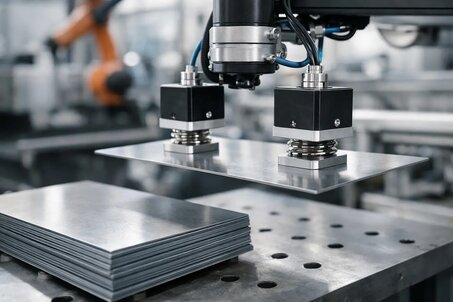
How to use magnetic grippers according to the application
First, it is necessary to distinguish what you actually want to transfer. The gripping of a steel pressed part is designed differently from the handling of a thin sheet, and differently again from the feeding of small components into a production line. A magnetic gripper works best where the material is magnetically conductive, sufficiently thick and has a predictable contact surface.
With solid steel parts, the situation is usually more favourable because the magnetic flux closes effectively. With thin sheets, the force already decreases significantly. Part of the magnetic potential is not used because the material does not have sufficient volume to conduct the magnetic flux. In practice, this means that a gripper that holds a compact steel block without any problems may have a noticeably lower real holding force with a thin pressed part.
The surface is also important. If there is paint, scale, grease, dust or unevenness between the gripper and the part, an air gap is created. And even a small gap has a major effect on the result in magnetic systems. The more precise the contact and the more continuous the surface, the more secure the gripping.
When a magnetic gripper is a suitable choice
Magnetic grippers have proven themselves when handling steel semi-finished products, burnouts, pressed parts, tubes, profiles or small metal components. In automation, they are also interesting because they do not need mechanical jaws extending into the outline of the part. This helps where there is little space or where mechanical gripping would slow down the cycle.
On the other hand, they are not a universal solution. If the part is made of stainless steel with low magnetic conductivity, aluminium, copper or plastic, a magnetic gripper will not work at all or only very limitedly. Extremely thin, perforated or significantly curved parts are similarly problematic, because the real contact surface is reduced.
Selecting the correct type of gripper
From a technical point of view, it is necessary to distinguish between permanent, electro-permanent and electromagnetic solutions. Each has its place, and the selection depends on the operating mode, safety and control requirements.
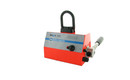
A permanent magnetic gripper is suitable where simple and stable gripping without continuous power supply is required. The advantage is energy independence while holding the part. The limitation may be the method of release and lower flexibility in some automated tasks.
An electromagnetic gripper offers fast switching on and off, which is practical in automation and high production cycle rates. However, it is necessary to account for the thermal load of the coil, energy consumption and the handling of the situation in the event of a power failure. If the application requires safe holding even when the current is interrupted, the electromagnet alone may not be the optimal choice.
An electro-permanent solution combines the advantages of both principles. It needs an impulse to switch state, but no longer needs energy for holding itself. In industrial applications, this is often a very reasonable compromise between safety, controllability and energy efficiency.
The shape of the pole surfaces also matters
When selecting, the contact geometry is often underestimated. If you are handling a flat sheet, a different pole surface is suitable than for bar stock, tubes or parts with embossed features. A well-designed gripper does not rely only on maximum catalogue force, but on how this force is transferred to the specific part.
With uneven or smaller contact surfaces, it is often effective to design multiple gripping points. Sometimes it is safer to use two weaker, correctly positioned grippers than one stronger gripper working at the edge of its possibilities. This applies especially to parts with the centre of gravity outside the centre or during fast handling with acceleration.
How to use magnetic grippers safely
Safety does not begin with the operator, but with the design. If the manufacturer or integrator starts only from the weight of the part, without considering acceleration, vibrations and the method of breakaway, unnecessary risk is created. A magnetic gripper must not be dimensioned for laboratory conditions, but for real operation.
The safety factor is important. During a static lift, the reserve may appear sufficient, but during horizontal transfer, sudden stopping of the robot axis or impact on an end stop, the load changes. If the part separates from the pole surface even slightly during movement, the holding force may drop sharply.
The orientation of the part is equally important. Different conditions apply during vertical breakaway and different ones during shear loading. A magnet may hold the part very reliably against breakaway, but noticeably worse against sliding on a smooth surface. Therefore, friction must also be taken into account in the design, not only magnetic force.
The most common mistakes in practice
Many problems arise when handling thin sheets one piece at a time. If the parts are stacked, an overly strong magnet can lift two pieces at once. If, on the other hand, it is too weak, it will not lift even one piece reliably. In such cases, a combination of correctly set force, separation and testing on real material helps.
A common mistake is also ignoring residual magnetism. Some parts remain slightly magnetized after release, which can complicate the next process, for example precise seating, measurement or packaging of small components. In sensitive applications, this phenomenon must be considered already when selecting the system.
Temperature is a separate chapter. Higher temperatures can change the magnetic properties of the system as well as the handled material. If the application works near furnaces, dryers or in a technologically warm environment, a standard solution may not be suitable without modifying the material or construction.
Design for automation and robotics
In robotic workstations, it is not enough for the gripper to lift the part. It must do so repeatedly in every cycle, with different input tolerances and without unplanned downtime. Therefore, during design, not only force is monitored, but also switching time, demagnetization time, stability of the part during movement and the possibility of status sensing.
With smaller parts, placement accuracy is often important. A magnetic gripper can attract the part, but if the application requires precise positioning in tenths of a millimetre, it is often supplemented with mechanical stops or guiding elements. In that case, the magnet performs the gripping function, not the final positioning.
In dusty or oily environments, it is an advantage that magnetic systems can have simpler mechanics than classic jaw grippers. However, this does not mean they are maintenance-free. Pole surfaces must be checked because trapped metal particles change the contact with the part and gradually reduce the reliability of handling.
Testing is faster than solving downtime
In serial production, it is worth carrying out a test on the specific parts before deployment into operation. Theoretical calculation is a necessary basis, but reality is often influenced by surface treatment, thickness tolerance, embossing, micro-deformation or a change of material supplier. A practical test shows more than the load capacity value alone.
If the application is to function long-term without failures, it is also worth verifying boundary conditions. What happens with a slightly greasy surface, at a higher transfer speed or with a positional deviation of the part in the magazine? This is exactly where a functional design is separated from a design that works only on a workshop table.
When to consult a technician
If it is a simple gripping of a compact steel part, the selection is usually straightforward. For more complex applications, however, it is reasonable to consult the solution before ordering a specific type. This applies especially to thin sheets, high cycle rates, handling multiple parts at once or the need for safe holding during a power failure.
Technical consulting is also meaningful when designing the whole assembly. It is not enough to know how strong the magnet should be. Mounting, distance from the part, tolerances, energy supply, control and service access must be solved. This is where the difference between a catalogue purchase and a functional industrial solution becomes clear. SELOS Magnety has long been involved in this field, and in more demanding applications, technical consultation is often the shortest path to a reliable result.
If a magnetic gripper is to make sense in operation, it should not be selected only according to force on paper. Material, contact, movement and process conditions are decisive. When these four things fit, magnetic gripping is usually precise, fast and surprisingly stable even in demanding operation.