



















Industrial magnets in practice and their correct choice
When a magnet fails in operation, the problem is usually not in the magnetism itself, but in an incorrect application design. Industrial magnets today determine whether material handling will be safe, clamping repeatable, and separation of metal particles sufficiently effective. In practice, it is therefore not enough to look only at the holding force stated in the catalog. The working gap, temperature, load surface, movement dynamics, and the way the magnet will be used in the system every day are equally important.

Where Industrial Magnets Deliver the Greatest Benefits
In industry, magnetic solutions are primarily used where mechanical clamping, sorting, or handling would cause delays, higher wear, or unnecessary risk. A typical example is lifting ferromagnetic parts, sheets, and profiles. Load magnets reduce handling time and eliminate the need for slings or fastening equipment for certain types of loads. However, this does not mean they are a universal solution for everything. A compact steel block behaves differently from a thin sheet, which provides poorer conditions for closing the magnetic circuit.
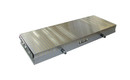
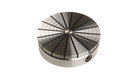
The same applies to machining and assembly. Magnetic chucks and clamping plates can significantly speed up workpiece exchange and improve access to machined surfaces. Their advantage is the even distribution of clamping force without mechanical obstacles. On the other hand, the result depends on the workpiece material, its thickness, and the required precision. With thin-walled or geometrically complex parts, it is necessary to assess whether magnetic clamping will ensure sufficient stability throughout the entire operation.
A large group of applications consists of metal separation in manufacturing, food processing, plastics production, woodworking, and recycling. Magnetic separators capture ferromagnetic impurities from the material flow and protect equipment from damage. Here, not only the field intensity matters, but also the separator position, material flow speed, particle size, and contamination level. A poorly positioned separator may look good on paper but fail to capture what it is supposed to in real operation.
What to Choose From: Magnet Material Is Not a Detail
When designing a magnetic application, the first question is usually the type of magnetic material. This is not a formality. The material determines strength, temperature stability, corrosion resistance, and the economics of the solution.
Neodymium Magnets
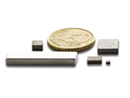
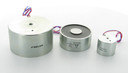
Neodymium is used where high magnetic force is required in a small volume. That is why it is used in fixtures, sensors, linear mechanisms, holders, and compact separation systems. Its limitation is sensitivity to higher temperatures and the need for suitable surface protection. If the application operates in moisture, aggressive environments, or elevated temperatures, selecting the correct grade and coating is essential.
Ferrite Magnets
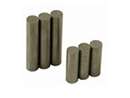
Ferrite is less powerful in terms of size efficiency, but it is cost-stable and highly corrosion-resistant. It is often used where maximum force in a small space is not critical, but reliable function at a reasonable cost is important. In many serial applications, it remains a very practical solution.
SmCo and AlNiCo
Samarium-cobalt is important in higher operating temperatures and where high magnetic stability is required. AlNiCo is used in specific technical solutions, measuring equipment, or applications where its material properties are important. These are not materials for every application, but in the right environment they make both technical and economic sense.
How Industrial Magnets Are Actually Selected
The most common mistake is selecting a magnet based on a single value — usually the specified holding force. This value is typically measured under ideal conditions, on a smooth steel surface, with a defined material thickness and without dynamic loading. Real operation is often far from that.
In handling applications, it is necessary to consider the load weight, shape, contact area, thickness, surface treatment, and safety factor. Paint, scale, grease, or air gaps reduce the effectiveness of magnetic contact. If the load rotates, accelerates, or vibrates during transport, the requirements for secure holding increase.
In separation applications, it is important whether the material flow is coarse or fine, dry or wet, and what the distance is between the particles and the active magnetic surface. Magnetic fields weaken rapidly with increasing distance. As a result, even a very strong magnet may capture less in the wrong position than a properly designed system with lower nominal force.
For clamping in machining and assembly operations, it is also necessary to consider demagnetization after the process, deformation of thin parts, and whether operators will be able to use the system safely and repeatedly. A technically correct selection is always a combination of material, design, and the specific operating mode.
Most Common Industrial Applications
Handling and Lifting
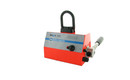
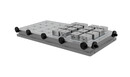
Load magnets are used for handling sheets, profiles, cut parts, and steel blocks. Their main advantage is speed and ease of operation. However, not every load is suitable for magnetic lifting. Thin sheets, bundles of material, or parts with large air gaps require individual assessment.
Clamping and Fixation
Magnetic chucks, blocks, plates, and holders help with grinding, milling, measuring, and assembly. Their advantage is a clean workspace and fast workpiece exchange. However, if extremely high lateral stability is required or the material is non-ferromagnetic, a magnetic system may not be suitable as the sole clamping solution.
Separation of Metal Particles
Magnetic rods, grids, plate separators, and drums are used wherever equipment protection or product quality improvement is required. In recycling and waste management, these systems often operate continuously, where the difference between a standard component and a solution designed for specific loads, cleaning, and service conditions becomes obvious.
Automation and Special Fixtures
In automated lines, magnets are used for gripping, positioning, locking, and control functions. Here, not only strength matters, but also repeatability, compactness, and integration into the entire system. In many cases, complete magnetic systems are used rather than a magnet as a standalone component.
What Is Most Often Overlooked in Operation
Magnetic solutions are often considered maintenance-free. That is only partially true. While a permanent magnet itself does not require power, the entire system operates under specific working conditions. Mechanical damage, contamination of the working surface, corrosion, improper storage, or long-term thermal stress can significantly affect performance.
Safety is also important. Strong magnets pose handling risks, can pinch fingers, damage sensitive electronics, and affect certain medical devices. In industry, it is therefore not enough just to supply a component. It is necessary to understand how it will be used, who will work with it, and what the actual operating limits will be.
Another underestimated issue is service and functional verification after long-term operation. For separators, this means regular cleaning and efficiency checks; for handling systems, inspection of mechanical parts, contact surfaces, and correct operation. A facility that depends on a magnetic system needs reliability not only at purchase, but throughout the entire lifetime of the solution.
When a Catalog Product Is Enough and When a Technical Solution Is Needed
If the application involves standard holding, simple attachment, or a common machine component, a catalog selection is often the fastest and correct approach. For repeated applications with verified parameters, there is no reason to complicate things.
The moment a magnet affects lifting safety, machining precision, separation quality, or line reliability, it becomes worthwhile to approach the application technically. Important details are often invisible in a basic product description. These include working distance, magnetic field orientation, surrounding structure material, cleaning method, thermal regime, and serviceability.
This is where the difference lies between ordinary sales and an expert approach. An experienced supplier can identify limitations that are easily overlooked at first glance and propose a solution that will work not only during installation, but also after months of operation. In technical practice, this matters more than a few percent difference in nominal force.
In the Slovak market, it has long been proven that industrial magnets provide the greatest value when selected according to the real task, not according to a general label. Whether the application involves handling, clamping, separation, or a specialized task, the correct result is achieved only when suitable material, proper design, and professional operational assessment are combined. If a magnet is expected to work reliably, it is not enough for it to be strong. It has to be the right one.