
















How to choose a lifting magnet correctly
If you are deciding how to choose a lifting magnet, it is not enough to look only at the maximum load capacity. In magnetic lifting, the shape of the load, surface quality, material thickness, handling method, and operating conditions also matter. It is precisely in these details that the difference often lies between equipment that works reliably and equipment that encounters limits in practice.
Tu je EN preklad 1:1, so zvýraznenými modrými časťami zo screenshotov:
How to Choose a Lifting Magnet According to the Real Application
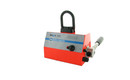
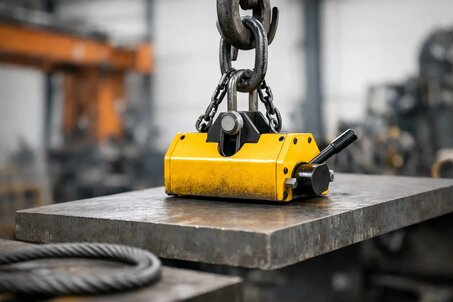
A lifting magnet is designed for lifting ferromagnetic materials without the need for hooks, slings, or mechanical clamping. Typically, these are sheets, cut parts, blocks, profiles, pipes, or workpieces in production, storage, and dispatch. The selection must therefore be based on what will be lifted every day, not on the most favorable value in the catalog.
The first step is to know the actual weight of the load. Not an estimate, but real data. If different parts are handled, it is necessary to work with the heaviest piece and at the same time check the most problematic shape. In other words, a magnet suitable for a massive steel block does not have to be suitable for a thinner sheet or round bar with a smaller contact surface.
The material is equally important. Lifting magnets are intended for ferromagnetic metals, but even among them there are differences. Structural steel behaves differently, alloyed materials differently, and surface-treated parts differently. If the material has lower magnetic conductivity or there is a layer of scale, paint, or dirt between the magnet and the surface, the holding efficiency decreases.
Load Capacity Is Not a Universal Value
The most common mistake when selecting is reading load capacity as a fixed value valid for everything. The manufacturer usually states it for ideal conditions – flat, clean, sufficiently thick steel material with full contact of the magnet. In operation, however, conditions are rarely ideal.
If you will be lifting thin sheets, the actual usable load capacity may be significantly lower than the nominal one. The same applies to round bars and pipes, where the contact surface is smaller. When selecting, it is therefore necessary to also follow correction tables or technical data for the specific type of load. A serious selection is not made according to one number on the label, but according to the entire application.
A safety reserve is also important. In handling technology, there is no room for borderline dimensioning. If the load weighs 300 kg, it does not mean that a magnet with a load capacity of 300 kg is the right choice. The reserve must cover surface deviations, material changes, and common operating uncertainties.
Material Thickness and Contact Surface
With sheets, thickness is key. Thin material becomes magnetically saturated faster and cannot transmit the same holding force as a massive block. Therefore, it is always necessary to verify for what minimum thickness the manufacturer declares the given load capacity. If several thicknesses are handled in operation, the thinnest piece is decisive.
With profiles, pipes, or cylindrical material, curvature also comes into play. The magnet may have sufficient force, but a smaller contact surface reduces its effective performance. Some lifting magnets are structurally adapted also for round bars, but even there it is necessary to take into account a different load capacity than with flat surfaces.
Permanent or Electromagnetic Lifting Magnet
In practice, the choice is often made between a permanent and an electromagnetic solution. A permanent lifting magnet is mechanically simpler, does not require power supply, and is suitable where mobility, simple operation, and lower operating demands are priorities. Activation is usually carried out by a lever or mechanism that switches the magnetic circuit.
An electromagnetic solution makes sense in automated or specific operations where fast switching, integration into a line, or handling of larger material formats is required. On the other hand, it requires power supply, control, and, during design, also a solution for safety behavior in the event of a power failure. The selection is therefore not only a question of force, but also of the operating method.
For smaller workshops, maintenance, storage, or piece production, a permanent solution is often more practical. For serial handling, overhead cranes, and automated processes, an electromagnet or a more complex lifting system may be more suitable. Here it is already reasonable to solve the application individually.
Operating Conditions That Change the Selection
The technical parameters of the magnet must always be read together with the environment in which it will operate. If handling takes place in a dusty environment, during flame cutting, grinding, or near metal chips, higher requirements for the cleanliness of the contact surfaces must be taken into account. Every impurity between the magnet and the load reduces the holding force.
Temperature is a separate topic. Magnetic materials have their limits, and under higher thermal load, performance may decrease. If hot cut parts, material after welding, or parts from technological processes are lifted, temperature resistance must not be left aside.
The frequency of use must also be considered. Occasional lifts place different demands on the device than all-day operation. With intensive use, the ergonomics of control, durability of the mechanism, and service availability are important. This is where the difference between a product intended for occasional deployment and a solution for industrial operation becomes apparent.
What to Watch Out for in Safety
A lifting magnet is not a universal tool for every load. It is not suitable for non-ferromagnetic materials, porous parts, or where a sufficient contact surface is not ensured. Likewise, it is not reasonable to use it on loads that may deform during lifting in such a way that the contact with the magnet changes.
Safety does not depend only on the magnet itself, but also on the correct work procedure. The load must be clean before lifting, correctly seated, and the operator must know how to check complete activation. Sudden impacts, oblique pulling, or swinging of the load increase the risk of loss of holding. Magnetic lifting should be smooth and controlled.
If atypical parts, cut parts with holes, thin segments, or bundles of material are handled, technical assessment is appropriate. In such cases, it is often more suitable to design another type of gripping or a combined solution.
Certification, Condition of the Device, and Service
When selecting, it is also worth monitoring the quality of workmanship, declared parameters, and service support. Lifting equipment works in a mode where technical compromises become apparent quickly. The condition of the pole surfaces, activation mechanism, and overall wear during long-term operation are important.
If a company uses lifting magnets regularly, it should also have their condition inspection set up. Damage to the contact surface, dirt, or mechanical wear can reduce functionality without being obvious at first glance. Therefore, not only the correct purchase matters, but also subsequent technical supervision and service.
How to Choose a Lifting Magnet Without Unnecessary Mistakes
The most reliable procedure is to start with four pieces of information: what exactly you are lifting, how much it weighs, what material it is made of, and what shape it has. Immediately afterwards, thickness, surface condition, and handling method must be added. Only on this basis is the type of magnet and the required load capacity selected.
For example, if you handle flat steel plates of the same thickness, the selection is usually relatively straightforward. However, if it is a combination of sheets, profiles, and cut parts, one universal magnet may not be optimal. Sometimes it is more effective to divide handling according to load types than to look for a compromise that will not be ideal for any of them.
In case of uncertainty, it makes sense to consult the application with an expert and provide the most accurate technical inputs possible. At SELOS Magnety, with such requirements, it is worth solving not only the product itself, but also the way it is used in a specific operation. It is often the technical details that decide whether handling will be fast, safe, and reliable in the long term.
A lifting magnet is not selected according to what looks more powerful on paper, but according to what will work every day in your conditions. If you precisely define the material, shape, weight, and usage mode at the beginning, the result will not only be the right purchase, but also calmer operation.