


















Maintenance of magnetic clamping plates
If a magnetic clamping plate holds unevenly, the problem often does not originate in the magnet itself, but on the contact surface. A fine layer of grinding sludge, micro-burrs or emulsion residues is enough, and the clamping force behaves differently in practice than the technical documentation indicates. That is why maintenance of magnetic clamping plates is a topic directly related to machining accuracy, operator safety and equipment service life.
In operation, maintenance is often underestimated because the plate “still works”. However, that is a weak criterion. With magnetic clamping, what matters is not only whether the workpiece holds, but how stably it holds, how it behaves under vibration, whether a deviation in parallelism occurs and whether the clamping quality changes between individual cycles. In grinding, milling and measuring operations, the difference between a clean and neglected surface can be fundamental.
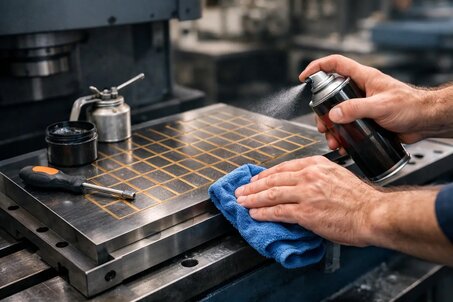
Why maintenance of magnetic clamping plates has a direct impact on production
A magnetic plate is a precise functional element, not just an auxiliary surface for putting a part aside. Its upper working plane transfers the clamping force, determines contact with the workpiece and affects the resulting stability. If scratches, baked-on dirt or local damage to the poles appear on it, the effective contact surface is reduced. This leads to weaker transfer of magnetic flux into the part and, as a result, to less reliable clamping.
In practice, this condition shows itself in different ways. In some cases, the workpiece starts to “move” during fine operations; elsewhere, the repeatability of positioning deteriorates. With thinner or smaller pieces, the problem is usually more pronounced because every loss of contact has a greater share in the total clamping force. With thicker parts, neglected maintenance can remain hidden for a long time until it appears in surface quality or deviations after machining.
What to check during routine operational maintenance
The basis is regular inspection of the working surface. It must be clean, free of metal dust, free of coolant residues and free of mechanical deposits. A quick wipe with a cloth is not enough. Fine ferromagnetic particles in particular tend to cling to the poles and create layers that the operator may underestimate with the naked eye.
The condition of the pole division and flatness is also important. If small scratches or locally pressed areas caused by careless handling appear on the plate, it is necessary to assess whether they already affect function. Not every cosmetic mark is a technical problem, but wear in areas of repeated load can already become one.
With mechanical magnetic plates, the movement of the control mechanism must also be monitored. Switching between ON and OFF must be smooth, without excessive resistance and without play that would indicate wear of internal parts. With electromagnetic systems, it is also necessary to check electrical connections, the condition of insulation, connectors and possible overheating.
Cleaning the working surface without unnecessary risk
The most common mistake is aggressive cleaning with a metal tool. A scraper made of hard material may remove dirt quickly, but at the same time it can damage the precise surface or disturb the pole lines. A more suitable procedure is to use clean non-abrasive tools, technical wipes and cleaning agents that do not leave a film.
After machining, it is advisable to remove chips immediately, not only at the end of the shift. Ferromagnetic dust and fine particles are pressed into the contact surface under the pressure of the workpiece, and later cleaning becomes more difficult. If the operation uses cooling emulsions, their drying must also be monitored. Old emulsion deposits reduce contact quality and can support corrosion marks, especially if maintenance is carried out irregularly.
After cleaning, it makes sense to check the surface not only visually, but also by touch and by test positioning of a suitable reference part. In practice, this is exactly how local dirt is detected that would otherwise remain unnoticed.
Flatness, wear and when routine maintenance is no longer enough
Routine operational care does not mean that every worn plate must be taken out of service immediately. The extent of damage and the required accuracy of the application are decisive. If the plate is used for less demanding operations, small signs of wear may be acceptable. In precision grinding or with thin-walled parts, however, even a smaller deviation can cause a noticeable problem.
When there is suspicion of unevenness, the plate must be measured using a suitable method. If a deviation outside the permissible range is confirmed, professional regrinding of the working surface may be the solution. However, this is not a universal intervention for every situation. Excessive material removal changes the functional parameters of the plate, so such service must be performed with respect to the construction of the specific type.
Similarly, if the pole structure is damaged or there is an internal problem in the magnetic system, surface treatment will not remove the problem. In that case, it is already a service intervention, not maintenance.
How maintenance changes according to the type of plate
Not all magnetic clamping plates behave the same way. With permanent mechanical plates, the key factors are usually the condition of the working surface and the switching mechanism. The advantage is lower operational complexity, but neglected mechanical parts show themselves gradually and often without immediate warning.
With electromagnetic plates, the electrical part also comes into play. Here it is not enough to monitor only cleanliness and flatness, but also power supply stability, thermal load and the condition of cabling. If the plate is used in a continuous cycle or in a demanding industrial environment, inspection intervals should be shorter.
With fine-pole plates, maintenance is usually more sensitive to detail because they are intended also for smaller and thinner parts. Every local contamination or small unevenness affects function more noticeably than with coarse-pole solutions.
The most common mistakes in practice
A typical mistake is using the plate as a universal workbench. Placing tools on it, striking it with the workpiece, sliding material across the surface or grinding without continuously removing metal dust lead to accelerated wear. A magnetic clamping plate is not intended for rough handling, even if it looks massive.
Another problem is neglecting inspection after an accident or collision. If a tool hits the plate, it is not enough to check only visible damage. Local deformation of the surface or deterioration of function may occur and only become apparent during the next production run.
Incorrect assessment of weak clamping force is also a frequent mistake. The operator sometimes looks for the cause in the magnet, while the problem lies in the geometry of the part, a small contact surface or contamination. A magnetic system must be evaluated in connection with the specific application, not in isolation.
Preventive maintenance is cheaper than downtime
From an operational point of view, a simple and disciplined regime makes the most sense. Remove chips and dirt after every use, check flatness and surface condition at regular intervals, continuously monitor mechanical or electrical elements and do not ignore changes in clamping behaviour. Such a procedure does not take much time, but it significantly reduces the risk of inaccuracy and unplanned downtime.
In companies where magnetic plates are used daily, it is advisable to include them in the standard machine maintenance plan. Not as an add-on, but as a separate controlled item. This is practical especially when several operators alternate at one workplace and the quality of care would otherwise depend on individual habits.
If an operation is not sure whether it is still routine maintenance or already a condition requiring service, it is worth consulting the specific type of plate with a technical specialist. With magnetic systems, an incorrect estimate is often more expensive than the inspection itself. SELOS Magnety has long been involved in this field, including technical consulting and service support for industrial applications.
A well-maintained magnetic clamping plate does not show itself by operators talking about it. It shows itself by production running accurately, repeatedly and without unnecessary question marks.