- Magnets
- Raw magnetic materials
- Flexible magnets
- Magnetic systems
- Electromagnets
- Magnetic separation
- Contacts

















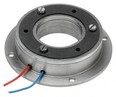


Electromagnets for production: where they make sense
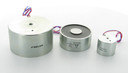
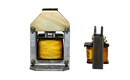
In production, reliability is often not decided by large technologies, but by details that must work repeatedly and without failures. That is exactly why electromagnets for production have a firm place in handling, clamping, sorting, and automation. If selected correctly, they shorten the cycle, stabilize the process, and reduce the number of unplanned operator interventions.
At first glance, the principle is simple – when electric current is supplied, a magnetic field is created that attracts a ferromagnetic part or activates a specific function. In practice, however, the details matter. An electromagnet for continuous operation on a production line is assessed differently from a solution for short-term pulse switching, and differently again from a system that must safely hold a heavier workpiece during handling.
Magnetic chucks and machining in practice
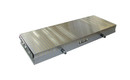
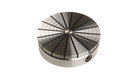
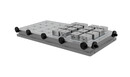
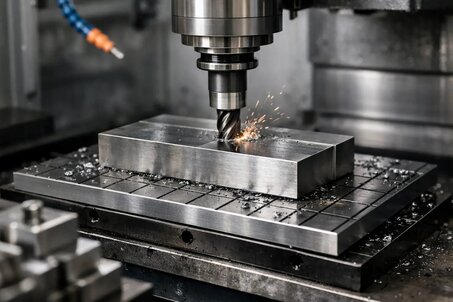
With thin-walled parts, ground surfaces or serial production, it is often not only the machine and the tool that are decisive, but also the method of clamping. This is exactly where magnetic chucks keep machining significantly under control - they can shorten preparation times, make more sides of the workpiece accessible and reduce deformations caused by mechanical clamping.
However, this does not mean that a magnet is always the right choice. With an incorrectly selected type of chuck, a small contact surface or an unsuitable machining technology, the result may be the opposite. That is why it makes sense to look at magnetic clamping not as a universal replacement for vises and fixtures, but as a precise tool for specific applications.

Ferrite versus neodymium magnets
If you are selecting a magnet for clamping, separation, position sensing, or standard assembly, the question of ferrite versus neodymium magnets does not arise only in the catalog. It determines whether the device will operate stably, whether it will have a reserve in tensile force, and whether the investment will truly pay off in operation.
In technical selection, it is not enough to look only at which magnet “holds more”. Ferrite and neodymium differ not only in force, but also in dimensions, behavior at higher temperatures, corrosion resistance, and the resulting economics of the solution. That is precisely why it makes sense to compare the material according to the specific application, not according to a general impression.
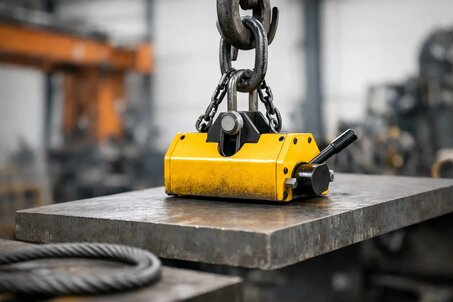
How to choose a lifting magnet correctly
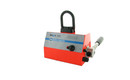
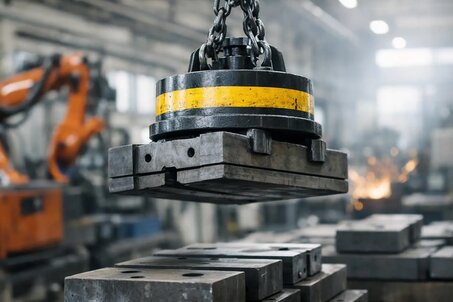
If you are deciding how to choose a lifting magnet, it is not enough to look only at the maximum load capacity. In magnetic lifting, the shape of the load, surface quality, material thickness, handling method, and operating conditions also matter. It is precisely in these details that the difference often lies between equipment that works reliably and equipment that encounters limits in practice.
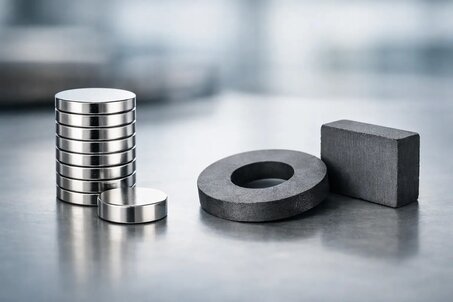
Neodymium or ferrite magnet?
Rozdiel medzi tým, či zvolíte neodymový alebo feritový magnet, sa v praxi prejaví veľmi rýchlo. Niekde rozhodne maximálna prídržná sila pri malom rozmere, inde odolnosť voči vyššej teplote, vlhkosti alebo nižšie obstarávacie náklady. Ak sa magnet vyberá len podľa rozmeru alebo „pocitu, že bude stačiť“, býva to častý dôvod reklamácií, nefunkčného návrhu alebo zbytočne predimenzovaného riešenia.
Pri technickom výbere preto nestačí pozerať sa iba na materiálový názov. Rozhoduje celá aplikácia - pracovná medzera, protikus, smer magnetizácie, teplota, spôsob upevnenia aj to, či ide o jednorazové uchytenie, sériovú výrobu, separáciu alebo manipuláciu. Práve pri tejto téme sa najčastejšie porovnávajú dva základné materiály: neodym a ferit.