- Magnets
- Raw magnetic materials
- Flexible magnets
- Magnetic systems
- Electromagnets
- Magnetic separation
- Contacts





















Magnetic tags for storage without chaos
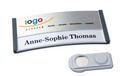
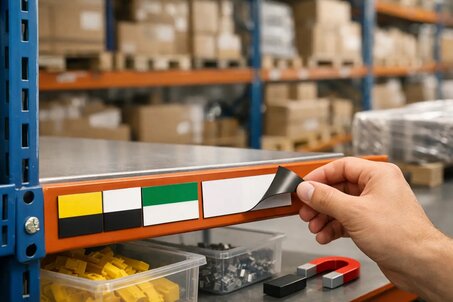
When positions, assortment, and stock levels change in a warehouse faster than shelf maps, fixed paper labeling starts to hinder rather than help. Magnetic labels for warehouses solve exactly this problem – they allow continuous changes in the identification of racks, boxes, metal shelves, or handling zones without glue, without residue, and without unnecessary downtime.
In warehouse labeling, it is not just about order. Proper labeling affects picking speed, error rates during replenishment, onboarding of new employees, and overall discipline in logistics. If labels cannot be easily updated, inaccurate data is often left in place. And that is where losses occur, which are not immediately visible.

Magnetic tape to label shelves in practice
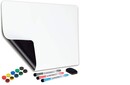
In a warehouse, the problem usually does not arise because the rack lacks space. The problem arises when the space is not labeled clearly, legibly, and in a way that allows immediate changes without glue, scraping, or downtime. This is exactly where magnetic tape for shelf labeling has practical value – it speeds up orientation, reduces picking errors, and makes every layout change easier.
When storage positions, product lines, or internal codes change, fixed adhesive labels quickly become a disadvantage. Replacing them is slow, they leave glue residue on metal racks, and over time they reduce workplace clarity. Magnetic labeling works differently. It stays where you need it, and when reorganization occurs, it can be moved within seconds.

Magnetic film for advertising: what decides
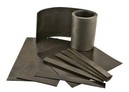
An advertising carrier on a car, shelf, or metal panel often fails not because it is a bad idea, but because the wrong material was chosen. Magnetic advertising foil may seem simple, but in practice the details matter – thickness, surface, type of print, quality of the substrate, and method of use. If the advertisement is to hold reliably, remain readable, and be easily removable, it pays to choose based on technical criteria, not just price per meter.

When to use AlNiCo magnet in practice
If you are selecting a magnet for a sensor, measuring equipment, or a device with higher operating temperature, the question of when to use an AlNiCo magnet is not academic, but very practical. In many applications, it is not only the maximum holding force that matters, but especially the stability of magnetic properties, resistance to heat, and predictable behavior over time.
AlNiCo belongs among the classic permanent magnetic materials that still hold a firm place in technical practice today. It is not a universal choice for every project. On the contrary – it makes sense where its specific properties solve a precise technical problem better than neodymium or ferrite.

SmCo magnets to high temperature in practice
If a magnet operates near a furnace, motor, brake, sensor, or another heat source, a standard material selection is often not sufficient. It is precisely under such conditions that smco magnets for high temperatures have a clear justification, as they maintain their magnetic properties even where other permanent magnets reach the limits of usability.
Samarium-cobalt magnets belong to specialized materials for technical applications where thermal stability, long-term reliability, and resistance to demagnetization are critical. They are not universal magnets for every use. However, if the operation combines higher temperatures, limited installation space, and a requirement for stable performance, SmCo is often a very rational choice.