- Magnets
- Raw magnetic materials
- Flexible magnets
- Magnetic systems
- Electromagnets
- Magnetic separation
- Contacts















What magnets to choose for automation
Which magnets for automation make technical sense usually becomes clear only when the line stops, the gripper does not hold repeatedly or the sensor reacts inaccurately. In automation, the strength of the magnet alone is not decisive. Temperature, distance, type of movement, surrounding material, cycling and whether the system is supposed to operate without maintenance intervention for months or years are all decisive.
When selecting, it is therefore not enough to look only at dimensions or declared holding force. A magnet in automation is a functional element of the system. If selected correctly, it speeds up handling, stabilizes the process and reduces mechanical wear. If selected incorrectly, it brings inaccuracy, downtime and unnecessary service interventions.
How to use magnetic grippers correctly
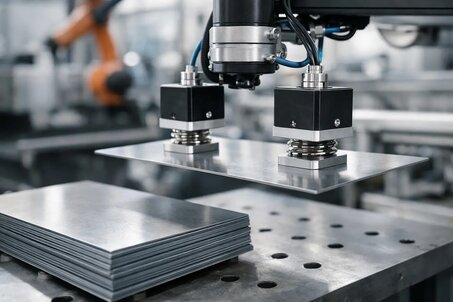
When a magnetic gripper fails in an application, the problem is rarely in the magnet itself. Much more often, it is caused by an incorrect understanding of the part material, the contact surface, the distance or the dynamics of movement. That is exactly why the topic of how to use magnetic grippers should be addressed technically, not only approximately according to catalogue load capacity.
A magnetic gripper is a simple principle with relatively demanding practical use. It must capture, hold and often also precisely release a ferromagnetic part in a repeated cycle. It works reliably only when the type of magnetic system, force, contact geometry and control method are selected correctly. In manual handling, the requirements are different from those at an automated workstation, where tenths of a second and repeatability are decisive.
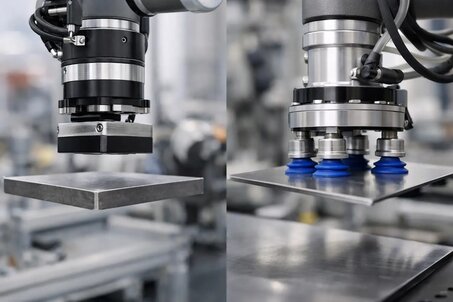
Magnetic griper vs vacuum: what to choose
When a robotic cell handles burnouts, sheet metal or parts from a press, the choice of gripper determines cycle time, stability and downtime. When it comes to the question of magnetic gripper vs. vacuum gripper, this is not theory, but a very practical decision - what will work reliably with your material, speed and operating conditions.
In practice, these two principles are often compared too simplistically. A magnetic gripper is usually perceived as a solution for metal and a vacuum gripper as a universal option for everything else. However, this division is only the basis. The details are decisive - the surface of the part, its thickness, the presence of oil, perforation, weight, the required acceleration of the robot and also what should happen in the event of a power failure.

Why the magnet loses power and when it's a problem
A magnet that yesterday held a fixture, door or separated material without any problems behaves differently today. It did not release “by itself” by chance. If you are dealing with why a magnet is losing strength, in most cases there is a specific physical cause - temperature, mechanical stress, unsuitable operating mode, corrosion or improper storage. In technical applications, it is important to distinguish whether this is a natural and small decrease in parameters, or a condition that already affects the safety and function of the device.
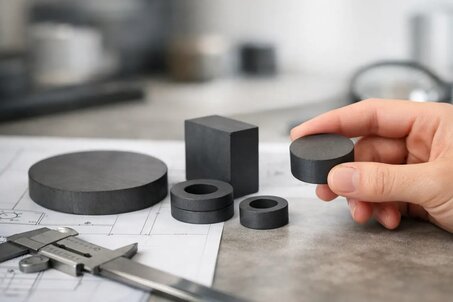
How to choose a ferrite magnet without error
A ferrite magnet often looks like a simple component. In practice, however, its function is not determined only by whether it is round, square, or “strong enough”. If you are deciding how to choose a ferrite magnet for a specific application, the dimensions, magnetization direction, working gap, temperature, and the material to which the magnet is attached all matter. It is precisely in these details that the most common mistakes arise during design and purchase.
Ferrite is among the most widely used permanent magnetic materials. It is stable, corrosion-resistant, and suitable for a wide range of common and industrial applications. At the same time, however, it is not a universal answer to every requirement. If you expect very high holding force from a magnet at small dimensions, another material will often be more suitable. But if you need a cost-effective, long-term stable, and operationally reliable solution, ferrite is usually the right choice.