- Magnets
- Raw magnetic materials
- Flexible magnets
- Magnetic systems
- Electromagnets
- Magnetic separation
- Contacts















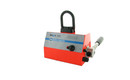
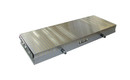
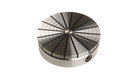
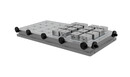



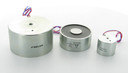





Guide to magnetic lifting of loads
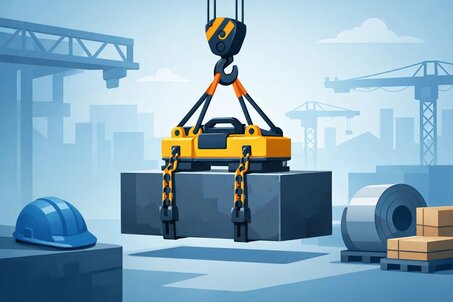
If you handle sheets, cut parts, profiles, or workpieces in operation, choosing the right handling method is not only a matter of performance, but also of safety, time, and process repeatability. This guide to magnetic lifting of loads is intended for technicians, buyers, and plant operators who need to understand when magnetic lifting makes sense, what its limitations are, and how to choose the right solution.
Magnetic lifting of loads is one of the proven methods for handling ferromagnetic materials. In practice, it can significantly speed up loading, transfers between workstations, and the operation of machining or cutting stations. At the same time, the load capacity stated in a catalog is not sufficient on its own. Real operating conditions are decisive — material type, thickness, contact surface, surface treatment, temperature, and gripping method.

Permanent magnet versus electromagnet
If you are dealing with clamping, separation, handling, or position sensing, the question of permanent magnet versus electromagnet is not textbook theory. It is a practical decision that affects energy consumption, operational safety, maintenance requirements, and the overall behavior of the equipment in a real application.
Both principles work with a magnetic field, but each in a different way. A permanent magnet creates a field without external power. An electromagnet requires electric current, and its magnetic effect is generated only when energy is supplied to the coil. At first glance, this seems like a simple difference, but in practice it determines whether the solution will be stable, controllable, safe during power failure, or suitable for continuous operation.

How powerful a magnet I need in practice
When you ask how strong a magnet you need, you are usually already dealing with a specific problem. The magnet is meant to hold a door, fix a fixture, capture a steel component, separate metal particles, or lift material in operation. The specific application matters more than the size of the magnet or the pulling force stated in the catalog.
The most common mistake in selection is simple – the customer looks only at the number stated for the magnet, for example 20 kg or 50 kg, and assumes they will get the same result in real use. In reality, this value is usually measured under ideal conditions. That means on smooth, clean, sufficiently thick steel, with full contact and detachment in a direction precisely defined by the manufacturer. A small air gap, thinner material, painted surface, or side load is enough for the real force to drop significantly.

Industrial magnetic separators guide
Metal contamination in the material stream rarely causes problems right at the input. More often, it appears later at the press, crusher, conveyor, or during complaints about the final product. That is why a guide to industrial magnetic separators is particularly useful for operations that do not want to deal with consequences but with the root cause. Well-designed separation is not an add-on to technology. In many applications, it is the foundation of equipment protection, production quality, and process stability.
A magnetic separator may seem simple at first glance. In practice, what matters is what material you are separating, in what layer, at what speed, humidity, and from what conveying distance. The difference between a functional solution and a formally installed component lies precisely in these details.
Metal separation in recycling without losses
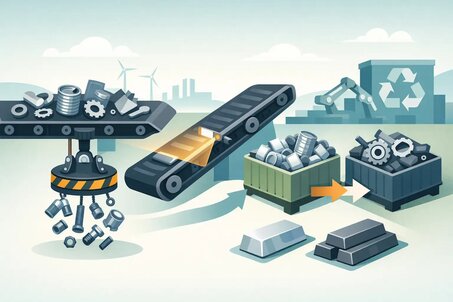
On a sorting line, it is often not only the performance of the crusher or the capacity of the conveyor that determines the result. What also matters is whether ferrous and non-ferrous metals can be separated from the rest of the material at the right moment and using the right technology. Metal separation in recycling has a direct impact on the purity of the output fraction, equipment wear, and the overall economics of the operation.
In practice, this is not a single operation but a sequence of steps that follow one another. The requirements differ for municipal waste processing, construction debris, wood waste, and entirely different for automotive or electronic waste. If the result is to be stable, it is not enough to simply install a magnet above the conveyor and assume the problem is solved. The properties of the material, particle size, layer thickness on the conveyor, moisture, conveying speed, and the actual metals present in the stream all play an important role.